


The tragicomedy being played out in the House has gripped the nation like a national train wreck. We look on both horrified and delighted as the insurrectionists grab McCarthy by the pussy and try to squeeze the life out of him. Friend o’ Ye Olde Blogge, Ten Grain, has a snarkier a run down than most over at Mock Paper Scissors, if you need a refresher of just how shambolic the whole thing is.
Don’t get me wrong, I’m enjoying the schadenfreude as much as the next liberal, but the inability to cooperate as an organization is embolic of a greater problem. However, according to the cultural multilevel selection model of group behavior, this level of group dysfunction is exactly what has portended the fall of every great country, kingdom, and empire.
The amount of governmental gridlock at the federal level and sheer chaos the GQP is willing to inflict upon us at the local level means that we are in a desperate race. Will the GQP succeed in destroying our democracy and plunging us into a generation of chaotic struggle against authoritarianism and allow other countries and regions to take our place on the world stage, or will the Democrats manage to defeat them so soundly that we recover and maintain our international position?
Cultural Evolution & The Multilevel Selection Model

The model suggests that the Republicans will continue to lose to the Democrats as they did in 2018, 2020, and 2022 since no group in such disarray can consistently win in competition to better organized and more functional group, which is weird to write about the Dems. They could and still can snatch defeat from the jaws of victory in any given election, right?
Cultural evolution is the academic field that studies changes made in societies over time analogous to biological evolution of physical traits. The cultural multilevel selection model is the idea that the same evolutionary principles that can be used to describe changes to physical traits of a species and the cultural traits of a society can be used to describe changes to the beliefs, behaviors, and norms of individuals within groups, groups of individuals, and groups of groups.
The Price Equation
The model is a mathematical one. There is a formula involved. It is called the Price equation. So, hold on to your mathematical asses, here it comes:
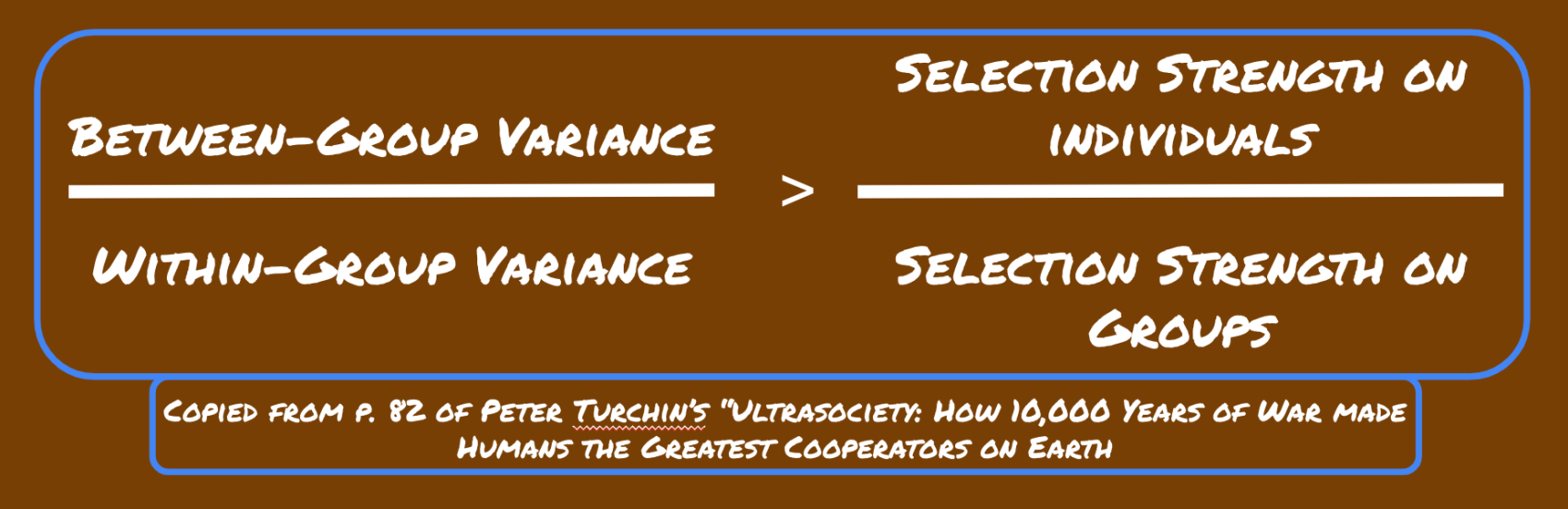
That’s a beaut as far as social science equations go. It has terms in all four quadrants, both sides of the inequality sign, the numerators and denominators of both sides, hyphenated terms, weird terms, all kinda stuff is happening there. Here’s what the terms mean (feel free to skip ahead if you already know, they’re pretty self-evident to those that know):

- BETWEEN-GROUP VARIANCE: The amount that the composition of the competing groups vary from one another, or how different are the groups in the types of members that make them up. Right now, for example, the difference between Democrats and Republicans is pretty high. The Democrats have lots more cooperators than Republicans do, and Republicans self-absorbed assholes than Democrats.
- WITHIN-GROUP VARIANCE: The amount the composition of a single group varies, or how many different types of members does one group have? Right now, neither the Democrats or Republicans vary very much in their types of members. Most Democrats are cooperators; most Republicans, self-absorbed assholes.
- SELECTION STRENGTH ON INDIVIDUALS: This number expresses the degree that a trait will be passed on to the next generation. Here’s the thing, self-serving assholes generally do better at passing on their assholery than cooperators do (nice guys really do finish last, I guess). Consequently, the number of assholes in your group tends to grow from one generation to the next. Assholery gets a higher mark here, cooperation, lower.
- SELECTION STRENGTH ON GROUPS: This number expresses the degree that a trait will help the group survive long enough to pass this trait on to the next generation. In this case, cooperative groups are more likely to win inter-group competition. Consequently, the cooperative groups tend to displace, wipeout, or otherwise beat the asshole groups. Cooperative groups get a higher mark here, assholery groups, lower.
Price Equation, Example
We’ll use Turchin’s example from his book, just for accuracy of explanation and reproducibility and all of that jazz. He wants to answer the question how will cooperators fair in a population with four groups consisting of varying numbers of cooperators and assholes, assuming that all other variables are equal. It will look like so:
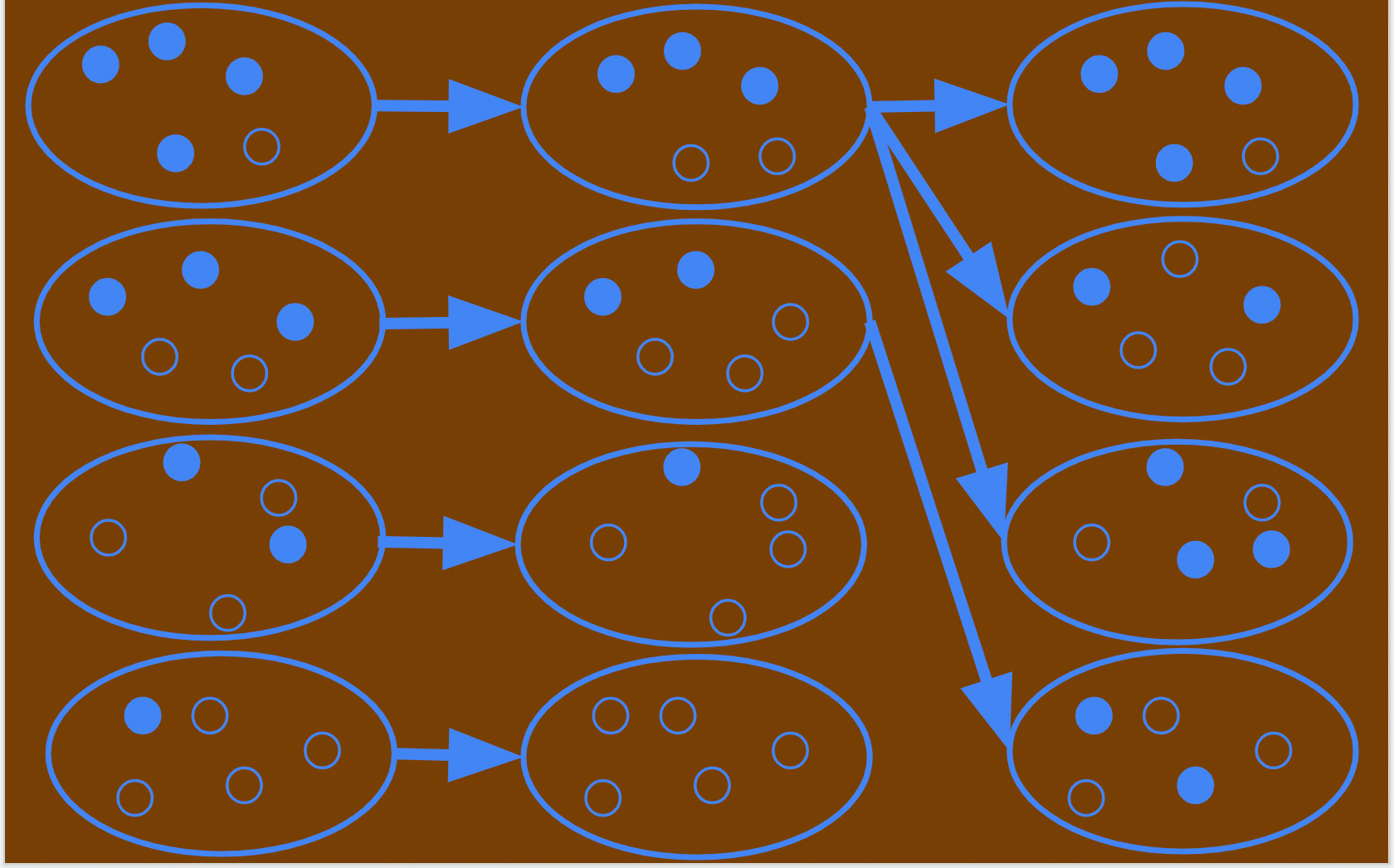
Here’s how the diagram works:
- Each oval represents a group in a larger population.
- Each dot or circle, represents an individual. The solid blue ones are cooperators, the transparent ones are assholes.
- Each column represents a generation.
- There are four groups of five individuals making a population of twenty individuals.
Now, let’s go column by column.
- The first column on the left is the starting population.
- The column in the middle represents the second generation. The changes to each group from the first to second generation are due to within group competition. Assholes tend to reproduce more effectively than cooperators do. So, you can see in the middle column that each group loses a cooperator.
- The third column on the right is the third generation. It is produced by between group competition. Groups with lots of cooperators tend to do better than groups with lots of assholes. You can see that the group with no cooperators and only assholes, disappeared. It got wiped out. Another group with only one cooperator, also got wiped out. The group with three cooperators was able to fill-in the gap and the one with two cooperators managed to replicate itself.
The Between-Within Group Variance Ratio
When the ratio on the left side of the equation is large, the number on top, the between-group variance is larger than the within-group variance. In other words, when a group is more homogeneous (the group members are the same), it will tend towards the number one, which will make for a bigger number or a larger ratio. When the within-group variance is larger than than the between-group variance, the resulting number will be small or a smaller ratio. Think, two divided by one is two, but one divided by two is one-half.

Hold that thought for a moment while we examine the ratio on the right side of the equation.
The Selection Strength on Individuals-Groups Ratio
When the trait favors individuals and doesn’t favor groups, so that the selection strength on individuals is large, and the selection strength on groups is approaching one, the resulting number is large or a larger ratio. When the trait favors groups and not individuals, so that the selection strength on groups is large, and the selection strength on individuals is small, then the resulting number will be small or a smaller ratio.

When the between-within group variance ratio is large, meaning that the groups are more homogeneous and are very different and the selection strength on individuals-groups ratio is small, meaning that the trait favors groups over individuals, the cooperation is likely to spread. We know from Turchin et al.’s studies that groups high in cooperation outperform groups high in assholery.
Applying the Price Equation to the Speaker’s Election

This is an important outcome when we are considering the fate of our democracy.
Consider what we just witnessed in the House with McCarthy’s election to the Speakership. Remember what we said up there?
- BETWEEN-GROUP VARIANCE: When comparing the Dems and Repubes in the House, this number is huge. The Democrats are cooperating, the Repubes are assholes.
- WITHIN-GROUP VARIANCE: There is little within-group variance. To the representative, the Republicans are assholes and Democrats are cooperators.
- BETWEEN-WITHIN GROUP VARIANCE RATIO: This number is quite large.
- SELECTION STRENGTH ON INDIVIDUALS: We’ve seen the number of assholes in the Republican House caucus grow exponentially over the years. Assholes really do attract other assholes. However, we are talking cooperation here, so cooperation has low strength on individuals. This number is small.
- SELECTION STRENGTH ON GROUPS: Because cooperative groups tend to outperform non-cooperative groups, this number is quite large.
- SELECTION STRENGTH ON INDIVIDUALS-GROUPS RATIO: This number is quite small.
At the end of the day, the between-within group variance ratio is larger than the selection strength on individuals-groups ratio.
As long as the two groups remain homogeneous, this relationship should hold. Republicans should struggle in their competition against Democrats both in the House as we saw in the speaker election and I’m sure we’ll see in the rules approval.
This is good news for our democracy. The question is will we vanquish MAGA, Q-Anon, and the authoritarians before we are too damaged on the world stage to be competitive or before climate change so radically changes the world stage that we lose out to a country that has adapted better and more quickly.
In lieu of cash money donations, please give us:
- SHARES on your social media!
- LIKES and RATINGS to let us know that you’ve been here.
- COMMENTS that tell us what you think about the Republican House, McCarthy as Speaker, or the fate of our democracy.
- FOLLOWS or joining our email list!
Image Attribution
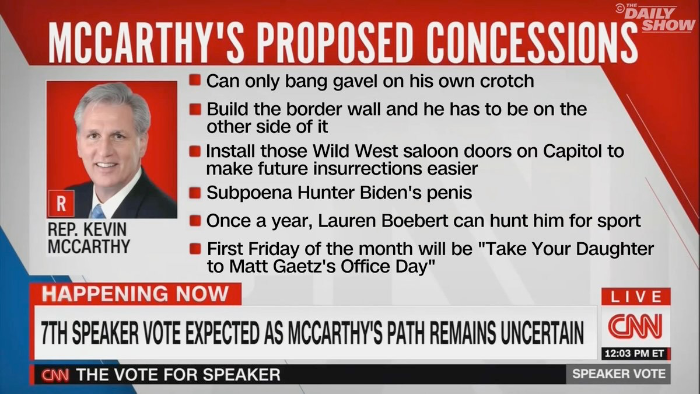
“McCarthy’s Proposed Concessions” from The Daily Show licensed status, unknown, but I found it on Mock, Paper, Scissors, so I blame Tengrain.

 The Psy of Life
I don’t recall being told there would be math here. Math distracts me; I do better with words.
I’m not complaining; I’ve always wanted to say “I was not told there would be math.” I did fine with this, even though I’m a couple days late Still, our government situation appears concerning, to me; I know to lower my expectations whenever there is a Repub majority anywhere in the US, but holy cow it’s so bad these days. I sure appreciate all you do here!
LikeLiked by 1 person
Howdy Ali!
I’m glad I could help you kick Ye Olde Buckette Liste.
I find this to be one of the most curious findings of all. That inter-group competition increases intra-group cooperation. And, that cooperative groups best non-cooperative groups. And, that it is the self-serving elites that quit cooperating in successful states that cause their downfall. Those three things, according to the research, are pretty solid findings.
As we watch them try to destroy our democracy by hamstringing the legislative branch so that executive action becomes the only way to get anything done, it is a small comfort to know that they are also causing themselves to fail.
I prefer the words to math, and so does the WordPress. It is nearly impossible to render mathematical formulations on there.
Huzzah!
Jack
LikeLiked by 1 person
I just watched it. WOW
Only five GOP members need to change their voter registration, or get hauled off to jail, for that man to become Speaker.
LikeLiked by 1 person
And, that is why one of the demands was to investigate the “weaponization” of the government including oversight of current DoJ investigations and to be privy to the same intelligence briefings as the intelligence committee. So, it’s not like they won’t be trying to meddle in the investigations to keep themselves out of jail and sell secrets to Russia.
Jack
LikeLiked by 1 person
They have reason to fear, and the sooner those fears become real consequences, the better.
LikeLiked by 1 person
Even if a Republican wins the Presidency in 2024, it is difficult to remove a special council. They keep harping on defunding the office, but as long as Democrats control one of the chambers, that will be difficult, too. I guess the question is who has the stomach for destroying the world economy to stop an investigation into the 6 January insurrection? There likely is a coalition of “reasonable” Republicans and Democrats that can get it done.
Huzzah!
Jack
LikeLiked by 1 person
I think you’re right. If/when debt default becomes a serious threat, Capitol Hill will be crawling with CEOs and other representatives of the planet’s biggest banks, retirement funds, sovereign wealth funds, AARP, and so on, making sure everybody knows how utterly stupid it would be. And, if it becomes an immanent threat, the markets will react in anticipation.
LikeLiked by 1 person
Howdy Bob!
When it becomes clear that the full faith and credit of the US is being jeopardized by a political stunt, cooler heads have prevailed in the past. I’m think of Cruz’s debacle in 2013 or so, for one. It seems like there was another in 2017.
As the saying goes, politics makes for strange bedfellows. We’ll see how the coalitions shift and form in the House.
Huzzah!
Jack
LikeLiked by 1 person
The Democrats will have a huge trove of video clips to use in attack adds for 2024, and the cray cray level will only ramp up as the things Repubs pass in the house die in the Senate.
LikeLiked by 1 person
Projection is such a predictable and transparent habit. The weaponization they see is exactly what they would be doing if they had the power.
LikeLiked by 1 person
And, it was exactly what Trump was trying to achieve throughout his administration. Luckily, it took time to tear down the mechanisms that prevented it from happening, and hopefully, Biden will be able to build them back up again before the next run at it.
Jack
LikeLiked by 1 person
Meanwhile, the insurrection caucus will be trying to cut all the executive branch non-military budgets.
“My goal is to cut government in half in twenty-five years, to get it down to the size where we can drown it in the bathtub.” – Grover Norquist
LikeLiked by 1 person
Howdy Bob!
They are also trying to cut the military budget by 10 or 15% or so. That seems like madness, especially for the strong defense GOP. But, these folks have been turning norms and traditions on their heads for a long time now.
Huzzah!
Jack
LikeLiked by 1 person
They are in burn it all down mode. Part of the proposing cut to the military budget is from isolationism. And, they tend to forget that the defense budget is very much about “jobs in your district”.
LikeLiked by 1 person
Reblogged this on cabbagesandkings524 and commented:
Calico Jack – Cooperation and otherwise
LikeLiked by 1 person
So, Kevin McCarthy has surrendered enough of his power as Speaker to “win over” enough of the “rebels” to get elected. Since one item of the “deal” is that it will take only one Member to call a vote to remove the Speaker, the scene of the past week can be repeated any time they feel disappointed.
“Nobody is ever sent to Hell. They have to insist on going there.” – W. H. Auden
Congratulations, Mr. Speaker. Have you read the sign above the door? Have you left every hope behind?
LikeLiked by 1 person
Howdy Bob!
Like I said, the Democrats have helluva leverage over him now thanks to that Sword of Damocles that hamstrung himself with. He’s going to need their votes, and they are going to extract what they want from him in order to get them. And, it will wreck his career just like it did Boehner’s and Ryan’s.
Did you have a chance to see Hakeem Jeffries speech introducing him and giving him the gavel. He was taking a victory lap. It was spectacular. One for the ages. I was glad I decided to watch today. https://youtu.be/JLOAQjjKJbM
Huzzah!
Jack
LikeLike