
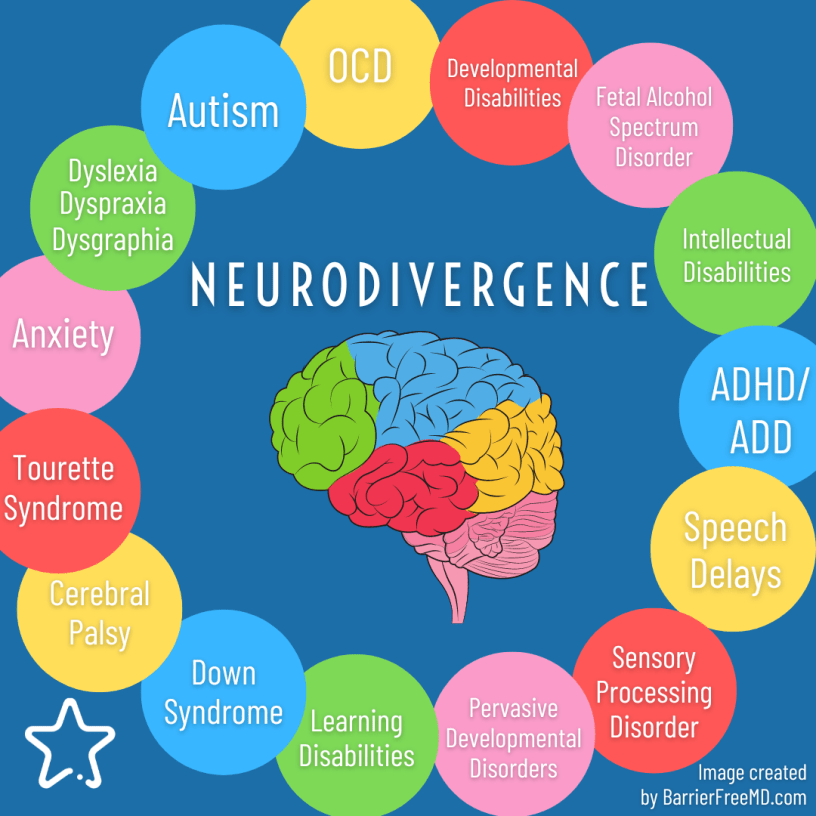
SUMMARY: Classrooms are fraught with complexities when trying to create an inclusive space for autistic, neurodivergent, and neuroconvergent students. Using real-life examples some of the difficulties and solutions are illustrated. Accommodating everyone’s needs, neurodivergent and neuroconvergent alike means striking a balance between allowing self-stimulatory behaviors and maintaining a conducive learning environment. It can be difficult to secure the necessary resources for effective accommodations due to societal biases that hinder inclusivity. Ultimately, it will take a broader commitment to supporting all students in educational settings than what is currently found in the US.
KEY WORDS: Autism Neurodivergence Neuroconvergence Inclusion Education Accommodations Stimming Learning Support Sensory Needs Advocacy
- A Couple of Illustrative Examples
- Meeting the Needs of Autistic, Neurodivergent, and Neuroconvergent People
- Image Attribution

As I’ve mentioned many times here on Ye Olde Blogge, autism runs deep in my family. My daughter and I are both autistic, as was my mother. My sister and her four daughters are also autistic. As a teacher, I work with autistic students every day, and this has made me keenly aware of the challenges in creating an inclusive learning environment for all—autistic, neurodivergent, and neuroconvergent alike.
As a professional teacher, I’ve been much concerned about making an inclusive learning environment for all of my students, autistic, neurodivergent, and neuroconvergent. My conclusion is that it is nearly impossible to do in the way we organize our schools and classrooms.
In a typical class of twenty students, you can expect four to five to be autistic and two to three more to be neurodivergent, including those with ADHD, the dys- disorders (dyslexia (reading), dysgraphia (writing), dyspraxia (motor control), and dyscalculia (math)), and anxiety-related disorders. This doesn’t even account for students with executive dysfunction challenges, like working memory issues, impulse control problems, and shortened attention spans.
That’s a lot to plan for! It’s not just about providing the right learning materials and activities; it’s the nitty-gritty details of teaching: seating arrangements, sensory considerations like sound and lighting, transitions between activities, and even the time of day. The last two classes of the day often require a vastly different approach than the first two, even with the same students.
A Couple of Illustrative Examples
The Disruptive Stimming Student

We keep a variety of fidget toys in the classroom, including inflatable dynamic seating cushions. One of my students enjoys sitting on these cushions, but he thrusts himself back and forth on the cushion so violently and graphically that it’s alarming, frightening, and disgusting. While I don’t think he means it to be a sexual imitation like twerking is, it is impossible not to relate the movement to sexual activity.
I’m so disturbed by it, that I want to ask him to stop. I can see in the faces of the other students sitting at this table that they are disturbed by it, too. While I know he’s simply stimming — a common movement-based strategy used by many autistic individuals to manage anxiety and energy — his movements are so outlandish that I feel I must respond to him.
He has a right to stim, but the other students have rights, too. We all have to be in the same space together. Obviously, the solution is to suggest some other form of stimming, but not all forms are created equally. Some students paces others flap their hands, and this one flings himself about in his seat. I manage it by carefully assigning table mates that are more tolerant and less distractible.
The Disruptive Hyper, Attention-Seeking, Angry Student
The Mismatch Between Needs and Environment

I have another student who is so distracted by being in a room full of people that he, literally, cannot focus on the material in front of him. He cannot get anything done in a class of twenty students. He lives his life in constant motion, and being in school is an anathema to him. It is the exact opposite of what he needs to learn and be comfortable, so after six years of teachers trying to force him into compliance — which isn’t true, he’s been accommodated generously over the years — he’s angry.
Then there’s another student who finds it nearly impossible to focus in a room full of people. He thrives on constant motion, and the school environment is the antithesis of what he needs to learn. After six years of well-meaning teachers trying to force compliance — which isn’t true, he’s been accommodated generously over the years — he’s understandably angry and often disruptive.
Adding attention seeking behavior to the mix creates a classroom that is nearly impossible to manage.
Choices Make for a Better Learning Environment
Fortunately, this year, we expanded our learning support staff, allowing him to spend much of his school day in the learning loft with a learning support teacher, a TA, and several other students in similar circumstances. This has given me the chance to experiment a bit with my teaching methods.
One of my teaching techniques is frequently asses understanding, knowledge, and thinking as we go through our lessons. Of course, I’m also accommodating learning needs and styles in the more formal testing I do — We are, after all, still required to produce a grade — but I don’t differentiate my progress-monitoring quizzes or assessments.
At the beginning of the year, this student was scoring between two and ten percent on assessments—an impressive feat considering random chance should yield twenty-five to fifty percent. It became clear that he knew many answers but was intentionally getting them wrong.
He learns best by watching video, so I started finding online on-topic videos, writing comprehension and thinking questions to go with them. He’s grades improved, but remained low. However, when the learning support teacher read the questions aloud, he became the center of her attention, and he could hear and read the questions, his grades improved even more.
Accommodating both boys’ needs takes a lot of time and effort from me. Luckily, I teach them both two of their four core subjects. Talking to their other teachers reveals a wide disparity in the level of accommodation provided. Not every teacher is as understanding or as willing to make the effort that these students require.
Meeting the Needs of Autistic, Neurodivergent, and Neuroconvergent People

The takeaway? Meeting the diverse needs of autistic, neurodivergent, and neuroconvergent students is an ongoing challenge, and often, we default to “average” accommodations. This seems fair to many of us who are neuroconvergent, as our own needs are typically met.
Convincing schools to allocate the necessary resources for effective accommodations is a daunting task. Bureaucrats and administrators can often prioritize budgets over learning needs, and biases about what can and should be done to support every student are prevalent. We’ve all seen the horrifying reports of neurodivergent students being bound, shackled, and locked in closets because teachers and administrators couldn’t manage their behaviors and needs. All it takes is a little training, sensitivity, and few more choices so that schools can meet the educative needs of all of our students, autistic, neurodivergent, and neuroconvergent.
Reorganizing our society to be inclusive of everyone feels like an impossible task. This challenge mirrors struggles for civil rights, LGBTQ+ rights, and women’s rights. And, like those struggles, the solutions must come from the majority, yet that majority often remains unwilling to act—at least in the U.S.
Image Attribution
This image was found on Barrier Free using a DuckDuckGo Creative Commons image search.

 The Psy of Life
I do not envy teachers at the best of times, much less in a classroom where there are several children with different neurodivergent needs. Like you, I have an autistic daughter, and I personally have dyspraxia. Concentration and focus have sometimes been elusive concepts for me, and I have at times been greatly frustrated with myself, sometimes feeling a bit hopeless. I try to be positive, especially for the sake of my daughter.
LikeLiked by 2 people
Howdy Ben!
I’ve just stumbled across a term I hadn’t heard before, but as soon as I read it, understood it immediately, autism burnout. I feel like that’s where I’m at in my life. I look at my daughter and wonder if all the effort I put into masking and humiliation I felt when I was unable to mask successfully and just trying to survive in a world that wasn’t built for me was worth it. Sometimes, I look at her and think, I hope we’re able to set up a trust that will keep her insulated from the world or that Universal Basic Income becomes a real viable thing in her lifetime. I don’t know that adapting to the world is really worth it. Which is the long way of saying, I share your feelings of hopelessness.
As always, we do the best we can and hope that the love, care, and guidance that we provide for our children will be sufficient to see them through.
Huzzah!
Jack
LikeLiked by 2 people
My son is a master teacher regarding such people. Currently, he has a theater in LA for Improv classes and shows. He’s found Improv to be a good way to help people manage their social anxieties.
LikeLiked by 2 people
Howdy Mark!
That’s really interesting. I see how that could work since you’re acting on stage and not reacting in real life. It shifts your perspective. I’ve used some improv and drama techniques in class, but it never quite works out the same way. The setting doesn’t allow for the same amount of freedom of thought and reaction.
I’m happy to hear that such work is going on. We all need safe places to explore and develop our talents and ourselves.
Blog On, Sibling!
Jack
LikeLiked by 2 people
Yes. He was in the education system for five years and found it frustrating. Eventually, he started his own “school”. I think it’s part of a solution, not the solution.
🤞🙏
LikeLiked by 2 people
Howdy Mark!
I’ve never taught in North America, and I won’t ever do it. I think the “system” of and attitudes toward education, especially public education, in the States is nuts. Schools like the one your son is developing is part of the solution, but convincing the majority to make space for a minority will always be an ongoing battle. We’re seeing the zenith of civil rights being eroded, right now. Hopefully, we will be able to rise back up even higher when its over, and, hopefully, extend those accommodations to other groups like the neurodivergent. Hopefully.
Huzzah!
Jack
LikeLiked by 1 person