
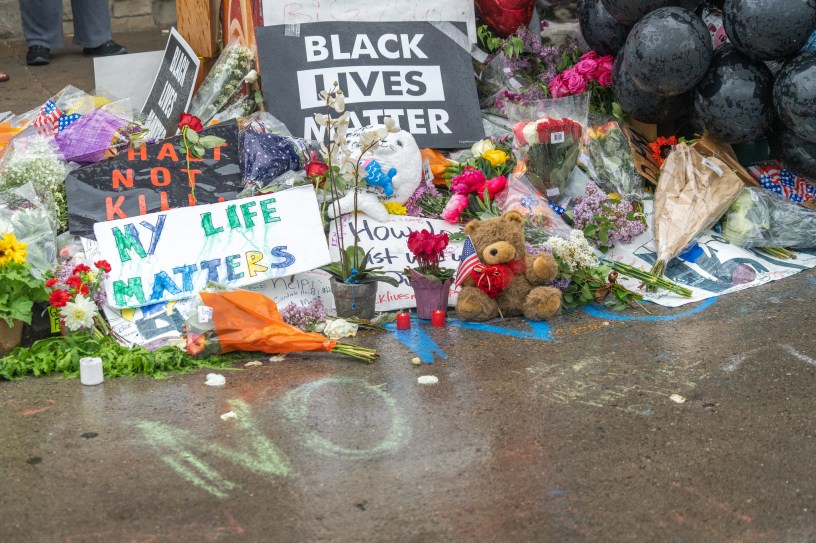
Derek Chauvin was found guilty of murdering George Floyd! The world is focused on the policing in America because of it. Passions are running high. It makes it the right time to call YOUR senator to express your support for the George Floyd Justice in Policing Act. If you’re already committed, please skip down to the sections that you need:
- scripts,
- tweets,
- tips for calling,
- suggestions for other things to do to support the bill, and
- links for contact information.
The George Floyd Justice in Policing Act
On 24 February 2021, Rep. Karen Bass (D – CA, 37) introduced HR 1280, the George Floyd Justice in Policing Act, in the House of Representatives. It was similar to a bill that had been considered in the previous Congress but never passed. The provisions of the bill are intended to improve policing in the country and reduce police violence against PoC, particularly Black Americans. In this Congress, the GQP has not introduced a smaller bill that they had proposed the previous year.
The bill has these provisions:
- make the prosecution of police misconduct easier,
- expand federal oversight into local police units,
- limit bias among officers, and
- change policing tactics
Unfortunately, these provisions can only enact changes at federal police agencies because state or local agencies are governed by state law. Out of the 18,000 police agencies in the country, only about a dozen are federal. So, while it cannot ban choke holds across the country, for example, it can provide incentives for state and local agencies to do so. But, it holds federal funds for policing as an incentive for state and local agencies to comply with its provisions. Essentially, if police departments don’t meet these standards, federal funding will be withheld.
Prosecuting Police Misconduct
The bill makes prosecuting police misconduct easier in two ways.
It changes the standard for proving police abuse of power.Currently, the federal law governing police use of force states that the prosecution must prove that the officer “willfully” acted to deny someone their “rights, privileges, or immunities secured or protected by the Constitution.” Apparently, this is a high standard to meet. It lowers the standard to “knowingly or recklessly,” which means that the act was not an accident and realizing that the act could cause harm. By making the standard easier to meet, federal prosecutors are more likely to bring cases against offending officers.
It ends qualified immunity. Qualified immunity prevents federal officers from being sued as long as in the course of fulfilling their professional obligations they did not “violate clearly established statutory or constitutional rights of which a reasonable person would have known,” which as we’ve all seen has not been workable shielding officers from accountability for even the most reprehensible behavior.
Federal Oversight
It establishes a federal database on police misconduct. National databases on police misconduct have been maintained my private groups. The bill would require the DoJ to establish publicly accessible databases on the police use of force and misconduct allegations.
It grants subpoena powers for investigating police agencies. It allows the federal and state attorney general’s office to issue subpoenas when investigating “patterns or practices” of violating the Constitution. The number of these investigations would be public information.
It requires the AG to ensure state and local police departments meet federal standards and requirements. The AG would develop a uniform standards for state and local law enforcement agencies to meet, ensure that only agencies meeting these standards receive federal grant money, and review departmental accreditation standards. The AG would also create a task force to find allegations of misconduct and refer them to the proper investigative authority and report laws that interfere with investigations into misconduct and racial bias in policing to Congress.
It would disburse grants for improving and reforming policing. Grant money would be available to implement new standards and techniques for improving policing, fund community organizations, and promote hiring, training, and oversight.
Bias in Policing
The bill does three things to reduce the impact of racial bias on policing: (a) It makes racial profiling illegal. (b) It mandates racial bias training for federal law enforcement officers. And (c) it creates training program concerning racial profiling and racial bias.
Changes in Police Tactics
The bill makes several substantive changes to police tactics at the federal level and encourages states to pass laws enacting these federal changes as well.
- No knock warrants in drug cases are prohibited
- Chokeholds and carotid holds are prohibited. They are also classified as a civil rights violation.
- Use of force rules have been altered. Lethal force cannot be used unless all alternatives have been exhausted and harm to bystanders eliminated. Non-lethal force cannot be used unless all alternatives have been exhausted.
Transfers of military equipment is limited. The transfer of a number of military weapons and vehicles to police agencies would be prohibited, although waivers for certain vehicles would still be allowed. And, requests for transfers by state and local agencies would have to be made public. Weapons and vehicles banned by the bill would have to be returned if currently held by an agency. Any weapon or vehicle used during a violation of civil rights would have to be returned to the federal government, also. And, transferred weapons and vehicles could only be used for counterterrorism or general law enforcement and not for drug enforcement or border management.
Body camera regulations are stipulated. All federal officers are required to wear body cameras. The manner of their use is spelled out in regulations.
Sexual misconduct is now illegal. What, this isn’t a thing already? An AP study reported that 990 officers lost their licenses due to inappropriate sexual conduct between 2009 and 2014, but, apparently, it is not explicitly illegal in all states. At the federal level, sexual contact with detainees would be punishable by a fine and up to 15 years imprisonment. States are urged to adopt these measures as well.
That’s the summary of the Vox summary of the bill in one of their explainers. Any errors are wholey my responsibility.
HR 1280 – The George Floyd Justice in Policing Act
Congress.gov offers this official summary of the bill.
- Sponsor: Rep. Karen Bass (D – CA, 37)
- Date of introduction: 24 February 2021
- Actions:
- Passed the House on 3 March 2021 on a 220-212 mostly party-line vote
- Received in the Senate on 9 March 2021
The Scripts
Call YOUR senators to express your support for these two bills even if it means modifying the filibuster. Following Indivisible’s lead, we’re tailoring our appeals to each of the five types of senators. Search through for the types that best fit each of your two senators.
Calling or Writing
Use this script when calling or writing your Members of Congress. Adapt as needed.
Regardless of the type of senator you have, they all should begin the same:
Hi, my name is [NAME] and I’m a constituent from [STATE and LOCALITY].
I’m calling today to support the passage of the George Floyd Justice in Policing Act. With the conviction of Derek Chauvin for the murder of George Floyd, we finally seem to have momentum to do something to end the police misuse of force. Unfortunately, with each passing day we seem to have another instance of the police misuse of force against a Black American or an American of Color. We have tolerated the abuse of our fellow citizens long enough. Congress must act to limit the misuse of force by police.
Find your type of senator from the list below and continue with that script.
The Member of Leadership
We cannot allow opponents of police reform to dissuade us from the passage of this important bill. We cannot accept amendments that would limit the scope of the bill or be distracted by alternatives like that offered by Mitt Romney during the last Congress. We must pass this bill even if it means modifying the filibuster.
The Moderate Democrat
We know that the Republicans will brand everything that passes as far-left extremism. We cannot let such demagoguery stop us from doing what is right for the American people and finally taking a concrete step towards building a more perfect union. While we must appeal for bipartisanship, we must be prepared to proceed without it. This bill must pass without being watered down or limited.
The progressive Democrat
We greatly appreciate your support for police reform. We must not let our desire to get something done allow Republicans and moderates to water down the provisions of this bill in the name of compromise or bipartisanship. With the near daily reports of police misuse of force, we know that the time is now to protect communities of color from police abuse.
The conservative Democrat
Anytime the police misuse force against a citizen it is a violation of the Constitution. We can no longer tolerate this type of abuse against our citizens. This bill takes vital steps to help us protect our Constitutional rights to Life, Liberty, and the Pursuit of Happiness. Help pass this bill as it is written as a first step towards that goal.
The Repube
As the trial of Derek Chauvin made abundantly clear, police misuse of force is a violation of our Constitutional rights to Life, Liberty, and the Pursuit of Happiness. As the near daily reports of police brutality and murder of People of Color, police misuse of force is widespread. We need to make systemic change to prevent these violations of our rights. This bill needs to pass as it is as a first step towards that goal.
Thank you for your time and attention.
IF LEAVING A VOICEMAIL: please leave your full street address to ensure your call is tallied.
The Starter Tweet
You may need to adjust the wording in the tweet because of your senator’s Twitter handle.
The near daily report of police misuse of force against PoC makes passing systemic police reform a necessity. This bill has the concepts and incentives we need to help make it happen. Pass the George Floyd Justice in Policing Bill.
Tweet
Tips for Calling
When you call your representative’s office, please remember the following:
- Only contact YOUR MoC! They only listen to their constituents and dismiss requests from non-constituents.Ask for the aide working on the policy-related issues.
- Be polite! No matter whose office you’re calling. No matter what their positions are. No matter how inflamed you are about the issue — and you should be very passionate — be polite.
- Remember that the people you are talking to are people! So, be nice.
- Call during business hours of the area code their office is in. Typically, that is 9:00 AM to 5:00 PM.
- Have a script or notes to follow so you don’t forget anything.
- Maybe call with friends. You know like a party.
Other Suggestions
I’ve heard back from readers that some MoC’s voice mail boxes are always full! It’s as if they don’t want to hear from their constituents. Kinda like those MoC’s who don’t hold town halls or other open forum meetings. Here are some other ways to contact your MoC:
In Addition to Calling
- in person visit, or what passes for in person during the time of #COVID19. Being in their office either in person or virtually and talking to the Congress person or a staff member is your best bet for getting your message heard.
- Send a postcard to their office. Nothing says I care like kicking it old school and using snail mail.
- Email their office. Lay out your concerns in a brief email and send it in. We all know how easy it is to email. Make sure you include the issue you are addressing in the subject line.
- Use the contact page on their website. This is the surest way of getting a message to them. Each MoC has an official government website and each has a contact page that comes with it automatically.
- Contact them using social media. It’s hard to break through all the noise on social media, but it can’t hurt to try given all the time we all spend using it. Be sure to tag your MoC’s when social mediaing about about a specific issue. Be clear and respectful, though, when addressing an issue that you want your MoC to act upon. Make sure you let them know you are a constituent.
- A form letter or petition. You see these on social media all the time. Text to this number and they’ll send a postcard. Sign the petition and they’ll deliver it. It makes it easier for you to do, and I guess it makes up for its lack of impact through its larger numbers? But, you wouldn’t be here reading this and thinking about calling your MoC if you were all about ease and comfort. There’s nothing easy, comforting, or comfortable about reading my syntactically garbled ranting snarky posts.
Coordination Makes an Impact
- Group Action. Visiting, calling, or mailing letters as a group has a bigger impact than just one person doing it, and it’s more fun. So, get your friends, neighbors, acquaintances, kidnap victims, whoever together and pass the phone around. Make it a day drinking game. Call in sick to work. It’s fun for the whole family!
- Join an Indivisible chapter. If you haven’t already joined an Indivisible chapter, consider doing it now. There are thousands of them dotted across the land. They sprouted and grew like invasive bamboo or mushrooms after 2017.
- Subscribe to Email Groups. I know those emails that claim to be from Elizabeth Warren, other political celebrities, or at least a real name are annoying, but they do help coordinate national action on issues. So, if a Congress person realizes that they just got a gazillion calls on issue X on the same day, then they know there’s a group that is pushing the issue and has voters behind it. See how that works for the anxious-to-be-re-elected Congress critter?
Film at 11:00
If you meet with your Congress person or staffer, film the interaction — this is where having a group comes in handy, one person talks, another one glares, and the third one films. So, if they are squirming or hemming and hawing or saying stupid stuff, you could go viral, and isn’t that everyone’s dream in this age of social media?
Use the Local Press
Again, if you’re going down as a large group, the press will cover it. If you’ve got a large phoning party, the press will cover it. And, you know who reads the local press? Congress folk, do, or at least their interns do. If you make the hometown newspaper or TV news, you’ve got that Congress person’s attention! So, go on, grab ’em by the press!
Informational Links
Useful links for getting the contact information for your MoC’s and anyone else in government local, state, or federal as well as tracking legislation, activism, and other information.
- Common Cause will give you the names, party affiliation, direct phone number, website link, and social media platforms of all of your federal, state, and local elected officials.
- USA.gov is the official guide to information and services of the US government. This page explains clearly how to contact everyone from the Ol’ Pussy Grabber to your representative to specific government agencies. Through it you can find the following information about your MoC’s:
- Their phone numbers: DC and state offices
- Their mailing addresses both in DC and their state offices
- Official website with their contact page including email, request a meeting, town hall schedules, and social media
- And, the committees they sit on
- Congress.gov is the official clearinghouse of information on all bills before Congress. You can find the sponsors, summaries, text, and status of every bill before Congress. It is a great tool.
- LegiScan uses the LegiScan API to search the LegiScan Data Service to provide a non-partisan federal and state legislation tracking service.
- 5 Calls: Sign-up for 5 Calls because they help you contact your member of Congress and keep you abreast of on going issues that are important to you! Now, that is a good deal.
- The Capital Hill Switch Board: (202) 224-3121.
- MassacreMitch and #MoscowMitch: His DC office, (202) 224-2541.
- Nancy Pelosi: Her DC office, (202) 225-4965; her California office, (415) 556-4862
- The WH Switchboard: (202) 456-1414 or the comments line at (202) 456-1111 during business hours
Join Indivisible
Follow the link to Indivisible to find a group near you, their campaigns, events in your neighborhood, and download their handy-dandy booklet!
If you want to be more active in our democracy and make your voice heard, sign up for our email list and never miss a post!
Image Attribution
“George Floyd” by chaddavis.photography is licensed under CC BY-SA 2.0
 The Psy of Life
Reblogged this on cabbagesandkings524 and commented:
Calico Jack – How to help change policing
LikeLiked by 1 person
It is hard to picture the bill getting through the Senate, if only because it is proposed by Democrats. Still, getting those against it on the record every way possible is important. I find that I’m waiting for the backlash on the Chauvin conviction. It will come. It will be ugly. But, the conviction of the leader will make it hard not to convict the other three officers of something, or pressure them into plea deals (if offered).
LikeLiked by 1 person
Howdy Bob!
It is so hard to predict how juries are going to break on cop cases. We give cops such a great benefit of the doubt. Since none of those officers testified or seemed to give evidence against Chauvin, I don’t know if a plea deal would’ve been offered. Although, just to avoid the pain and expense of a trial, maybe it is worth it.
For every action there is an opposite and equal reaction, right? I doubt the bill makes it through the Senate even if Tim Scott does his Uncle Tom dance next to it. Maybe they can get pieces of it through. Apparently, one of the big sticking points is the qualified immunity is the straw sticking point. We’ll see.
Huzzah!
Jack
LikeLiked by 1 person
I agree. Qualified Immunity (along with union dominance) is deeply ingrained and precious to the police community. It is part of their victim stance when facing any criticism. Perhaps the most unusual feature of the Chauvin case was how completely he was thrown under the bus by that community, disowned, really, and the prosecutors ran with “It’s not about the police or policing, but about this particular action by this individual.”
LikeLiked by 1 person
Howdy Bob!
The difference between the Chauvin case and the shooting of Duante Wright and the shooting of the teenager in Columbus is that the behavior of Chauvin was so egregious and disgusting that not even other police officers could tolerate it. To have done what Chauvin did marks him as a true sadistic psychopath. The Wright and Columbus shootings probably won’t result in charges or convictions because they have a thin thread of an excuse for their inexcusable actions.
Huzzah!
Jack
LikeLiked by 1 person
True. Chauvin’s action was clearly beyond the Pale and independently documented. The others are what sadly what passes for “normal”.
LikeLiked by 1 person
I was listening to some punditing heads pundit earlier today and essentially they were saying that some of the more recent shootings were more ambiguous than the Chauvin thing — nine and a half minutes is not a split second decision spurred by fear for your life. We probably won’t see much come out of them because of it.
Huzzah!
Jack
LikeLiked by 1 person
The one that may have the best chance to produce some results is, I think, the one mistaking her gun for her Taser. An awful lot of people just can’t comprehend how that could be. Apparently, they don’t read Ye Olde Blog.
LikeLiked by 1 person
Howdy Bob!
Of the three of the five recent police shootings that I know about — admittedly, I don’t know much about the Elizabeth City shooting or the other one — that’s the one with any chance of a conviction. But, I imagine no jury will convict her. It will end in a hung jury at best and the state will decline to pursue further prosecution if they bring a case at all. Our real chance at reforming police is pushing through legislation at the national and state level and convincing municipalities to change their model of policing.
Huzzah!
Jack
LikeLiked by 1 person
You’re probably right an all counts. The challenge is, or at least one of them, re-training the officers of 18,000 police departments. By that, I mean training the ones left after weeding out the anti government militia members, White Supremacists, and sociopaths. Hmmmm – Maybe not so many after all.
LikeLiked by 1 person
That’s the sobering realization that the high rate of infiltration of the police force. At least, we realized it. #SilverLining.
Jack
LikeLiked by 1 person
A silver lining, but also a difficult challenge. The military is claiming to making the effort more seriously after 1/6/21. Maybe the methodology will transfer down to law enforcement.
LikeLiked by 1 person
Howdy Bob!
The easy thing will be getting rid of the folks who have the white supremacist tattoos and beliefs. They make themselves obvious in so many ways. The harder part is ending implicit bias. There is some evidence that implicit bias training can backfire because it simply activates the bias and like disparagement humor makes it more likely that those officers harboring bias will act on it at their next opportunity. There are small increases in racial incidents after implicit bias training. So, there’s that.
Huzzah!
Jack
LikeLiked by 1 person
Implicit bias isn’t only, or maybe even primarily, about words and verbally expressible beliefs. It acts in the nervous system in involuntary reactions, like anxiety in the presence of target persons, gut reactions. So, it makes sense that raising someone’s awareness of it calls up those responses. I’m thinking that an effective process would resemble exposure therapy for phobias. And, there are long standing perverse incentives in the system, such as setting goals for numbers of arrests that push cops to go after low hanging fruit of easy targets, like traffic stops for minor reasons and suspects who can’t afford a lawyer (i.e., POC in low income neighborhoods).
LikeLiked by 1 person
Howdy Bob!
This is exactly what did Duante Wright in. My understanding is that Kim Potter was training other officers when they decided to pull Wright over. They were making a pretext stop. They saw the air freshners in his car which have correlated in police minds with marijuana use. Any cop can find some reason to give someone a ticket. And, most can come up with an excuse to search a car once they can get a look inside it. This is what she was teaching.
If you think about how many people have broken taillights, license plates in their rear windows, damaged mufflers, and other flaws in their vehicles, cops have lots of options about who to pull over when for what. Couple that with quotas on the number of tickets issues — they are considered revenue streams by most municipalities and local governments — it is easy to target the poor who have a more difficult time maintaining their vehicles.
I’ve been there and done that. I experienced it so often as a young man in the late ’70’s and early ’80’s when I drove a ’63 VW van and looked pretty hippie dippie that I developed a technique that would get me out of scrapes with the cops. I called it, “If I were you, I’d be doing exactly what you’re doing.” Essentially, you had to convince the cop that while what you were doing was illegal, it was perfectly reasonable and they would probably be doing it, too. The best example was getting pulled over for a busted taillight a couple of blocks from my home and being caught without valid insurance. I told the cop that I had just rebuilt the engine — I had but it was a couple of months earlier — and was taking it for a test drive around the block. Luckily, my license had my correct address on it and grease under my fingernails — you were always working on VW engines, so it was always the case. He let me off with a warning.
Of course, the technique is a lot easier to use when you’re both of the same race and that race is white.
Huzzah!
Jack
LikeLiked by 1 person
The revenue stream issue was quite prominent in Ferguson, MO after the death of Freddy Gray, with traffic fines and other minor infraction fines and court fees being more than half the town budget. So, how do you “defund” the police when the police are funding the city? That and the accompanying performance quotas are self-reinforcing perverse incentives. The alternative would be to raise taxes on everybody, and you know how well that plays.
Making nice with the cop never hurts.
LikeLiked by 1 person
Howdy Bob!
We’ve always built America on the backs of the most vulnerable marginal communities. The GOP infrastructure outline of a bill wants to fund it by raising user fees and a gasoline tax. Both of those measures are going to be unpopular and almost guarantee that it fails. If it passes, the rich get a pass, AGAIN, and it gets done at the expense of the middle class effectively transferring that wealth to the 1%.
Huzzah!
Jack
LikeLiked by 1 person
How very predictable that is, alas. Of course, raising the gasoline tax, which is both a use tax and, in effect, a carbon tax, could incentivize more buying of electric cars.
LikeLiked by 1 person
Howdy Bob!
Talk about the silver lining to the dark cloud! Somehow, I don’t think that’ll be the reasoning of the party of rolling coal. They’ll just double down on the gas guzzling pick ’em up trucks. I swear everyone in the base is willing to die young if it means they can be as racist, misogynist, and macho as they wanna be. It is worth the trade off for them.
Huzzah!
Jack
LikeLiked by 1 person
Well, folks got their RIGHTS and the Hell with how their behavior affects anybody else, right? And, it ain’t a real good pick ’em up truck if they can’t hear you hit the gas at least a quarter mile away.
LikeLiked by 1 person
That’s at least how Ron Anon Johnson thinks about it. Surely you heard the quote the other day of “Why do we care if everyone gets vaccinated as long as you’ve gotten vaccinated.” Since when do we openly tout screw your neighbor as part of the American value system? I know the rule is that it has to hurt Black folks first and worst, but I think in the end the anti-vax folks are going to end up hurting the conservative white voter the first and worst.
Huzzah!
Jack
LikeLiked by 1 person
It is already happening with rural counties and town especially in the West having to decline delivery of vaccine supplies because of lack of demand, despite already having lower rates of vaccination than the national average. Maybe it would help to spread a rumor that getting COVID can lead to Erectile Dysfunction. That would change the picture fast.
LikeLiked by 1 person
I think that is actually true. Not every case, but it can affect any of the body’s systems including the cardiovascular system. Kinda takes the haul out of the long-haulter, though, don’t it?
Jack
LikeLiked by 1 person
Quite possible
LikeLiked by 1 person
I guess if I were more motivated, I would actually found out. But, you know.
LikeLiked by 1 person
I know well. LOL
LikeLiked by 1 person
LOL
LikeLiked by 1 person