
“The election was stolen! The election was stolen! ” the Ol’ Pussy Grabber runs around his golf course flapping his arms and screaming like some common Chicken Little.
On the left-hand side of politics, It has become known as the Big Lie. On the far right-hand side, it has been accepted as true… at least among the rank and vile of MAGA Nation and the useful idiots of the political offices of the Repube controlled states and the back bench of Congress.
In fact, it has burrowed so deep into the Collective Unconscious of the politically gullible and willfully ignorant that it may prove to be difficult to eradicate from our political discourse.
Last week, Ye Olde Blogge included a link to a story, that was only a link really to a summary of a national survey from an obscure organization called Bright Line Watch, oh, and a smartassed snarky comment on Mock, Paper, Scissors. I was surprised to hear an interview with one of the co-founders of Bright Line Watch and Dartmouth College professor of government, Brendan Nyhan on Five Thirty Eight’s Political Podcast. Who knew Tengrain was so clued into media and stuff.
The survey looked into the state of our democracy and specifically examined the effects of the Big Lie in a very interesting way, which we’ll summarize with the usual value added from heaping helpings of snarky sarcasticky profaney commentary and by connecting it to proportionality bias.
There were several big take aways which we’ll focus on, but their overall conclusion is that Americans are MEH about maintaining our democracy. See if you can spot the MEH-made in each of the excerpts below — please let us know your feelings on it in the comments; I’d be happy to discuss it with you — and then we’ll wrap it all up with proportionality bias.
The Bright Line Watch Survey Results
Secession
The biggest finding to come out of the survey is the percentage of respondents who favor secession from the country. The best evidence for this comes in the question that Tengrain reacted to: “Would you support or oppose [your state] seceding from the United States to join a new union with [list of states in new union]?” They made five geographically based groupings. For the complete list, you’ll have to see the article. The relevant results, though:
- The percentage of Americans agreeing with secession has increased since they asked the question LAST FEBRUARY! Overall, support for secession is up to 37%. A full third of the Americans surveyed thought their region should secede from the Union. What would Lincoln say?
- These kinds of questions garner expressive responses, meaning they are less literal than they are reflective of the general sentiment that they represent. In this case, unhappiness with the state of our union. Or, it could be that a third o of our population has always not really cared whether we’re a democracy or not or remained a federated union of states.
- That said, 60% of Republicans and 50% of independents living in the Confederate States plus Oklahoma favored secession. Even support among Democrats increased. It was the only region to have a majority of any political group favor breaking up the country. See? The Civil War never really ended.
- The West was close to a majority with 47% of Democrats favoring withdrawal.
Overall, it strongly suggests that breaking the country into regional more politically uniform units is gaining acceptance. What once was unthinkable is now plausible.
I guess it begs the question of whether we’d actually fight a civil war to maintain the union.
The Candidate Experiment
In a somewhat complicated experiment, they mixed and matched candidate attributes in order to determine which attributes had the greatest influence on candidate support by type of respondent. They asked this question in both their Febuary and June surveys making the results comparable.
They asked their participants which Republican candidate they would support. All candidates were clearly identified as Republican, but these attributes were randomly assigned:
- Gender: male or female; identified through their name
- Race or ethnicity: white, Black, or Hispanic; also, identified through their name. One assumes that all participants assumed Georgette Washington was a white female, Rashid Washington, Black male, and Juanita Washington, female Hispanic.
- Policy positions supporting or opposing:
- #COVID19 spending
- Transportation infrastructure spending
- Political positions supporting or opposing:
- Certifying the presidential election
- Trump’s impeachment for the 6 February Insurrection
It turns out EXACTLY as you expect:
- Demographics:
- Republicans and independents only support white candidates. Hunh.
- Republicans and independents supported female candidates in June but not in January. Hunh.
- Democrats supported candidates of both genders and all races and ethnicities. Hunh.
- Policy positions:
- #COVID19: Suprisingly, everyone supported the spending.
- Transportation infrastructure: Only June Repube participants didn’t support spending here. Hunh.
- Political positions:
- Confirmation of the presidential election:
- Democrats overwhelmingly supported candidates who supported it
- Independents supported it, but support really jumped from February to June
- Trump’s Impeachment for the 6 January Insurrection:
- Democrats overwhelmingly supported those candidates
- Neither Republicans nor independents supported candidates who supported impeachment
- Between February and June, support for candidates who supported impeachment increased, but never to a positive correlation by independents
- Confirmation of the presidential election:
Obviously, Republican and independent voters are influenced by implicit racism and misogyny, but that is not news. We see it every presidential election when we have candidates who are not white men running. It also shows the depth of support for the Big Lie and wavering support for democracy. Americans, especially Repube and iNdEpEnDeNt voters support democracy as long as their white guy wins, but if he doesn’t, it’s what else have you got?
Proportionality Bias
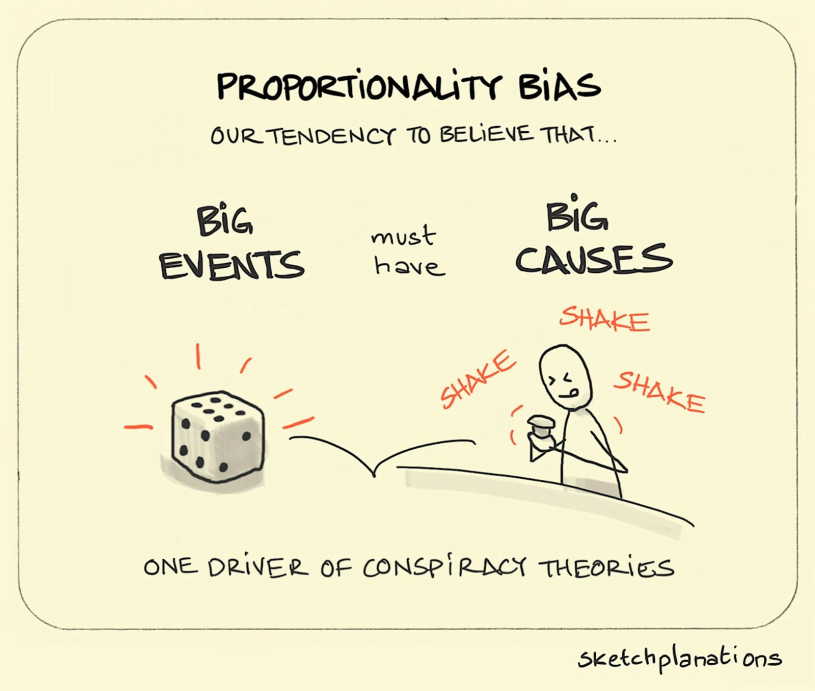
Proportionality bias is the cognitive tendency to expect that big events have big causes. For example, JFK’s assassination was a big events so there had to be a vast conspiracy behind it. It couldn’t possibly be due to one misguided individual.
The Big Lie, Voter Fraud, and Conspiracy Theories
If the Big Lie is true, then it had to have been caused by something big like massive voter fraud. Once you’ve accepted the Big Lie, then the absence of evidence of voter fraud is huge. The absence of evidence, then can only be explained by something equally as big, a vast conspiracy to cover it up.
The bigger the belief, the bigger the cause must be. When combined with motivated reasoning — the conclusion wagging the search for supporting facts — proportionality bias drives conspiracy theories or other crazy twists to reasoning. You KNOW it’s true, so you twist the supporting evidence into whatever Gordian knot you have to and ignore whatever contradictory evidence there is in order to maintain your belief. Worse, it all feels so damn intuitive, logical, and reasonable It becomes a reified cognitive dissonance that is nearly impossible to break.
The Threat to Our Democracy
The contrary also applies. If, as so many claim, including Ye Olde Blogge, that our democracy is under threat, then there has to be a big threat looming out there. Unfortunately, the state laws that the Repubes are passing are not seen as looming threats. They are too abstract, too obscure, too difficult to understand. Worse,the gerrymandering and filibuster don’t rise to the size necessary to be recognized as a sufficient threat, either. Consequently, they slip under the proportionality bias radar. It just doesn’t FEEL threatening because we’d KNOW if we were under attack, right?
Revolution and regime change and the toppling of democratic governments means fighting in the streets with bloodshed and gunfire and armies and stuff like we see on the TV.
The constitutional hardball tactics that the Repubes are using don’t meet the requirements of proportionality bias, so no one takes them seriously. It really is that simple… and that difficult to overcome.The

Thank you for spending some of your time with Ye Olde Blogge. It is greatly appreciated. Please take a moment to personalize your visit beyond the tick in the visitor count:
- COMMENT: What do you think about the threat to our democracy and how well proportionality bias explains the apathy and indifference we see among the American people.
- LIKE this post and every blog post you read by using the buttons below!
- RATE this post with FIVE stars using the buttons just after the title above.
- SHARE this post on your favorite social media platform using the buttons below.
- JOIN our email list using the subscription form:

 The Psy of Life
There is no point of maintaining the union when both sides would benefit socially, politically, and economically from a split. The largest portion of people of color are stuck in the South, so if the South seceded again, there would be a much larger chance for people of color to be given equity in an America with guaranteed Democrat control, while the conservatives and white people who don’t like living in a more diverse nation can simply move South, dominated by the Republicans.
LikeLiked by 2 people
Howdy Chunky!
This is a thought that I’ve had as well, but I would argue that it is not beneficial for any of us to dissolve our union. White supremacy is a cancer that knows no borders and will be exported from whatever country they are given. We will not be able to completely segregate all of the people of color from the white supremacist country either. It is just too simplistic of a solution to the problem. Seriously, we have to change or norms and morays back to where racism is not acceptable from anyone and rid ourselves of systemic racism. We were headed in that direction until highjacked by Trump and the Russians.
Huzzah!
Jack
LikeLike
The idea of succession is so stupid, it hurts my brain to entertain it. Sorry, we’re all stuck on this continent together. Geography means that we have to work together…especially when it’s fire season over here in the west.
LikeLiked by 4 people
Howdy Krista!
I definitely agree, secession makes my brain hurt. It amazes me how destructive and nihilistic MAGA Nation is. Essentially, the belief seems to be that if they can’t be racist, life ain’t worth living.
And, you’re absolutely right, we are stronger together. Every region experiences natural disasters. We have to help each other through them. We’re stronger and better off together.
Thank you for the comment. I hope we hear from you again.
Huzzah!
Jack
LikeLiked by 3 people
“Essentially, the belief seems to be that if they can’t be racist, life ain’t worth living.” SO TRUE! Nails it on the head.
LikeLiked by 1 person
Everything has to meet the racist requirement of hurting Black folks first and worst, which is probably why Gov. Meemaw, as she is affectionately known in Alabama, has hit the airwaves claiming she’s done everything she knows how to do and it is high time folks got caused cause now #COVID19 is hurting white Alabamans worse than the Blacks.
Huzzah!
Jack
LikeLiked by 1 person
Reblogged this on cabbagesandkings524 and commented:
Calico Jack – Boiled frogs
LikeLiked by 2 people
One of the most difficult parts of systems thinking for most people is the idea of small causes having large effects, along with the idea that people do not need to actively conspire if they share a world view, vested interests, and goals. These are very counter intuitive ways of thinking.
Once you have a population well soaked in breathless reporting of murder, mayhem, and catastrophe on an hourly schedule, it takes a lot of drama to get their attention. Their frogs are then easily boiled by a creeping takeover, the death of democracy by a thousand cuts.
LikeLiked by 5 people
Howdy Bob!
One of the things that has me despairing is the notion that enough of us are no longer sufficiently committed to democracy to do what is necessary to keep it. My fear is that enough of white America is either ambivalent about it or prefers racism and more.
As long as we have fast food, fast fashion, and Netflix, nothing else may matter enough to get us off of our couches.
Huzzah!
Jack
LikeLiked by 4 people
Another element is, I think, our persistent myth of exceptionalism, that it can’t happen here the way is happens and is happening in other places, like Hungary and Poland, by the perversion of constitutional processes. The focus of our narratives of loosing our democracy is always on invading armies and foreign fifth columns – always from outside.
LikeLiked by 1 person
Thank the movies for that one and the mad success of the one rogue hero who sees the truth no one else does and pursues that goal no matter what and in the end, the end achievement has justified whatever violence, mayhem, and death he’s had to met out to get there.
Jack
LikeLiked by 3 people
I was thinking about the movie Red Dawn (2012), in which the US is invaded by Soviet troops, with Cuban troops doing most of the work (An island of 7 million population providing enough troops to control one of 150 million? Really?), and the heroes are white, rural, militias. There were several others around that time.
LikeLiked by 2 people
Howdy Bob!
I remember Red Dawn. It was pretty much a right-wing militia fan boi fantasy.
Every one of those mother’s sons and daughters who were in the Capitol had visions of Second Amendment patriots resisting the overreaching Big Brother socialist gubment dancing in their heads. It was everyone of their conservative fantasies come true.
The overlap between white racial angst and white supremacy militias is pretty frightening. The 6January Insurrection, unfortunately, is now a recruiting tool for those militias, radicalization of white middle class, and deepening white identity grievance politics.
Huzzah!
Jack
LikeLiked by 2 people
Very much so
LikeLiked by 1 person