
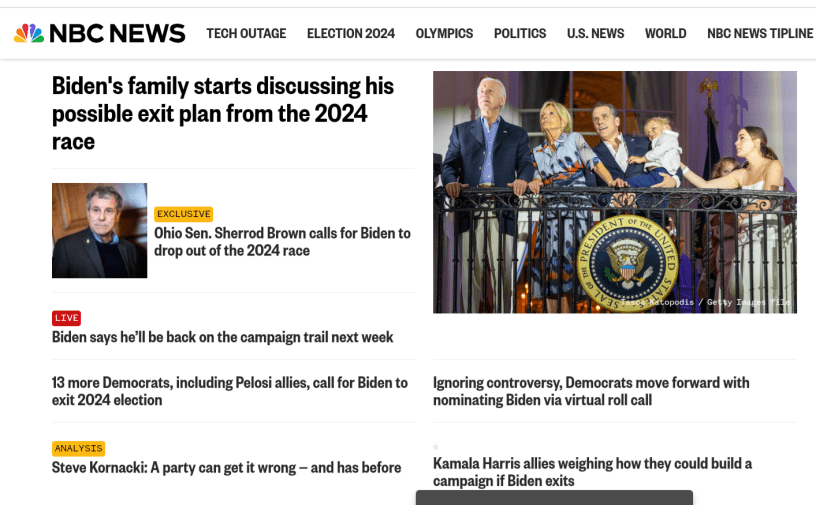
I don’t know about you, but waking up to these headlines, leaves me feeling just a wee bit depressed. It looks like it is just a matter of time before Biden is out of the race. It defies all reasoning and logic to push Biden out of the race unless there is a VERY GOOD REASON. For the life of me, I can’t find one other than blind panic among the Democrats fueled by a few Rubles slipped to Lloyd Doggett and a couple of other early naysayers.
It does, however, bugger the question, what happened the last time the incumbent withdrew late in the election? That would be Election 1968 that was marred by assassinations, riots, and the election of one of the biggest crooks to ever shit in the Oval Office toilet, Slippery Dick Nixon.

I KNOW TL;DR
It’s a 3,000 word block buster that no one has the focus or attention or time to read any more. But the material is compelling, so Ima help all y’all out with a clickable table of contents. You can go to the sections that seem the most interesting to you, okay?
You remember Election 1968. Even if you weren’t born then, even if you weren’t politically aware then, you remember it because it was one of the most pivotal elections in American history right up there with Lincoln’s in 1860 and FDR’s in 1932. It was an election that would change the course of American history.
Let’s see how Election 2024 stacks up against Election 1968 in ways profound, mundane, and ridiculous.
Election 1968: LBJ, Wallace, Nixon, Viet Nam, and National Strife
Disapproval Over the War in Viet Nam
The Viet Nam War hadn’t been going well. By 1968, the US had sent nearly 500,000 American troops there, we had dropped more explosives on them than all of the bombs dropped in World War II combined, and there was no sign of us winning. Instead, we had Water Cronkite — I really miss Walter Cronkite, don’t you? — somberly intoning, the number of missing and killed in action that day at the end of every broadcast. But, it was his withering February editorial that concluded the war was unwinnable, unloseable, and only negotiable that caused LBJ to have his Cronkite Moment, concluding, “If I’ve lost Cronkite, I’ve lost Middle America.”
To say that we are mired in stalemate seems the only realistic, yet unsatisfactory, conclusion. … [I]t is increasingly clear to this reporter that the only rational way out then will be to negotiate, not as victors, but as an honorable people who lived up to their pledge to defend democracy, and did the best they could.
Walter Cronkite quoted in 50 Years Ago, Walter Cronkite Changed a Nation by Kenneth T. Walsh on 27 February 2018 in US News & World Report
In many ways, the war broke LBJ. He couldn’t bring himself to follow Cronkite’s recommendation and negotiate an end to the war as an honorable people. The war had thrown his administration and country way off course. There was widespread opposition to the war. It had bankrupted his Great Society programs. And, he would become the first of many American presidents to not win the war they were fighting. He just couldn’t do it.
In short, the Viet Nam War was a crisis for him personally and for the country. It was galvanizing public opinion against him. It overshadowed all of his monumental accomplishments as president.
It was as though they had forgotten that Johnson had pushed through two major pieces of civil-rights legislation: the Civil Rights Act of 1964, which made discrimination by race or religion or sex illegal, and the Voting Rights Act of 1965, which guaranteed the franchise to African-Americans in the formerly segregated South. Those were the greatest legal advances in race relations since the Civil War amendments. But by 1968 Vietnam had eclipsed them.
Lessons from the Election of 1968 by Louis Menand on 1 January 2018 in The New Yorker
The Challengers
On 30 November 1967, Eugene McCarthy declared his candidacy for the Democratic nomination for the presidency, challenging LBJ. Although losing to Johnson in the New Hampshire primary, he only lost by seven percentage points (42% to 49%), signaling the president’s weakness as a candidate.
On 16 March 1968, Robert Kennedy announced his candidacy, sealing both his and Johnson’s fates. RFK had the sympathy of his brother’s assassination ,and the support of his White House advisors and staff. RFK had close relationships with every constituency needed to win the election, blue-collar workers, college-educated professionals, the Black community, women, liberals, moderates.
Just fifteen days later, LBJ uttered that infamous line, “I shall not seek and I will not accept the nomination of my party for another term as your President.” And, 82 days later, RFK would be dead on a hotel kitchen floor.
Conventional wisdom states that when an incumbent faces a strong primary challenger, they generally lose the election. LBJ probably could’ve beaten McCarthy, but he might not have beaten Kennedy. It didn’t matter, though. He saw that he didn’t have the support of the party and the American people, and he did the only thing he could, decline to run.
Hubert Humphrey and the 1968 National Democratic Convention
Nearly a month after Johnson shocked the nation by withdrawing from the presidential race, his vice president, Hubert Humphrey declared his candidacy on 27 April 1968. In a clear demonstration of how much the presidential nomination process has changed, Humphrey didn’t run in a single primary, yet he won the nomination on the first ballot.
At the convention, all of Johnson’s delegates and half of Kennedy’s delegates voted for him. Those plus the ones pledged to him by the party bosses, like Chicago Mayor Richard Daley, gave him an overwhelming victory on the convention floor.
Yet, the party was not healed. Humphrey still supported Johnson’s attempts to bomb the North to the negotiating table, and Eugene McCarthy refused to endorse him. He started way behind in the polls.
In September, he announced he would halt Johnson’s bombing campaign. The October surprise was McCarthy’s endorsement. He came close, but he did not get a cigar or the presidency. Okay, maybe he got a cigar. I don’t know.
National Lawlessness and Disorder

1968 was a tumultuous year in American history. Two major assassinations, Martin Luther King and Robert F. Kennedy. National protests against the war in Viet Nam. Race riots in nearly all of America’s major cities. The dissatisfaction was palpable.
Nixon knew he could exploit that dissatisfaction, but so could another challenger for the office, George Wallace. Wallace had entered the race as a candidate for his American Independent Party. It formed because of the racial backlash to Johnson’s Civil Rights legislation. Back in those days, being openly jaw-droppingly racist wasn’t a liability. Wallace went on to win five Southern states, the only modern independent candidate to ever win Electoral College votes and nearly 14% of the popular vote.
Wallace was the ex-governor of Alabama who uttered the immortal words, “Segregation now! Segregation tomorrow! Segregation forever!” He ran on the openly racist platform.
Nixon realized that he could exploit Wallace’s naked white supremacy by dog whistling his way through the election campaigning on Barry Goldwater’s law and order theme. Of course, we all know that law and order means Bull Connor setting the dogs on the darkies marching across the bridge, but we don’t even have to think about. We can vote for it with a clear conscious. Isn’t cognitive dissonance grand? But, that is a blog post for another day.
Large numbers of white Americans did not interpret this disorder in terms of social justice. They interpreted it as a breakdown of civil society. The rioters were not black or white; they were arsonists and looters (who happened to be black). Nixon showed that political advantage came from steering clear of the underlying issues. He gave people respectable reasons to vote for a candidate they favored for what they might have worried were not such respectable reasons.
Lessons from the Election of 1968 by Louis Menand on 1 January 2018 in The New Yorker
With lawless disorder raining chaos across the country, Nixon and the Republicans didn’t have to openly oppose civil rights, they just had to talk about law and order. The white public would do the calculus in their heads. They would put two and two together and come up with Segregation now! Segregation tomorrow! Segregation forever! without having to offend themselves with their own racist stench.
Douglas Kiker [a reporter following the Wallace campaign], tried to explain the phenomenon. “It is as if somewhere, sometime a while back, George Wallace had been awakened by a white, blinding vision: they all hate black people, all of them,” Kiker wrote in New York. “They’re all afraid, all of them. Great God! That’s it! They’re all Southern! The whole United States is Southern! Anyone who travels with Wallace these days on his Presidential campaign finds it hard to resist arriving at the same conclusion.”
Lessons from the Election of 1968 by Louis Menand on 1 January 2018 in The New Yorker
That was Election 1968. It was a wholly dissettling disturbing disruptive time in American history. No one who lived through the year came away without being shaken. In many ways, it feels like what we’ve been going through since 2016 when the Felonious Rapist Traitor condemned Mexican immigrants as rapists and criminals.
Election 2024: Biden, Trump, Chaos
Let’s see how much our situation now, with pressure on Biden to withdraw from the race is to the situation in 1968.
The Disappearing Incumbent

We’ve seen lots of pressure, increasing pressure, on Biden to withdraw from the race. So much so that we should be anticipating his withdrawal any day or week now. Anyone who thinks otherwise is just fooling themselves. His candidacy, rightly or wrongly, is no longer tenable.
In contrast, there was no pressure on Johnson to withdraw. In fact when he declared that he would not seek the nomination, the nation was shocked.
In some ways, Johnson was much more politically savvy and disciplined than we are now. He sized up his situation, weighed his options, and made his choice. In contrast, the hair fire of Democrats is spreading faster than a July wildfire in California. The Democrats have only just now begun muttering about plausible alternative candidates with Kamala Harris now making preparations and Nancy Pelosi endorsing an open convention should Biden withdraw — like he has a choice now.
Johnson’s withdrawal was a political calculation. The Democrats is a panicked route. No similarity.
The New Standard Bearer

In 1968, it was presumed that the vice president would step in and seek the nomination after Johnson’s shocking withdrawal. It was an orderly transfer. Johnson made his announcement with time enough for Humphrey to get his act together, and he very nearly pulled it off.
Democrats are afraid of a Harris candidacy. In fact, I still maintain that if Harris had proven herself at all capable of managing a successful campaign — do you remember the debacle that was her 2020 campaign? — or be a successful two term president, Biden wouldn’t be running and would’ve handed it off to her.
When questions about Biden’s age and competence were no longer ignorable, had Harris been seen as a viable candidate, everyone would be talking about her as the natural successor. The most disturbing thing about the whole #BidenSoOld thing is that it is being done with absolutely no plan or consideration for what comes next. The focus is on getting Biden to withdraw.
Johnson’s handover was orderly. Biden’s is an implosion. No similarity.
The Kennedys, Third Party Candidates, and Assassinations

Two things that both campaigns have in common are the Robert Kennedys and the assassinations. It’s spooky, isn’t it?
In 1968, Robert Kennedy, Sr runs for the nomination and in 2024, Robert Kennedy, Jr (Spoiler: that’s RFK’s son) is running for the nomination. Of course, RFK is probably spinning like a battling top in his grave, but, you know, there is no denying the Kennedy connection.
In 1968, Kennedy was gunned down in cold blood on 5 June and Trump was shot at and grazed by shrapnel on 14 July 2024. Now, that’s also a coincidence that cannot be denied. We just can’t make too much of it because it insults the memory of RFK and his sacrifice even more than Junior’s nutty self-serving run.
RFK changed the 1968 race. Arguably it was his candidacy that pushed Johnson to get out of the race. Junior is going to be an asterisk on the 2024 race. No similarity.
George Wallace ran as a third party candidate. While he didn’t change the outcome of the race (his 46 electoral votes couldn’t change the outcome of the election), he did quicken the realignment of the parties and demonstrated the power of the Southern Strategy. Junior will be lucky to have his asterisk. No similarity.
RFK’s assassination was a national tragedy that shook the foundations of the nation when coupled with MLK’s assassination and resulting riots and the anti-war protests. Trump being grazed reified his Messiah complex. Fucking great. No similarity.
Dominating Issues: the Viet Nam War versus Civil Rights Legislation; #BidenSoOld versus Climate Change Legislation

One of the things that did LBJ in was the war in Viet Nam. Being the first president to tie in a war was more than his ego could take. While waging a war was outside his area of expertise, so he left it to his generals and experts. He got screwed.
The towering transformational accomplishments of his presidency, the Civil Rights Legislation and Great Society Programs, could not counter-balance the damage the war was doing to his chances of re-election. Looking at from the vantage point of almost sixty years later, it doesn’t seem possible. But, that’s how electoral politics works.
Biden is arguably one of the most consequential presidents since Reagan. He literally remade the economy and pulled us out of the debacle that Trump made of the #COVID19 pandemic. He has done more to counter climate change than anyone else on the planet. It should be a no brainer to re-elect the man, right? Right?
The Democrats, ever the expert of pulling defeat out of the jaws of victory, have managed to shoot themselves in the gonads… AGAIN. What a colossal own goal. It is just unbelievable. Why the Democrats didn’t circle the wagons and pull a demented Reagan, I don’t know. If he really was that bad, they could’ve organized a 25th Amendmenting of him right now. Or they could’ve quietly organized it for early in 2025. It could’ve been another Goldwater and Rhodes telling Nixon that they could no longer prevent his impeachment in the Senate.
The Viet Nam War destroyed Johnson’s chances of winning. #BidenSoOld have all but destroyed Biden’s chances of winning. Neither person could overcome the setback. Very similar.
Racism

Wallace ran on open naked racism; Nixon, the Southern Strategy; Humphrey, Civil Rights Legislation. The racial animus of white America won the day in 1968. The Blacks were getting too uppity after MLK’s assassination unlike when that bad old Bull Connor set the dogs on those nice Negros and the terrible Alabama (there’s that Wallace connection again) state troopers beat that nice John Lewis nearly to death on Edmund Pettus Bridge. Now, they were acting like garden variety white supremacists wanting revenge for the outrages perpetrated upon them.
We’ve got Trump ringing every race bell he can reach. The Republicans aren’t even trying to use dog whistles, they are singing it loud and proud for everyone to hear. White racial animus carried Trump in 2016 and nearly in 2020. It very well could do so again in 2024.
The Democrats have been failing the Communities of Color since their zenith in 1965 with the passing of Johnson’s Civil Rights legislation. Black support of Biden and the Democrats is wavering and incredibly, Trump is making gains among Communities of Color.
In 1968, race was a very open and obvious issue with Nixon and Wallace playing their cards skillfully. In 2024, race remains an open and obvious issue, with Trump blundering his racist ass over all of our fragile white-people racial norms — don’t talk about skin color because calling a Black person Black is racist — to make a secret ballot for the racist satisfying to white people again. Very similar.
The Press

The press is played an outsized role in 1968. Covering the riots after MLK’s assassination and at the violent police repression of the anti-war protesters at the DNC, although, very little actual news coverage was given to the Battle of Michigan Avenue. Then, as now, there was an inherent bias towards the police and against the protesters.
George Wallace also commanded outsized attention from the press, reminding us of the role the press has played in Trump’s success.
By late September of 1968, election polls showed Wallace with 21 percent of the vote. Wallace’s campaign was well-funded, but he was also helped by the fact that he got a lot of free press. “He had this ability to seize upon issues to capture public attention,” Dan Carter says. “And very quickly newspaper reporters and the broadcast media realized that he was good copy.” Many professional commentators derided Wallace (Tom Wicker of the New York Times referred to him as “the Alabama demagogue”), but still he appeared frequently on major television news shows.
George C. Wallace: Powerful Third-Party Candidate on APM Reports
Sensationalism in the press is nothing new, and the ability of the focus and slant of press coverage also is nothing new. In 1968, it the nation was beset by riots and protests, civil order seemingly breaking down. When Walter Cronkite, the middle-class whisperer, turned against the war effort, Johnson knew he was done. When Wallace ran, the white nationalist, he made for “good copy.”
We’re seeing the same thing now with Trump. Political violence is the province of the right, but bothsidesism wouldn’t let you know that. Crime has fallen drastically across the country, but you wouldn’t know it from reading the MSM. Trump’s dementia is evident in his every speaking engagement, including the debate that set off #BidenSoOld, but the media doesn’t report it that way.
The role of the media in 1968 and 2024 are very similar. How they cover the change from Biden to whoever will be pivotal to how the race turns out.
Just like in 1968 when Humphrey started his campaign after the DNC nomination, he was behind Nixon in the polls, whoever becomes the Democratic nominee instead of Biden, they will be starting way behind. Hopefully, the election will be similar enough to 1968 with Humphrey catching up by election day. Hopefully, it will differ with the Democratic nominee actually winning on election day.
If you enjoyed this long analysis of the similarities between the 1968 and 2024 elections, then you should consider doing one or more of the following:
- SHARE this post with someone who might enjoy it. You know who they are in your life. Everyone knows one of them, right?
- LIKE or RATE this post using the buttons at the top and bottom of the post. It’s easy. Just a click before you’re away.
- COMMENT on this post. I’d love to hear what you think of the impending Biden withdrawal and its effects.
- FOLLOW the blog or join our email list:
Image Attribution
The feature image is a screenshot of the front page of NBCNews taken on Saturday 20 July.

 The Psy of Life
Dude! As soon as I heard the news this morning, I said, “I did a LBJ!” I was only 8 years old in 68 but I remember that campaign vividly. It was the first presidential campaign I really paid attention to. Fully politicized at 8 years old LOL
LikeLiked by 1 person
Me, too. Eight in ’68. I remember Johnson’s speech, Walter Cronkite’s éditorial, the MLK & RFK assassinations, the riots, the protests, the DNC. it was my political awakening.
And, like LBJ, he’s done it with enough time for Harris to get it together and win.
Jack
LikeLiked by 1 person
Except that Nixon won.
LikeLiked by 1 person
Arguably, RFK’s assassination led directly to Nixon’s victory, not LBJ’s withdrawal. Michael Bechloss, presidential historian said yesterday on air that Lady Bird had told him that Johnson thought he could bring peace in Viet Nam by the time of the convention and the Dems would draft him. Well, that didn’t happen.
Nixon won, but by a percentage point in the popular vote. Many of the states were closely contested. Humphrey came close with a lot of baggage and an albatross around his neck.
Huzzah!
Jack
LikeLiked by 1 person
Didn’t Nixon sabotage the 68 Paris talks so that he could say that only he could end the war? Much like what Reagan did with Iran in 80? The GOP always cheats. ALWAYS.
LikeLiked by 1 person
Not only do Republicans always CHEAT, they are so corrupt that every Republican president since Nixon should’ve been impeached and removed from office. Nixon, Watergate. Reagan and Poppy, Iran-Contra and the cover up. W, illegal war in Iraq. Trump, Ukraine and 6 January Insurrection.
Jack
LikeLiked by 1 person
THANK YOU
LikeLiked by 1 person
I read about Johnson’s withdrawal a few weeks ago, tried to compare it to post debate, couldn’t do it. Meanwhile, US media are having their fun, losing subscribers because Dem and sensible voters are po’d that media won’t move on from the debate. Rep. Hakeem Jeffries has stood up twice (at least!) once earlier today, to announce that the ticket is Biden-Harris, and we’re in it to win it. Voters feel the same way. It’s just silly for us to dwell on the debate when we have TV to GO (GOTV.) ☮🖖🙂
LikeLiked by 1 person
Howdy Ali!
Why anyone would turn away from Biden or any candidate without a clear articulated reason and a strong alternative is beyond me. Biden can’t win doesn’t seem to be anything more than opinion. No one has offered any real analysis of the subject. It really makes no sense other than they’ve got a hair firestorm going over there.
Two main take aways from the comparison: (1) Johnson’s withdrawal was more or less planned and done with plenty of time to organize a campaign. And, the decision originated with Johnson. He wasn’t forced out. Still, the party was deeply divided, and barely healed the rift in time for the election. Humphrey came close to winning the election. And (2) I miss Walter Cronkite. I miss the trust we all had in him, his professional studied neutrality, his calm nonpartisan demeanor. We are the worse for having a nakedly partisan press corps now chasing profits rather than professional standards.
TV to GO. Great pun. Explains everything, really.
Huzzah!
Jack
LikeLiked by 1 person
Oh, I miss Walter Cronkite, too. And Dan Rather, though he posts blogs somewhere. And Peter Jennings. I’ll never forget how he kept on reporting Iran-Contra even while people pooh-poohed it. Plus he was hot, but that was then. Anyway, I wish Pres. Clinton had never signed that Republican business allowing news media to consolidate. I’ll also not forget how then-Rep. Brownback wrote me in response to my letter request he vote no, saying he didn’t see how it would hurt we the people to let media increase their profit. grrrr
See, I can complain about Dems. I just have no complaints about Pres. Biden-he’s far exceeded my hopes as a president, and his admin has far exceeded my hopes, as well.
LikeLiked by 1 person
Howdy Ali!
Biden has been one of the most consequential presidents in our history. Returning him to office is a no-brainer. Not only is he not Trump and the corrupt oligarchs, he actually has the policies and plans that will address our biggest needs as a country. He is one of the few who actually seems to care about the middle class. How can this possibly be the discussion we’re having. It’s like being sane in insane places.
Huzzah!
Jack
LikeLiked by 1 person
” It’s like being sane in insane places.”
Ain’t it just!
LikeLiked by 1 person
Howdy Ali!
My heart is heavy. The insanity continues. Biden is out. Hopefully, Harris is in. Maybe it will be a good thing, but I am just saddened and sickened by it.
Huzzah!
Jack
LikeLiked by 1 person
Yes. I’m glad the president made his endorsement right away, so we have a focus. Things likely are still shaking out, although ol’ Handsome Joe knows how to do politics, and it could be he’s got it shaken out for the very best to be had for us. But it has to shake out a bit, yet.
I’m just so embarrassed for those who put on the pressure, and so relieved he didn’t just wave off the entire lot of all of us for some people’s ingratitude.
LikeLiked by 1 person
Howdy Ali!
It really is the measure of Joe Biden that he rose to the occasion and LED the movement to remove him from the campaign. He recognized the dilemma that AOC outlined in her viral Instagram video that if the change was going to be made, it had to be in time for the viral roll-call vote at before the convention so whoever the candidate was would have unfettered access to the Ohio and Michigan ballots even though the Republicans are likely to mount a legal challenge to it any way.
He also recognized that with early voting starting in September in some states, whoever the candidate would be, they would need all the time they could get to campaign.
And, he recognized that the #BidenSoOld movement had so damaged his candidacy that he would likely be unable to recover even though he would likely win the nomination on the roll call vote.
What a mensch.
Huzzah!
Jack
LikeLiked by 1 person
The opposition to Biden is not coming from the Democrat rank and file; it is coming from the donor class, who have been driven to panic by the click-hungry press, citing anonymous ‘insiders’ after his One Bad Day At The Debate, which they have decided that is all the evidence they need to prove he’s unelectable. By now the ‘unelectable thing has likely become a self-fulfilling prophesy.
The same click-hungry press happily declared, once again that Trump saught unity, by pointing to the prepared text of his acceptance speech, which turned out to be a mere third of the whole thing, the rest taken up by his exhortations to vengeance and airing of his grievances.
The DC political press wants Biden to lose or step away now, a mere weeks from the convention (which by staggering coincidence is in the same city as the 1968 debacle); LBJ exited before the end of the primaries. Biden won the primaries, decisively, often getting more votes than Trump.
We’re not only in uncharted waters, we’re in uncharted waters in an unknown ocean on a distant never before visited planet, but this has nothing to do with Biden.
It’s entirely the making of the corporate mass media, for whom the previous Trump administration was a great money-maker, and enormous fun for the reporting class: so many juicy leaks to break, scandals to cover, lucrative book deals to be had selling information that they withheld from the public they allegedly serve so they could privately profit. Good Times.
They’re in complete denial of what a second Trump term will mean, demolishing all the norms of American Democracy in favor of an Orban-esque theofascist state that will entrench itself into power. Their faces will definitely get eaten, along with millions of people in this country and billions around the world, because they want to take the world back to the Great Powers days, and that way lies madness.
And the democrats are mindlessly freaking out like a roomfull of cats.
LikeLiked by 2 people
Howdy Bruce!
I certainly miss Walter Cronkite and the days when the press adhered to professional standards, but jettisoning the Fairness Doctrine and unleashing a for-profit newsroom on us ended those days. Well, that and Ted Turner, thanks CNN.
Corporations will support and go along with and adapt to anyone who guarantees their profits. They don’t care about anything else. If we live in an oligarchy, then they’ll toe the party line and report within the carefully drawn lines that the government lays down. Same with all corporations. Just compare corporate Pride Month in June 2024 with that in June 2023 to see all you need to about the commitment to social principles of capitalism.
Like Wallace before him, Trump is “good copy.” He brings the clickbait. Biden on the other hand is steady, predictable, and stable. Hell, the readership of Ye Olde Blogge took a big tumble as the reaction to the 6 January Insurrection cooled and Biden got busy righting the ship of state. I’ve seen a big bump since Trump was shooting adjacent. They are not wrong in their analysis about what is good for their profit margins.
What will happen if Trump is re-elected, though, is that the planet will no longer be able to support the lives of seven billion people. Well be seeing people dying by the millions in horrific heat waves and super cyclones. We’ll be witnessing atrocities committed against climate refugees as people attempt to squeeze into the shrinking livable portions of the globe. All the while, the rich will live in their protected enclaves reaping greater profit squeezed out of remaining middle class desperate for some relief from the increasingly inhospitable climate.
The only thing the corporate class cares about is the chance to become a five hundred billionaire before the environment collapses completely.
When viewed through that lens, it should be a no brainer. Trump should be treated like the pariah that he is. The press has to fight to keep him a viable candidate no matter what so the profits from their dying industry will continue to flow for, literally, months longer. But, we’re down to countable months now for many of our media organizations.
Capitalism is no way to organize an ultrasociety.
Huzzah!
Jack
LikeLike
Damn, Jack, that’s a lot of sort through. I think the comments conversation is going to be long and interesting.
I’m thinking about self-fulfilling prophesies, and “Biden can’t win.” looks like one.
The American public, and even more so, the media, tend to see a Presidential election as a cage match between two individuals instead of a World Series between two teams. In the present situation with the stakes so high, that is a huge mistake, particularly when made by the leadership or would-be leadership of a party.
If Biden does drop out, there is (at least so far as we have heard) no clear plan for what or who happens next and how and why. The Dump Joe effort is looking too much like a panicked Hail Mary Pass with no idea who is downfield to catch it.
I still want to say to those people, “Get on the train or at least get out of the way, this train’s got to run today.” [for the song reverence, see my SONG OF THE DAY for today]
LikeLiked by 1 person
Howdy Bob!
The Great Civics Lesson continues to a new chapter. First, we had how do we elect a president and voting matters in 2016. Then, we what is democracy anyway and who needs it in 2020. And, now, we have what do presidential elections really mean. The outcome of the election is like a poll. It is a snapshot of the electorate at the time it happened. Hold the election a week later or earlier, you may very well get a very different result, especially in a close election.
But, we take the results of an election as the spoken will of the people. That’s why we got a mandate when W was elected even though he didn’t win the popular vote and barely won the Electoral College. That’s why we never talk about Democrats actually winning more votes at the state and national level, yet ending up with fewer seats in the state legislatures and state delegations to the House.
The winner take-all mentality lends itself to equating election winners with the will of the people when the entire electoral process is designed to subvert the will of the people.
The most troubling thing about #BidenSoOld is that there is no plan, and given the way state ballot laws work and the status of the federal judiciary, looks like a train rushing over a cliff.
Huzzah!
Jack
LikeLiked by 1 person
Really, trying to change the candidate, even to his running mate, at this point does look like a train wreck. It reminds me of another song, “Casey Jones”. I see the only remotely safe option is for the DNC to do the virtual roll call, officially nominate Biden/Harris, and get the filings in on time and nailed down ASAP. Anything else is madness.
LikeLiked by 1 person
Yeah, I think that it is slowly dawning on the parties involved that it is madness. Well, all except the donors.
Huzzah!
Jack
LikeLiked by 1 person
Well, when I’m getting this, you already know that Joe has thrown in the towel. I am suspecting that you may be right, that when he does the TV speech his recent bout with COVID and medical advice will figure in.
LikeLiked by 1 person
I’ve yet to see his TV speech. That’ll be next today.
I just can’t get over the level of sacrifice he’s making for the good of the party, country, and world. Few others in his position would be capable of it. The #BidenSoOld people sat across the table from him and pushed the revolver over to him asking him to do what they could not figure out how to do. It just defies irony and imagination that Biden had to lead the #BidenSoOld folks because they couldn’t do it themselves.
Huzzah!
Jack
LikeLiked by 1 person
The TV speech hasn’t happened yet. They say, “later in the week”.
LikeLiked by 1 person
Yeah, I realized that only later. I look forward to the address, though. I hope it goes well.
Jack
LikeLiked by 1 person
It ought to be one for the history books.
LikeLiked by 1 person
Hope so. Between the #COVID19 and the emotion, it is going to be a difficult speech to make.
Jack
LikeLike
Very, but , I think the response in and beyond the party to the decision and Haley might make it easier by proving he did the right thing.
LikeLiked by 1 person
He certainly seems to have elevated his stature in many people’s views.
I’ve seen interviews with both Lloyd Dogget and Seth Moulton the first and one of the next people to call for Biden to step down. Both of them droned on about having some kind of open mini-primary to select the next candidate seeming not to have a clue about the parameters of the process. Obviously, paid shills… at least to me.
I think the donors who didn’t want Biden or Harris will be sorry that they got their wish to have Biden removed from the ticket. Biden was a known quantity. Harris isn’t.
Huzzah!
Jack
LikeLiked by 1 person
Paid shills, sounds about right. The media have all been going on about mini primaries, “a real race for the nomination”, and a contested convention. All that would serve them well and profitably.
One of the constant themes in Joe Biden’s long political career has been that it is a serious mistake to underestimate Joe Biden, but some people keep doing it. I think and hope that a lot of people have also been underestimating Harris.
LikeLiked by 1 person