
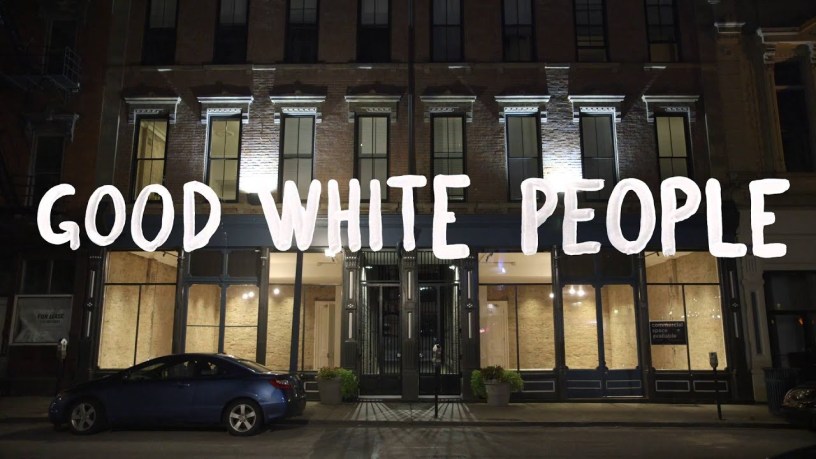
I’ve had some illuminating conversations with a broad spectrum of people — people who, you’d think, would be more sensitive to issues of race, ethnicity, and sexual orientation. The more I’ve thought about those conversations, the more I feel compelled to share them on Ye Olde Blogge. There is something that we could all learn from them about standing up for our beliefs and
Wait! Maybe Black Americans REALLY Are Lazy!
In a casual conversation that turned political — when does that ever ended well? — a friend blithely offered, “I think the liberals went too far with the pronoun thing. I don’t give a shit about what pronouns get used.”
I avoid arguments both in person and in the comments. I’ve been on social media for too long to think that engaging in a back-and-forth can be any more successful than trying to convince a brick wall to be flexible. The only thing you get out of it is higher blood pressure, so I just nodded and mumbled something about how it matters to some people.
They charged right over my meek response, saying their alma mater celebrated the appointment of an indigenous scholar to lead the indigenous studies department, loudly doubting whether the direct lived experience of being an indigenous minority in a discriminatory majority culture contribute anything meaningful to the study of their own people.
Again, I demurred by saying that we all have our unique perspectives based on our experiences. By now, I was desperately searching for an exit when they continued, “Tom Hanks said he could not make Philadelphia today because he’s not actually gay… It’s called acting!” I smiled and commented on what a dramatic performance Hanks had turned in, surprising everyone at the time.
I knew I had stepped in it, when they pivoted to Nigerian immigrants of all things — how, dear god, how did we get to Nigerian immigrants without even the blessings of Nigerian prince email scam joke? — claiming, “There are studies showing they succeed and don’t experience discrimination.”
I swallowed hard, afraid of where this was heading. “Surely, you’re not suggesting that maybe there’s something to the idea that Black Americans really are lazy after all?” I left it at that, hoping to avoid a full-on train wreck and dreading the next time we met.
Hungarian Romani?
At a small social gathering, the conversation took a bizarre turn when one guest said, “My sister-in-law is Hungarian, and she says that ‘gypsies’ really are lazy and prefer government handouts” in a clearly disgusted tone.
Surprised that anyone would bring up the Romani experience, I bit my tongue, hoping others wouldn’t join in. I was hesitant to respond to directly least it “ruin” the evening get together. However, our host chimed in, “It’s the same with First Nations in Canada. They don’t want to work.”
I knew I had to think on my feet to be both diplomatic and firm. “You’re surprised that a people, like the Romani or Native Americans, might be reluctant to engage with a dominant culture that has discriminated against and abused them for centuries?”
They’ll Just Drink and Drug the Money Away
Then, there was the discussion about how to help people. Out with friends, someone related the anecdote about their housekeeper’s younger brother who found an iPhone in the trash — I’m not vouching for the veracity of the story here — and sold it for $600.00. We all agreed that to the average Cambodian person that was a small fortune, but to us, it was a windfall but not life-changing.
The story took a surprising turn. The brother used the money to buy a used tuk-tuk and started driving for an Uber-like rideshare app. Naturally, someone remarked on how miraculous it was that the money wasn’t squandered on drinking and drugs — because, you know, poor people, amirite?
I suggested that most people actually want to work and earn an honest living. And here’s a #ScienceFact: the best way to lift people out of poverty is to give them money. The reaction? Skepticism. “Poor people can’t be trusted with cash,” they said practically in unison.
In that moment, it struck me: if my middle-class friends were given a direct cash monthly payment of $200, they’d likely use it to buy “luxury” items, party, eat out, catch movies, or whatever because they already are taking fabulous vacations to exotic places and paying off mortgages and saving for retirement. They already have a much more than needed income.
They also know that instances of drug and alcohol abuse in marginalized communities is higher than in the dominate culture, so obvs, they are all lazy alcoholic drug-users who can’t be trusted to spend money wisely.
This time, though, I was much more confident. I pointed out that on all five populated contents — including the US — that direct cash transfers had been used to alleviate poverty and few people squandered the money. As a social scientist, I trusted the data. I’ve looked at the studies. The evidence is overwhelming. Direct cash transfers have been used for decades and across demographic groups with huge success, yet objections from my middle-class friends continued to fly. “What about giving money to alcoholics? Will they spend it wisely?” Not necessarily, but how many people are actually alcoholics or abusing drugs? Not as many as you think.s you think.
There is an absurdity to the white privilege that conceives of success as being as simple as getting a job at McDonald’s and working your way up. After that you’ll be integrated into the dominate white culture and be able to enjoy the successes that are available to white people. I hope my friends have spent some quality time thinking about what it might be like to be a member of a racial, cultural, ethnic, or linguistic oppressed minority, and that the topics come up again so that we have more opportunities to point out the difficulties that many people face in our communities.
To me all of these conversations demonstrate the difficulty of breaking through to middle-class white people about what it is really like being a minority that we’ve oppressed for generations — not that I could ever truly understand what it would be like. What I’d really like to know is whether you’ve had conversations like these with people in your life, how it went, and what you think of how we can change our white culture to being more inclusive.
Image Attribution
This image was found on By Their Strange Fruit using a DuckDuck Go Creative Commons License search

 The Psy of Life
That’s one of those discussions that ought to have a greeting over the doorway: Abandon hope, ye who enter.
Though I’d never be able to let a comment like that go, either. A comment I got one time is that universal health care coverage is wrong, because some people make poor choices that impact their health, and why should everyone else pay for that? Of course, I said that with universal coverage, it’d still be cheaper, and without it, those of us able are still paying, through increased costs for our own care. The subject got changed quickly, though not by me.
Another time, when I was volunteering at the food bank, we’d been out to eat with a group and were leaving. As we put on our coats, one of the group who was still sitting having another beer said they hated the food bank because they see people who don’t deserve food leaving the food bank with a bag. DH had hold of my elbow, and directed us out!😄🤬
Seems as if it’s always at least the same number of steps back whenever there is a step or two forward.
LikeLiked by 1 person
Howdy Ali!
I’m reminded that a good definition of a conservative is someone who is certain that there is a person somewhere doing something that they shouldn’t be doing. The notion that poor health and illness doesn’t have a societal cost beyond the personal is one of the biggest lies ever peddled by the rugged individualists.
I’m also reminded of all of the conservatives who went without health insurance rather than participate in the ACA who had to resort to GoFundMe-type appeals when illness and injury struck their personal lives. I guess they found out how important insurance and healthcare was not only to your personal wellbeing but to that of the community you live in.
I remember early in my social work career handing out the Reagan-era surplus cheese and butter at a community center. People who came to pick it up either dressed up because they viewed it as a social event, and it was. Friends, neighbors, and acquaintances got to meet and catch up with one another. Or they dressed down to appear as poor as possible — this is my assumption — to justify receiving the “handout.”
The speed with which the racists crawled out from under the refrigerator and danced in the kitchen light at midnight after the Clown made being openly racist safe again makes me wonder how many steps forward we actually took.
Blog On, Sibling!
Jack
LikeLiked by 1 person
In any social system, those raised and living within generations of privilege and little direct contact with marginalized folk , take their own experience as “normal” and “natural”, and easily fall victim to beliefs like Genetic Essentialism (those groups who are “unsuccessful” are genetically inferior) and the morally just universe (success and poverty are determined by virtue or lack of it). These cognitive shortcuts simplify the world and reinforce the feeling that successful and comfortable have earned what they have, or naturally deserve it.
One thing that I notice in such conversations is the tendency others to jump in with examples once one person gets away with a prejudiced statement sufficiently mild and framed as “everybody knows”. Peer pressure works that way.
The actual functioning of the social systems, economically, politically, and historically is complicated, far more complex than the vast majority want to even try to think about. Systems thinking is hard work. Behavioral economics done well is very hard work and disillusioning of the easy answers. When weird people like us try to insert such thinking into conversations, people get uncomfortable.
It’s kind of like being a folk singer:
“It’s a folk singer’s job to comfort the disturbed people and to disturb comfortable people.” – Woody Guthrie
LikeLiked by 2 people
Howdy Bob!
I think old Woody was on to something there. I know that arguing and presenting tit-for-tat point-counterpoint arguments doesn’t work. Once people are angry and fighting, you’re not going to get anything but an angry fight. I’m glad to have avoided that outcome. I can only hope that by asking questions about the subtext of what they’re saying helped them to think a little bit more about it.
When someone makes a racist joke or other inappropriate comment, it is important to interrupt any agreement. Racists overhearing the comments whether directly involved or not will feel empowered in their beliefs and are more likely to act upon them. By offering some mild counterpoint or disapproval, you can interrupt that process.
We all think that our lives are average. That is a surprising psychological finding. Even people living lives of the far fringes of the bell curve think their lives are average. It leads to Poppy Bush expressing surprise at a price scanner at a grocery store, for example. And Romney to suggest that if you’re having trouble paying for university, you just get a loan from your father. It really is another reason to speak up when the opportunity presents itself. You’ve got to interrupt that kind of thinking and presumption.
Blog On, Sibling!
Jack
LikeLiked by 1 person
I’m thinking that it is that, “My life experience is normal, natural, average”, presumption which makes the reports of the marginalized and oppressed so unwelcome that silencing or disqualifying them can become policy. The negative stereotypes of those groups serve that purpose and defend against cognitive dissonance.
LikeLiked by 1 person
Howdy Bob!
I think that really is it. Relying on the stereotypes to justify attitudes and social outcomes cushions our consciousnesses. We also have the deeply engrained cultural beliefs that god shows their love through worldly wealth, god has a plan for all of us, and the racial hierarchy of white supremacy. The colonialists reliance on slavery, first the indigenous populations and then Africans, to operate their plantations in the Caribbean and the Southern States, developed a deep-seated racial animosity in order to justify the brutality of the system, to harden the morality and consciousnesses of those implementing it. That is steeped deep within our national psyche. So much so that it seems normal to just about everyone including the marginalized groups who suffer from the oppression.
Huzzah!
Jack
LikeLiked by 1 person
I can’t put my hands on the actual quote at the moment, but the gist was that it is easiest, even emotionally necessary to hate those we have abused and oppressed.
In the song, “The Yew Tree” by The Battle Field Band, there is this verse:
“Did you no’ think tae tell when John Knox himsel’
Preached under your branches sae black
To the poor common folk who would lift up the yoke
O’ the bishops and priests frae their backs
But you knew the bargain he sold them
And freedom was only one part
For the price o’ their souls was a gospel sae cold
It would freeze up the joy in their hearts”
LikeLiked by 1 person
Howdy Bob!
When I was researching the motivations of mass shooters and murderers, the assumption was that murder didn’t usually occur without some real anger involved. Some mass shooters and murderers have better executive functioning than others, and that was usually the dividing line between getting caught and not caught or having a large number of deaths in a mass shooting. That anger is necessary in order to inflict such terrible harm on others. It strikes me that it isn’t so far from needing hatred to inflict such harm.
I can’t get away from the definition of a conservative being someone who is certain that somewhere there is a person doing something they shouldn’t be doing. It is that intrusive controlling nature that seems to me to define conservatism. There is a certainty that they know best and everyone should be following it. There is a bitterness that is at the root of such beliefs and behaviors. There is a lack of trust that others won’t do as they think they should. Ironically, they are both right and wrong. While we might not do exactly as they say we should, we generally will act in the best interest of society at large, follow the law, and act in ways consistent with our society’s morals.
I think that hatred, anger, and bitterness is further exposed by the consistency of the belief that if given a chance, Black Americans will seek violent revenge against innocent white people for what our forebears did during slavery and Jim Crow and the harms of systemic racism. It is, of course, what they would do. They cannot conceive of the grace that most Black Americans grant us whites.
Huzzah!
Jack
LikeLiked by 1 person
In many ways, the argument between Liberals and Conservatives is twofold. On one level, it is the argument between Hobbs (the philosopher, not the toy tiger) and Locke, and theologically, between the Calvinists (humans are wicked sinners except for “The Elect”) and the more hopeful versions, between an angry God and a loving one.
As for White Americans not being able to conceive of that grace,
“Good can imagine Evil; but Evil cannot imagine Good.”
― W. H. Auden
LikeLiked by 1 person
Howdy Bob!
Thank you for the Auden quote. I didn’t know that one, but it goes a long way to explaining the fear that the majority of white Americans have about living as a racial minority. They cannot conceive that the majority won’t treat them in the same way they treated People of Color when white people were in the majority.
I’d much prefer Hobbes, the stuffed tiger, because he was always the superego to Calvin’s Id, but a gentle kind superego instead of the harsh screeching beating “Mommy Dearest” superego that our current crop of “conservatives” seem to prefer.
The angry and loving god also parallels the Old and New Testaments.
Huzzah!
Jack
LikeLiked by 1 person
Another favorite quote on the subject:
“Cruel men believe in a cruel god and use their belief to excuse their cruelty. Only kindly men believe in a kindly god, and they would be kindly in any case.” — Bertrand Russell
The other element involved is the Calvinist notion of a just universe (God), which says that you deserve whatever you get, whatever that may be, wealth, poverty, slavery, health, illness, everything. I guess they prefer to skim over the story of Job, who did nothing to deserve his afflictions and in which, confronted with the “Why me?” question, the voice in the whirlwind gives a lecture and never cops to the fact that it all happened on a bet with Lucifer. It’s interesting, I’ve read that the scholarly consensus is that Job is the oldest book of the Old Testament, possibly in the oral tradition before the Babylonian captivity, or picked up there from even older tradition. In essence it denies the Just Universe idea and posits a deity both capricious and incomprehensible, like several other episodes in the collection.
LikeLiked by 1 person
Howdy Bob!
While I’m not big on Biblical anything, I’ve always been amused by the inconsistency with which Christians portray their god. It’s almost like the Christian god has dissociative personality disorder. At any rate, anything a Christian does can be justified by one portrayal of their god or another, including slavery. Add to that the Calvinist notion that god has a “plan” for all of us and that our lives are neatly laid out in a big book somewhere up in heaven, well then, anything and everything you do is justified. The ultimate rationalization machine.
The funny thing is that cruelty is not really baked into us as a species, yet it can become baked in by culture. White America has a cruel culture. It is as simple as that. Because white culture assumes people are essentially cruel and evil, they can’t conceive of a culture of kindness, grace, forgiveness, and acceptance. Perhaps the biggest tragedy of America right there.
Huzzah!
Jack
LikeLiked by 1 person
There was an article, maybe last week sometime, I think on Salon titled “The Pilgrims Made us Do It”, that talked about those themes of “God’s Plan”, “you deserve what you get”, and “the Elect”, with all their contradictions that really are baked into our language and unconscious presuppositions and biases. I know I saved the link. have to find it.
LikeLiked by 1 person
That’s the problem with out digital age, finding things, especially photographs. Christ, organizing digital photographs seems like a Sisyphean task. Same with bookmarked websites and web browser histories. It’s all just information overload. Hope you find it, though, because I’d enjoy reading it.
Jack
LikeLiked by 1 person
It is sometimes overwhelming for us digital pack rats and hoarders.
LikeLiked by 1 person
I found it. https://www.salon.com/2025/05/26/how-america-got-so-weird-the-pilgrims-made-us-do-it/?utm_source=flipboard&utm_content=Salon%2Fmagazine%2FBooks
LikeLiked by 1 person
This is a difficult subject….I live in Mississippi and worked for a housing authority so I dealt with people of color everyday and found them open honest hard working and friendly but trying to convince my fellow citizens that it is so is difficult because they have the stereotypes burnt into their brains by their peers and parents and very little will change their minds.
We cannbo9t change this situation today at least do9wn here…..Little Donny is making sure there is no way to have this honest conversation. Good post my friend chuq
LikeLiked by 1 person
Howdy Chuq!
I’ve spent some time in Mississippi and my father’s family is from Tennessee. I know of which you speak. The funny thing is is that it is the institutions that perpetuate the racist attitudes as much as any family does. The people who work at institutions, private and public, contribute to the culture that develops there. People who join, acculturate and adapt their worldviews to that of the institution often making them more racist than they realize. The idea that culture is geographic blows my mind and lets you know just how difficult it is to undo the racist mess that we created in the US.
The speed with which the racists all ran out from under the fridge when the Clown made open naked racism acceptable again shows you how little real progress we made. People just figured out not to express their views too openly or only to certain people.
The hardest thing I encounter is the desire not to sour social gatherings or to upset people by directly or forcefully challenging their positions. It’s crazy how the rules of politeness can keep us from engaging in deeper conversation that might could actually change someone’s point of view.
Blog On, Sibling!
Jack
LikeLike
Jack those feelings have always been with Mississippians most did not even try to hide them….I have been an outsider since I hold very few of views they like. Have a great Sunday my dear friend chuq
LikeLiked by 1 person