
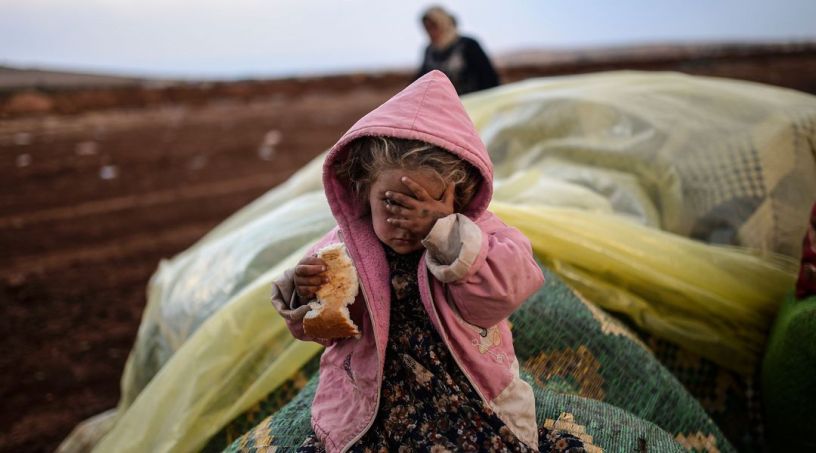

Wow! That picture just kills me. The look of utter defeat and despair in that little girl’s pose just breaks my heart. I just ache seeing her. Please relate your reactions to her in the comments. I’d love to hear them.
The phenomenon described in this article and studied by Paul Slovic is well known to me and to many of us. It is the reason that charities often use a picture of one child or one person or the story of one person to solicit donations. We are moved by one person. As soon as we have two, we begin the disproportionate rise in apathy; by the time we get to millions — 22 million to lose healthcare — we have very little empathy left. It just doesn’t move us in the same way.
Slovic extended the work of Kahneman and Tversky’s prospect theory from valuing things to valuing human lives. It meets all the requirements of Ye Olde Blogge, too: it is scientific and factual — lots of research has gone into verifying the phenomenon of psychic numbing — it is diagnostic — it helps us understand what is happening in certain situations and people’s reactions — and it is prescriptive — it helps us understand what to do to affect a situation. As mentioned above, we often talked about kicking 22 million people off of healthcare. While that number is significant and people responded — and boy did people respond — if we want to rope in the middle of the roaders and non-responders, then we should be focusing on one person’s story.The singularity effect.
When people stand up at constituent meetings and tell their personal story of healthcare woe and others boo and shout abuse at them, we’re not likely to reach those callous partisans, but there are the fence sitters who think that the whole thing is too confusing and overwhelming and it doesn’t affect them personally and both sides do it and elections don’t matter and politicians are the all the same and there’s no difference between the parties and maybe it is better to let their representative decide. That person can be moved to vote by this phenomenon and that person’s story of healthcare hardship and despair.
A psychologist explains the limits of human compassion
Why do we ignore mass atrocities? It has to do with something called “psychic numbing.”
There are now 65.3 million people displaced from their homes worldwide, the United Nations reports. It’s an all-time high: likely the largest population of refugees and asylum seekers in human history.
Think about that number: 65.3 million. Can you even imagine it? Like, really imagine it. When we see one life, we can imagine their hopes and pain. But 65 million? You can’t. That’s just an abstraction. There’s a hard limit to human compassion, and it’s one of the most powerful psychological forces shaping human events.
I often report on political psychology. And in my conversations with scientists, I’ll often ask: “What research helps you understand what’s going on in the world?” The answer — whether it’s pegged to the refugee crisis abroad or the health care debate at home — very often involves Paul Slovic.
Continue reading at Vox: A psychologist explains the limits of human compassion – Vox

 The Psy of Life
I enjoyed the blog. To your point in last comment about NK and nukes – that is terrifying. I feel like everyday brings some news that is hard to wrap ones brain around – like the president encouraging the police to rough up perps or alienating our allies. If this is too overwhelming for any of us to process then I see why Vox tried to make it grab attention in a way that is easier to get peoples attention. I know so many intelligent deep people but they all seem stunned into silence and non-action in the face of chaotic leadership.
LikeLiked by 1 person
Howdy Feisty!
What a great point. No one quite knows how to react to the Ol’ Pussy Grabber, especially those of us who have been well versed in manners and the social niceties. In fact, there is an entire area of psychology devoted to the study of how new situations affect behavior and mental processes, social psychology. One theory is schema theory meaning that we develop rules that govern our behavior that match the situation we find ourselves in. When the situation is ambiguous or so different we feel completely unprepared for it, we look to the behavior of others for guidance. If they are silent, we are much more likely to be silent. That is the bystander effect. One more reason that it is important to speak out.
Huzzah!
Jack
LikeLike
yes.. as the mother of 5 daughters …. it really hits home! the effect is also increased ,the younger the child . We relate quickly to those that can’t fend for themselves…the very young and sometimes, the elderly. However … it quickly can devolve into overwhelmed and cause the reaction of ” I just can’t handle it ” This picture is the essence of how to hit the target.
Fran
LikeLiked by 1 person
Howdy Francese!
Over the years we’ve seen a number of these from the little Vietnamese girl running naked from the napalm to the dust and blood-covered boy being set into an ambulance in Aleppo, they all have that same heart-rending effect. Animals often have the same effect.
I wonder if Slovic or any of his students have done studies on the age or innocent nature of the victim. Perhaps, I’ll look that up.
After reading the day’s news about NK and nukes, I’m feeling drained though. I’ll leave that to another day… if we survive.
Huzzah!
Jack
LikeLike
Little girls ought to be concerned about which doll to play with, not how and where will I eat or sleep?
LikeLiked by 1 person
Howdy Larry!
Children should be children. We should be protecting them from the harsher realities so that they can develop to the fullest extent possible. That photo just pulls that realization out of you, doesn’t it?
Huzzah!
Jack
LikeLiked by 1 person
The picture made me sob. The combination of pain, fear, resignation on that baby’s face just did me in this morning. My secondary reaction was “what can I do to help her? I have to do something”. Thanks Jack
LikeLiked by 1 person
Howdy Suze!
I KNOW, right? And, that is the finding of Slovic’s research, too. It is a very human reaction to want to help HER, i.e. a single person (or animal) in trouble. In the interview on Vox, he says that they tracked people’s reactions to the picture of the Syrian boy who drowned, and the effect lasted for about a month. There were other caveats to it, though.
Huzzah!
Jack
LikeLike