

When it rains, it pours, amirite? If the tension between the hopefulness and despair of the George Floyd murder trial weren’t enough to keep you awake at night, the demonic gods that be blessed us with the murder of Daunte Wright by mistaken tasering — OOPS! Those things gonna happen! What ya gonna do? Oh, well — and, now, we get police footage of a police officer shooting the unarmed surrendering 13 year-old Adam Toledo to death in a dark alleyway, ya know, just in case you could relax and feel like our worries about police brutality might could be over or something.
Why do these police shootings seem to happen in fits and starts. Suddenly, we seem to be inundated with mass shootings and police murder, again. Thanks Biden!
While each of these murders is different, they are depressingly the same: police over-react to the presence of a Black person in their midst and kill them. No matter the circumstances or causes, though, people always wonder how it could happen. How could Chauvin kneel on Floyd’s neck for nine and a half minutes including a full four minutes after the poor bastard died unless he intended to kill him? How could Kim Potter mistake her pistol for a taser and end up shooting a man fleeing a misdemeanor warrant? How could an officer shoot an unarmed surrendering 13 year old?

The Adam Toledo Shooting
Here’s the set-up of the Adam Toledo shooting:
The Chicago PD are summoned to a specific place by reports of shots fired. They are called in to 911 and picked up by their ShotSpotter audio sensor network. Police show up and two people flee down a dark alley — it is like 2:00 AM after all. Police pursue on foot. The officer is yelling for Young Adam to drop his weapon and show him his hands. Adam runs to a fence and drops something over it, and then turns while raising his hands just as the officer asked. The officer shoots him in the chest.
The question is, should the officer have known that the boy was unarmed at that point?
Lucky for us, there are answers to these questions that point us in the direction of how we can best reform policing in America to — hopefully — prevent so many of these murders in the future. We’ll address two primary issues here: (1) the shoot-don’t shoot dilemma that police so often find themselves in and (2) the way that our brain plans and executes movement probably sealed this kid’s fate long before the shooting occurred.
To Shoot or Not to Shoot
The decision of whether to shoot a suspect or not has to be made in split second with little information at least little information that we are consciously aware of. One of the primary pieces of information is whether or not the suspect is armed and many tragic shootings have happened because the police officer has wrongly believed that the suspect was armed and many travesties of justice have occurred because police officers have lied about whether someone was armed in order to avoid accountability.

Unfortunately, it isn’t just the belief of whether the suspect is armed that enters into it. It is also the race or ethnicity of the suspect that influences the decision. We know this because of the Project Implicit Weapons IAT (You’ll have four choices on the initial page: register to take a social attitudes test, continue as a guest to take a test, take the health test, or complete the featured task. I recommend continuing as a guest. The next screen gives you a long list of implicit association tests to choose from, scan for the weapons test).
The idea behind this test is that you’ll see pictures of white and Black people in various settings in a variety of positions. Some of them will be holding a weapon and some of them will be holding something else. You decide whether you shoot them or not. You have one second per picture. Most people regardless of race end up shooting more unarmed Black people. Go figure.
This isn’t the first time we’ve referred readers to this test. Here are some of our conclusions and insights after taking it. See if you agree:

Let us know how you did in the comments!
- Cell phone and wallet manufacturers might could take a lesson from this game and make their products more easily and readily distinguishable from guns. I tell you, when the object is black, it is easy to confuse it with a gun.
- The people standing at the sides with an object in their outside hand were the hardest to figure out. It must be a peripheral vision thing.
- If the object is obscured by blending into something into the background, you’re likely to shoot, too. Anything that interferes with your ability to see the outline of the gun clearly, is likely to cause you to shoot an unarmed person: appearing on the periphery of the screen, holding the object even further towards the periphery (left, right, up, or down), blending with the background, two hands extended, two objects held.
- If it is this bloody hard to decide who to gun down in cold or hot blood when you are sitting in the comfort of wherever you are and not even being required to aim, then how much harder is it for an officer who is running down a dark alley at 2:00 AM after someone who may or may not have been involved in shooting several shots in the area?
Not only is it difficult to determine whether the person you are facing down is armed or not, we all have an uncomfortable propensity for shooting Black people! Even the police when they take the test! Even the Black police!
Planning Movement or Priming
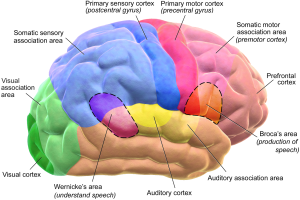
Our big beautiful complex brains have several curious habits borne of necessity. With over 80 billion neurons and 100 trillion connections between those neurons to coordinate, our brains are incredibly complex. Because our brain consumes 20% of the total energy used by our body, it is extremely costly to operate. We’ve had to come up with ways to conserve energy and coordinate all those firing neurons. Here’s how it pertains to movement and police shootings since you have to move to shoot someone.
Fine motor movement is controlled by our motor cortex shown in the illustration as being in dark pink. Anytime you’re moving this is one of the areas of the brain that is working. Moving is complex, so there’s lots of areas working together to make it happen, but this area is the one that controls the movement of all of the parts of the body that can be voluntarily moved. The lighter pink area in front of it is labeled the somatic motor association area or premotor cortex. This area is involved in PLANNING movement.
Since we carry out complex sequences of movements, we could not wait for each one to be laboriously plotted out and executed by the primary motor cortex, we need to line up the next sequence BEFORE the previous sequence has been completed. There is evidence that this occurs BEFORE our conscious mind realizes we’re going to be making that particular sequence of movements.
It doesn’t mean we will. Our conscious minds can intervene and direct our movements if need be, but before the cop actually pulled the trigger, the behavior had to be cued up in the premotor cortex. As discussed in the analysis of Duante Wright’s murder, cops are primed for violence, especially when they roll up on Black men. In this case, though, the cops were primed for violence by rolling up on a scene where multiple shots had been fired.
Their suspects were very possibly armed and dangerous. This cop was primed to shoot.
Solutions
Assuming that the goal is to actually prevent the police murder of unarmed innocent PoC, then one of the solutions the murder of Adam Toledo points us towards is getting guns off of the street. We’ve got too many damned guns in our lives. The police have to assume everyone is armed. You’d be an idiot not to.
That we won’t reduce the number of guns in our society suggests that we’re still following the racist principle of hurting PoC first and worst with any given policy.
Another solution is to break down the implicit bias that police in particular have against Black people and PoC. Police cannot go into encounters with PoC assuming that they are all violent unpredictable criminals.
Image Attribution
Motor cortex illustration
“File:Blausen 0102 Brain Motor&Sensory (flipped).png” by BruceBlaus. When using this image in external sources it can be cited as: Blausen.com staff (2014). ‘Medical gallery of Blausen Medical 2014’. WikiJournal of Medicine 1 (2). DOI:10.15347/wjm/2014.010. ISSN 2002-4436. is licensed under CC BY 3.0
Featured image
“Fire Arms.” by Ant1_G is licensed under CC BY-ND 2.0

 The Psy of Life
Oh, how wonderful. That’s definitely on my list of countries to visit👌
Enjoy your day ☀️
LikeLiked by 1 person
Gosh, that’s a very in-depth analysis. None of it helps me forgive those officers crimes however. I’m hoping Chauvin is sent down. I anticipate carnage in the streets if he doesn’t. ☹️
LikeLiked by 1 person
Howdy Sunra!
It doesn’t me either, but it does point us towards how we need to reform policing in America. The problem of implicit bias drives systemic racism. And, it can only be resolved by white people.
The prosecution in the Chauvin trial has proven to the public that he is guilty. By being able to watch every minute, as many of us did, allows us to draw our own conclusions. If the jury comes to a different conclusion, no one will be able to understand the reason why. It will make the protests riotous, I’m afraid. And, with the other side emboldened to “protect” business and what not, it could lead to real bloodshed.
Huzzah!
Jack
LikeLiked by 1 person
Yes, I absolutely agree 100%. Sorry you have to suffer the protests, hopefully they’re not on your doorstep. It has been upsetting and compelling watching, I’ve also been following it closely. Thanks for your concise post updates👌☀️
LikeLiked by 1 person
Howdy Sunra!
Like you (I read your about me page) I am an international teacher. We’ve taught in international schools over the past thirteen years or so but started out as ESL teachers in South Korea 25 years ago. It’s been quite an adventure, but it means that the protests are far far from my door step.
Huzzah!
Jack
LikeLiked by 1 person
Hey Jack!
We all got the result we wanted – thank the heavens! It’s still only scraping the surface of the change that needs to happen but it’s good news nonetheless.
I haven’t taught as far afield as South Korea (though a dear friend of mine is teaching there), I’ve been based mainly around various countries in Europe the past few years. I take it you’re back in the States now?
Sunra 🙂
LikeLiked by 1 person
Howdy Sunra!
No, we’re in Cambodia. I haven’t lived in the US since 1996 and probably won’t ever live there again.
Huzzah!
Jack
LikeLiked by 1 person
i took the test…of course I did. I ended up not shooting when I should have actually…guess I am a pacifist at heart. Also took one on bias against “foreigners” and came out biased (in a good way) towards everyone except whites. Now, I find I am biased against white men. terrific! Going backwards now is not exactly what I was hoping for……
LikeLiked by 1 person
Howdy Suze!
It is those responses that give us hope for the future. When I took the racial bias one years ago, I turned out similarly with a slight bias against white men and for black men. With the shoot-don’t-shoot test, I had a slight propensity towards shooting Black men, though. The importance of getting as many people to take these tests as possible is to understand how we work. When I’ve had my students do the tests, they are often sobered by their results because it reveals their implicit bias. The problem is that the test is so weird it doesn’t feel like it has any validity outside of the lab. One of the issues is switching hands. While it controls for handedness, it introduces an order effect. I always found I made more “errors” when I switched hands meaning now was identifying black with the left when it had been the right. I guess it all balances out, but it seems to lack external validity. It doesn’t though. It just seems like it does.
Huzzah!
Jack
LikeLiked by 1 person
Reblogged this on cabbagesandkings524 and commented:
Calico Jack – To shoot or not?
LikeLiked by 1 person
Add to all this the fact that young Black and Latino men and boys in some neighborhoods are socialized to believe that they need a gun to defend themselves or as a sign of manhood and group membership, and there is an entire industry of selling them straw-purchased and stolen guns (Gee, interesting connection there, right?).
It is also important to note that the communities and families of these victims do not understand the neuro-muscular processes involved in the shoot-not shoot process, and presume malicious intent in their reactions and statements, as also do many media talking heads. The cops, generally, do not understand it either. The fact is that if officers go into certain classes of interaction with gun in hand, sooner or later (likely sooner) somebody is going to get shot.
Another wrinkle is the foot chase situation. The cop is chasing a often much younger person, presumably is reasonably good physical condition. The cop is burdened with a significant weight and bulk of equipment. In that running, blood flow is directed to the large muscles, not the brain. The cop comes to the critical encounter sweaty, panting, and in fight or flight mode. The odds that they will have the clarity and concentration to apply to a shooting decision are very low. The same goes in the situation in which there is any physical struggle with the suspect.
LikeLiked by 2 people
Howdy Bob!
I’m reminded of two tangentially related ideas:
(1) I think it was Jean-Luc Godard who said that once a gun is seen in a movie, it has to be fired. I guess, statistically, you are far more likely to fire your gun once it has been drawn than if it is still holstered.And, certainly, drawing a gun is an indication that a police officer is considers himself in danger.
(2) Hobbes’ belief that the life of man was solitary, poor, nasty, brutish, and short and necessitated defending your honor at all costs.That is the world of many of those Black and Brown boys living in poverty. You can’t be dissed. And, there is no mystery about the school to prison pipeline and the role that straw purchases and lax gun laws plays in it. In many ways, the police are in the same world and can ill afford to have a Black person dis them by getting away.
(3) One of my favorite experiments to have my psych students do is the one in which you have participants rate the attractiveness of pictures of people. You compare the ratings given by the set who was at rest when they saw the pictures and the set who saw them after running fifty meters or yards. The general sweatiness and faster heart rate convinces the person that it must be because the person in the picture is so attractive and they rate them higher. Similarly, the elevated heart rate, respiration rate, and sweatiness convinces the police officer that the situation is much more dire than it is.
It is amazing how extreme stress can cloud the mind and literally give you tunnel vision unless you take proactive steps to fight it. Any time the police are chasing or fighting, they are under extreme stress and will have trouble seeing their situation clearly. It is very telling that the preponderance of people shot by the police every year are Black and Brown.
Huzzah!
Jack
LikeLiked by 1 person
When a person’s or organization’s job is defined primarily as maintaining control, especially of a defined population or area, letting a minor offender get away to be picked up later is a failure, and a bad example to others of the subject group. Honor culture only makes the imperative stronger and the stakes higher.
LikeLiked by 1 person
Howdy Bob!
I had heard earlier today on one of the talking pundit shows that police training mainly focuses on compliance. They want immediate and total compliance with commands even if they are unnecessary and contradictory. Their main goal is to establish and enforce compliance no matter what else is going on.
The other thing the commenter said was that by introducing a badge and a gun to almost any situation automatically escalates the situation.
When your honor depends completely on Black people acting deferential to you, then almost any normal human reaction on the Black persons part is an insult to your honor and begs for retaliation. It really is a no win situation.
Huzzah!
Jack
LikeLiked by 1 person
And, given that emphasis on compliance, the profession attracts people who have a need to be complied with. And, in many of the incidents that go badly the “suspect” is in Fight-Or-Flight state and the first phase of that response is to freeze (deer in the headlights) which makes processing and obeying commands slower and more difficult.
LikeLiked by 1 person
Howdy Bob!
That’s a bad combination. The suspect is in the freeze phase of flight and the cop is in the fight phase of fight. Like I said earlier, that “ramped up” attitude that many cops enter situations that they anticipate will be dangerous like that displayed the other day when the army lieutenant was pulled over for not having a license plate, delivers a dopamine high that keeps cops coming back to it. Bullying people, watching them squirm, actually hurting them all activates the reward system for the more sadistic among us. I wonder how most cops would score one the dark triad questionnaire.
Huzzah!
Jack
LikeLiked by 1 person
I suspect that if passing the Dark Triad Test were a requirement for becoming a cop or staying one, many would not qualify. Chauvin definitely would have failed it.
LikeLiked by 1 person
Howdy Bob!
I’m pretty sure Chauvin is a sadistic psychopath. Others probably have psychopathic and sadistic elements to them but not as extreme as Chauvin.
Huzzah!
Jack
LikeLiked by 1 person
Agreed
LikeLiked by 1 person