
I don’t think we can just automatically escape from our implicit biases. We actually have to do serious introspection about how we’re thinking and to slow our thinking down.
Harold Neighbors, PhD

All y’all should know that racism is near and dear to the heart of Ye Olde Blogge. It is a topic that we return to often and our chiefest statement is that white people have to reach down their individual and collective pants, grab their individual and collective balls, and confront their individual implicit bias and collective structural racism. Because it ain’t the Other who is doing all the racisms, y’all. They can’t. They don’t have the structural advantages to harm whitey, but whitey sure as shit has the structural levers to harm people of color.
This article address all these issues so directly and clearly and consistently, that I can’t do or say hardly anything other than read it. These are well-educated, experienced clinicians in psychiatry, medicine, public health, and as patients and clients. They’ve seen it from all sides, and, siblings, they have the inside dope.
As I read, I kept finding passages that I’d think, surely, I’ll want to quote that statement. but then I ended up just copying all of it and parceling it out as quotes. That’s no way to write an introduction and opinion piece for such an article. But, garsh darn it, y’all, I can’t find much to add.
I mean look at the lead quote. It is exactly what I’ve been saying. We have to slow down our thoughts and observe how they form as we react to the race of the people around us. Saying I don’t see color is just a way of hiding from your discomfort of talking about your own implicit bias, which we all have given that we grew up in a very racist country. It’s like being embarrassed to admit that you have to go to the bathroom or something. Oh, yeah, many of us are embarrassed about needing to go to the bathroom, so, maybe, that explains a lot, hunh?
Look at this next quote and try arguing with it. You can’t unless you’re a person of color, but you won’t if you are because you know it is true. White people will argue with it because we don’t want to own our implicit bias. We are desperate to say that it is those bad white people over there that are perpetuating the systemic racism and open white supremacy but not us because we don’t see color.
Speaking as a Black man who grew up in the United States, I feel it’s impossible for people not to see color. I just don’t think it can be done. Every time I walk into the room, it’s just obvious that everybody sees a Black man coming, which is something that needs to be addressed.
Harold Neighbors, PhD
This next quote just show why we cannot not see color. We’ve got too much baggage to claim that seeing the single most obvious physical trait of a person — their skin color; skin is the largest of all of our organs — doesn’t affect the way we treat that person. It can’t help but do so.
[W]e cannot treat everybody the same without coming to terms with the effects that implicit bias, structural racism, colonialism, sexism, homophobia, et cetera, have on clinical care. It’s these unconscious automatic mental associations between a social group, stereotypes, and a form of prejudice that is really very prevalent in most societies, if not every society. In the United States, there’s a very strong anti-Black implicit bias, particularly because of structural racism.
Roberto Lewis-Fernández, MD, MTS
The statistics of treatment outcomes betray the effects of implicit bias and systemic racism has on people of color. It is undeniable that people of color receive worse medical and mental health treatment in the U.S. than white people do.
[O]ne of the main reasons we can’t be color-blind is because of the obvious fact of difference. In this case, differences in how people look are highly correlated with inequalities at the structural level.
Harold Neighbors, PhD
I’ll close out with one more quote, and if that don’t convince you to sign up for Medscape so you can read the whole thing then you just didn’t read to this point, did you?
[W]hat I’ve discovered is that very often in the cross-race therapeutic relationship, when the therapist is white, there’s a level of discomfort that they have in even bringing up issues of race. This happens even though they’re looking at somebody who’s obviously a Black man. And in fact, I feel that so many of my emotional issues are tied directly to the experience of growing up in the United States, starting in the early 1950s, and being part of this grand experiment of racial integration.
Harold Neighbors, PhD

Neighbors entire discussion of his interaction with white psychotherapists shows just how uncomfortable white liberals are in talking directly about race with people of color. His advice is to move towards your discomfort, embrace it, and just be sincere and honest when dealing with race with people of color because you’re only fooling yourself. People of color has seen racism, bigotry, and bias in all of its ugly forms coming out of white people. You ain’t special. You’re going to say and do things that are racially insensitive. Own it and you’ll do it less often.
But, don’t take my word for it. Read the damn article and tell me what you think in the comments!
“I Don’t See My Patients’ Race”: The Myth of the Color-Blind Psychiatrist
Stephen M. Strakowski, MD; Roberto Lewis-Fernández, MD, MTS; Harold Neighbors, PhD on 11 October 2021
We’re glad to have you both back today, because the goal is to extend the previous conversation we had about structural racism in psychiatry. We received a lot of comments back from all of you, which we appreciate. It’s always important for us to see what our viewers are thinking.
One of the frequent comments we received expressed some disagreement about the concerns around structural racism. A lot of people shared that their solution is simply to treat everyone the same. I’ve had other friends and colleagues tell me that they’re color-blind — that they just ignore race and manage people accordingly. Taken at face value, that seems like a fair and reasonable approach. But it’s something we’re going to talk about today.
I’d like to open with a question to my friends: Is being color-blind the solution to providing fair and equitable mental healthcare?
Continue reading on Medscape: “I Don’t See My Patients’ Race”: The Myth of the Color-Blind Psychiatrist

If you enjoyed reading my introduction to and editorializing about this interesting conversation about race and mental health treatment, then consider doing one or more of the following because honestly, I’d rather have your acknowledgment for my effort than your money.
- Comment: I’d love to hear from you especially your views on race since race, especially anti-Black bias, is so very central the American experience.
- Like: The easiest and one of the most rewarding is to see a like for a post. Please use the like button at the bottom of the page.
- Rate: Almost as rewarding as liking is the star rating. Use the five stars at the top of the post, just after the title, to rate this post.
- Share: Shares on social media not only make us feel appreciated but they have the potential to bring more views… and more likes, etc.
- Follow: We have a large community of followers numbering in the hundreds, you’d be joining a fine group of human beings if you hovered your mouse in the lower right-hand corner until the follow menu came up.
- Join: Our email list is an exclusive list of a few self-selected readers who get a handcrafted email from me every time a post is posted just for adding their email in the blank below.
Image Attribution
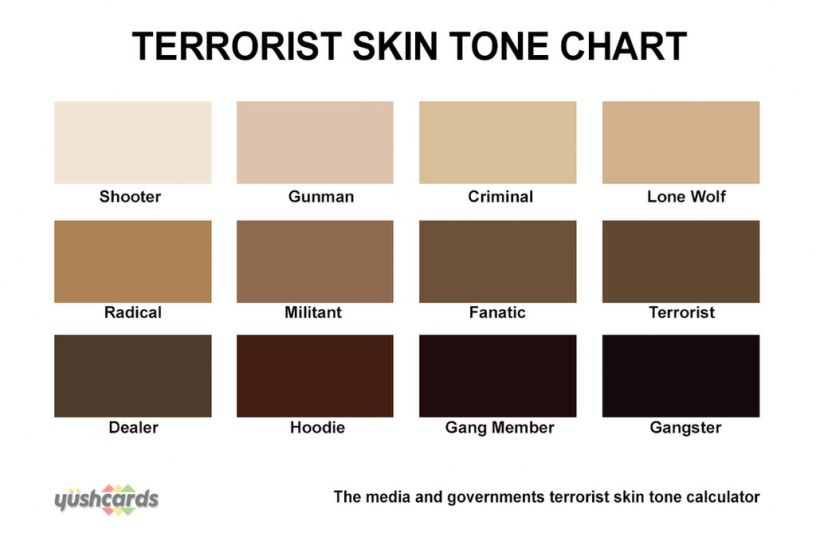
Terrorist Skin Tone Chart found on Deviant Art page of YushCards and was found using a Google Image search for works licensed with a Creative Commons License

 The Psy of Life
Heh, Militant.
‘Course, there’s little variation ’round the world in big, bushy beards …
LikeLiked by 1 person
Who are you calling a big bushy beard?
When I taught in Kenya, I had a number of Muslim students. At least once a year, I’d have a middle school boy gush, “When I grow, I want to have a beard like yours!” It always tickled me.
Huzzah!
Jack
LikeLike
Not quite so rotund, but I often get asked the Santi Claus question. Of course being Forest Man, a man of the wood, I say yes 😎
LikeLiked by 1 person
Howdy Ten!
I LOVED to play Santa back! Best gig ever. Back when we lived in China and I was 25 k heavier, I used to do three events every year. Last year with #COVDI19, there weren’t any real opportunities. I doubt there will be this year, either.
Huzzah!
Jack
LikeLike
Reblogged this on cabbagesandkings524 and commented:
Calico Jack directs our attention to an important article.
LikeLiked by 1 person
Clearly, a Must Read. Any and every claim of “Color Blindness” in any interaction, institution, or application of law just cannot be true, any more than would be a claim of “Gender Blindness” (part of the reason the existence of LGBTQ+ people is so upsetting to many).
LikeLiked by 1 person
Howdy Bob!
When you read it, I would really appreciate hearing from you. These are psychiatrists and public health experts discussing the impact of implicit bias on treatment. They were amazingly insightful and articulate. I guess I should say, if you read it since it is hidden behind a registration wall. I find Medscape, though, to be a useful source of information on the medical and mental health issues I’m interested in. Not everyone is interested in registering with websites, though.
They were especially insightful on the role of implicit bias and systemic racism on all facets of treatment issues. I wished they had talked longer and gone into more detail. The comments by the Black public health specialist, I thought, were very insightful about how avoidant white therapists could be of the entire race issue with Black clients. His suggestion for the therapist to move towards race seemed important and need to be expanded upon.
Huzzah!
Jack
LikeLiked by 1 person
I have to say that the training I got in therapy school on “cultural sensitivity” paid little heed to race. It dealt with immigrant populations and religious differences, but not Blackness. Where I worked in CA and AZ, the client population was (like the local population) very white, with some Hispanic, and in AZ we were next to a reservation, but that population got services through IHS and their own child and adult protective services. Generally, in both places, the Hispanic folks in our client population tended to be at the more assimilated end of the scale.
I didn’t have trouble scanning through the article for a quick look. We’ll see whether that stays true when I go back to read through it. They are right. White people, whatever sort of work we do, shy away from talking about race, especially with Black people, unless they are among the minority who are blatant, vocal racists. Deep introspection of implicit bias is hard, it is work. But in the helping and healing professions, there really is no other way to be able to take into account in role of the trauma of oppression in dealing with disadvantaged populations.
LikeLiked by 1 person
Howdy Bob!
I have to say that this comment is cursed. Twice I’ve tried to answer it and twice the response has been swallowed up into the nether regions of the Internet.
My training also was deficient in terms of any kind of ethnic or racial awareness or sensitivity other than some anecdotal “evidence” given by our one professor of color and the admonition that racism was bad and we shouldn’t do it only it wasn’t said in so many words. It wasn’t until I was actually working with clients that I started coming up against my own issues of race and ethnicity. It was one of the biggest gifts that working AIDS gave me. The gay community was very much promoting racial awareness and consciousness raising around the issue. Much more so than the hippy-dippy artsy-fartsy kids I’d spent my university days with.
I have to say that the old style training of psychoanalysts where everyone had to be thoroughly psychoanalyzed so they could understand and know where there issues were as a hedge against transference and counter-transference was actually useful. We would all benefit from therapists being required to be in extended therapy as part of their licensure and renewal procedure.
I’ll close by noting just how much the clients I’ve worked with over the years have taught me about race and inequality in our society. AIDS cutting across the socioeconomic strata and through our ethnic and racial divides made it necessary that we be able to deal with everyone and visiting clients in the projects and barrios and “bad” neighborhoods taught me a lot.
Huzzah!
Jack
LikeLiked by 1 person
Yes. I learned a lot about the clients, myself, and the system working in public aid (AFDC) in the early ’70s.
LikeLiked by 1 person
I can imagine just what a world AFDC took you into. The three rules of social work: (1) don’t let your client get between you and the door; (2) don’t let your client get behind you; and (3) look out for dogs. Those were good rules.
Jack
LikeLiked by 1 person
Actually, in the neighborhood where i worked, I was quickly known (that long haired and bearded hippie guy) and never had a problem. It was the “Mama got to get her check.” rule. One coworker who had worked one of the worst neighborhoods told me that when she parked to make a visit, the local gang would guard her car for the same reason. CPS workers did not get the same courtesy.
LikeLiked by 1 person
It is funny how visitors to those neighborhoods were treated. When I was working AIDS, I was afforded no such privileges. The parents of the sick and dying were respectful and, often, grateful, but it did not come from others in the community. CPS workers are just hated. I don’t know how anyone works CPS.
Jack
LikeLiked by 1 person
I think that to work for CPS someone has to strongly believe they are doing good, and maintain a close relationship with cops.
LikeLiked by 1 person
The CPS workers I’ve known complained of the stress from the caseload and the results of making mistakes: mistakenly taking someone’s kids from them and mistakenly leaving a kid in danger and all of the anger and outrage being flung at them during investigations. It just seemed a thankless job.
Jack
LikeLiked by 1 person
I expect that they have a high burnout rate.
LikeLiked by 1 person