

Hopefully we’ve all watched or heard parts of the 6 January Select Committee hearings on Trump and the Keystone Kops stupid coup. If you’re like me, you’ve watched some of them live when you could and watched the recaps and read the hot takes. If you have, then you know all the punditing pundits have pundited that they are doing a good job because they are telling a story.
That’s funny because they didn’t begin with “Once upon a time” and with any luck none of the major characters will live happily ever after unless you think a 76 year-old man getting three squares and a cot for the rest of his life is a happy ending. For some of us, sadly, it is more than we can ever hope for, but that is the topic of another blog post.
Why are all of the talking heads jibbering and jabbering so confidently and animatedly about the power of stories? Is there any truth to the idea that stories can significantly change our opinions or outlook? Lucky for us all the pointy heads over in the psychology ivory tower looking down on all us peons trying to infect us with their communist socialist feminist hatred of America for our freedoms have come up with narrative psychology.
Narrative Psychology

Narrative psychology is the systematic study of the role that stories play in behavior and cognitive processes. Psychologists, like many people throughout history, have noticed that people tend to make up stories to link present experience with past, explain causal relationships, and all kinds of necessary things.
We’ll take a deeper dive into narrative psychology and relate it to the 6 January Committee hearings and findings and stuff.
Stories and the Brain

Pamela Rutledge, a media psychologist, on the faculty of Fielding Graduate University, lists the following ways that stories affect the brain in Story Power: The Psychology of Story. Some of these are going to be very familiar to regular readers.
- CORTICAL ACTIVATION: Stories activate the areas of the brain that process facts, emotions, movement, and the senses. As you imagine a story, you use the same areas of the brain as you would use as if you were doing it, but, advantage imagination, we don’t die or become grievously injured.
- THE LIKING-WANTING SYSTEM: When you successfully predict parts of a story, dopamine is released into the liking and wanting system! It’s why a good story is so good and you want it to continue forever.
- OTHER EMOTIONS: As other emotions are invoked, you experience those, too. You’re releasing dopamine in response to pleasures, cortisol with stress, and oxytocin with empathy, compassion, and trust. That level of emotional engagement is as satisfying as having it in your life. We live vicariously.
She cites these functions that stories serve:
- PRIMAL FORM OF COMMUNICATION: Stories make use of common symbols, popular myths, previous story, and prior knowledge of the listener. She says Jungian archetypes and collective unconscious, but it is really deep culture of shared symbolism. This is one reason that attacking the police so brutally has created such bad press for the insurrectionists. White culture in the US dictates that the police are your friends and will help you; you don’t attack them.
- SOCIAL CONNECTION: Because as we listen to and understand a story, we feel connected to the teller and other listeners by our shared experience of the story. We’re all experiencing the same emotions in the same places; consequently, we feel connected to each other. Just like we discussed the episodes of The Game of Thrones or Better Call Saul or last nights game at the water cooler, we should be discussing the hearings. Our common reactions and interpretations will help us feel connected.
Stories and Theory of Mind

Theory of mind plays an important role in understanding how stories affect us. Theory of mind is the cognitive ability to attribute mental states to those around us. These mental states include beliefs, intents, desires, emotions, and knowledge. We do it without even thinking about it. For most of us, it is instinctive, natural, you don’t have to be taught how, but you can refine it. For those on the autism spectrum, there is a big smoking hole where this type of understanding should be, but that was the topic of another blog post.
Narrative psychology extends this cognitive ability to not only include emotions, but also to integrate emotions closely into it. Because emotions are fundamental to our cognition and decision-making, making them central to how we understand the world and those around us is an imperative. S
Stories put us in another world, the world of the characters, To understand the story, we have to understand the emotions of the characters as well as the cognitively understanding the setting and plot. More importantly, we are able to personify inanimate objects and animals. We project human attributes, especially reasoning, motivations, and emotions onto the objects and animals surrounding us, but, especially, in stories.
These projections are based on theory of mind.
The Effect of the Insurrection Story

When we learned that Trump watched the insurrection from the kitchen of the White House and refused entreaties to “call off” the attackers, we immediately began to attribute motivations, reasons, and emotions to Trump. Most of us expressed these ideas on social media, but when we heard the testimony of the witness, we imagined the scene anew and were influenced by their interpretations. Wh
When Matthew Pottinger said that he decided to resign the moment that Trump tweeted that Pence was a coward, we understood immediately. When Pence’s secret service detail members were telling their families good-bye anticipating their own deaths, we understood immediately. Trump began to transform from the blundering fool with the feculent touch to the archetypal evil archvillain. When Trump said, “I don’t want to say the election is over, I just want to say Congress has certified the results,” we knew him to be a delusional petulant toddler. And
We knew these things because of our theory of mind. We knew how we’d feel if we were there. We knew what would motivate us to do and say those things or that there was nothing that would motivate us to attack police officers so savagely or refuse to admit defeat after an election.
Because stories help us make sense out of our world by translating events into a linear series of events, it is important that we get a full and complete picture of the events that led up to, occurred on, and transpired after 6 January. By fitting the story of the 6 January Insurrection into a linear narrative, it has helped us attribute causality, motivation, importance, and relevance.
Narrative structure also plays an important role in memory. We attach new information to things that we already know. We use past similar stories to make predictions about what will happen next, and when we reconstruct the memories later — remember, memory is like putting together an IKEA desk; it doesn’t always turn out like the picture on the box and is colored by the difficulty of assembling it — we will use those already learned patterns to help us. I
For a story to be effective and engaging, it has to be culturally meaningful. It has to capture the mind, focus the imagination, engage the emotions, encourage empathy. In this sense, the narrative constructed by the 6 January Insurrection has accomplished its mission. Tens of millions of people watched them live, tens of millions more read the hot takes and watched the discussions on the boobtube. I
Even though Fox News refuses to show the hearings and discusses only their twisted spin on it, the facts and events are now part of the national discourse. The hearings have shaped and re-shaped the memories and interpretations of those who watched them or the coverage of them. They will increase the cognitive dissonance necessary for Trump supporters to maintain their views; they will peel away some supporters who can no longer maintain the cognitive dissonance; they will engage the disengaged; they will harden the hearts and determination of those who already opposed MAGA.
Between now and the elections in November, as the story gets retold, we cannot allow the fundamental truth to be lost in the spin and obfuscation: Trump and his supporters wanted to destroy our government just so he could remain in office.

Comment on this post!
I’d love to discuss how you see the hearings affecting the national narrative and the 2022 elections in the comments!
Like and rate this post! Let me know that you were here!
Share this post with your friends, family, acquaintances, or complete strangers!
Follow Ye Olde Blogge or join our email list!
Image Attribution
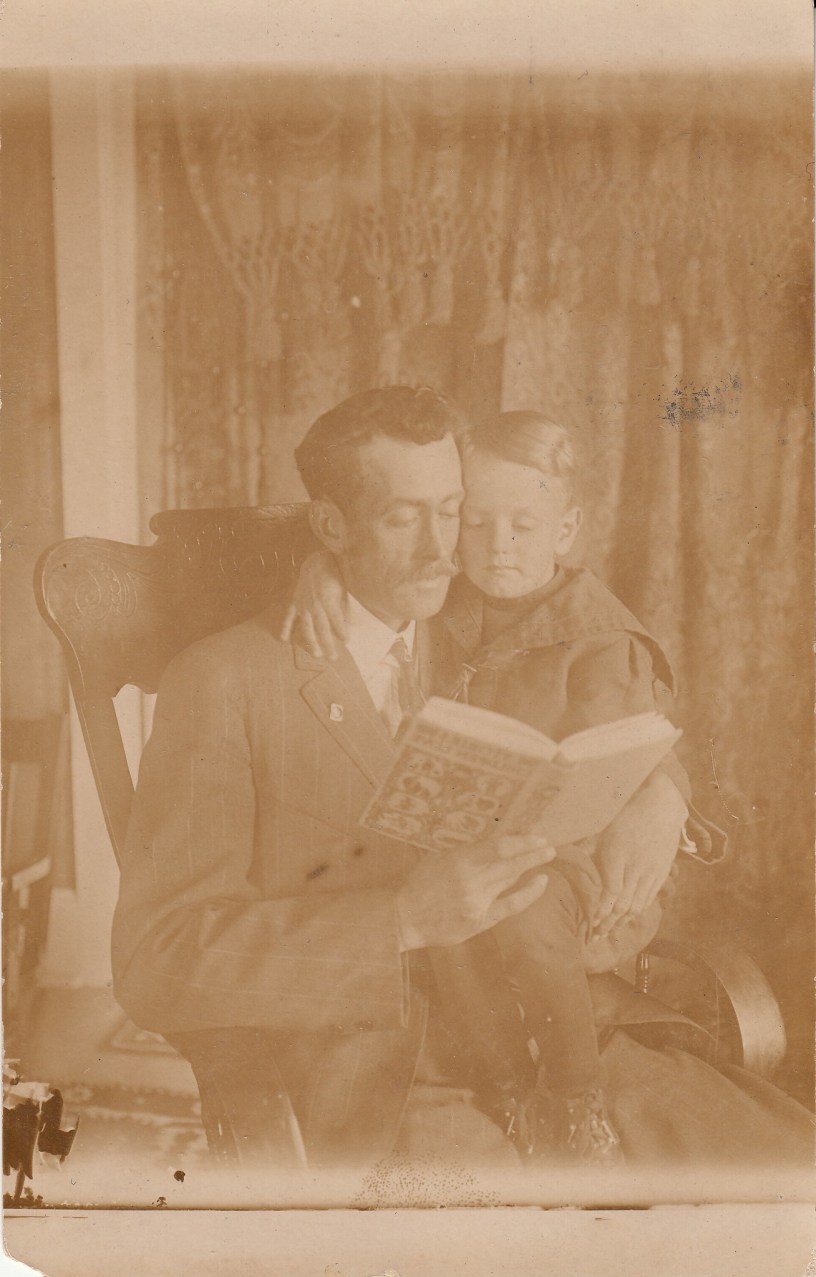
“Story time (c.1913)” by pellethepoet is licensed under CC BY 2.0.

 The Psy of Life
Reblogged this on cabbagesandkings524 and commented:
Calico Jack – It’s the story, the telling and the hearing, then the feeling.
LikeLiked by 1 person
“Neither revolution nor reformation can ultimately change a society, rather you must tell a new powerful tale, one so persuasive that it sweeps away the old myths and becomes the preferred story, one so inclusive that it gathers all the bits of our past and our present into a coherent whole, one that even shines some light into the future so that we can take the next step… If you want to change a society, then you have to tell an alternative story.” – Ivan Illich
One of the keys to this story is the disillusionment of so many of the witnesses, people loyal to Trump who now feel deceived, disgusted, and betrayed. Lots of people are getting an opportunity to walk in those shoes repeatedly.
LikeLiked by 1 person
Howdy Bob!
The dominant story of America is that of the rugged individual, but there are significant correlates: (1) The individual is male. (2) He’s white. And (3) he’s chivalrous, so he can be trusted to do the right thing at all times. When taken to its extremes we get the open carry, trust me, I’m a good guy with a gun unlike the open carry bad guy with a gun mass shooter. It’s also why they want us to believe that every murder of an unarmed Black person is justified. And, why we shouldn’t prosecute any of the armed insurrectionists from the Bundy’s to the Oregon park stand off, to the 6 January insurrectionists.
The other correlate is might makes right.
American exceptionalism is the other significant white narrative. It’s the basis for the unspoken rule, I’m good, so everything I do is good.
Of course, these narratives apply mostly to the white majority, but influence minority communities, too. They do ignore the narratives from the minority communities. And convincing the white majority to exchange these delusional narratives for something more inclusive is going to take a hell of a lot of convincing.
Huzzah!
Jack
LikeLiked by 1 person
I suspect that it is going to take becoming a minority among minorities, which is exactly what the Right fears most, because then the dominant narrative will have to become more inclusive. Unfortunately, it will probably still be of the rugged, male, chivalrous individual with a gun.
LikeLiked by 1 person
Howdy Bob!
Unfortunately, the updated version of the narrative will probably be the armed avenger righting every perceived wrong with might. The other narrative will be that of the avenging minority taking violent revenge against the system. Both of these will be in the minds of white people, though.
The media plays an outside role in developing and sustaining these narratives. As the buying power of PoC grows, the market for more PoC appealing stories will, too as we’ve seen already.
Huzzah!
Jack
LikeLiked by 1 person
There is a growing wave in Afro-Futureism since Black Panther came out, as well as more aimed at other communities also. Minds are changed by stories. There are also signs that the story of the Stolen Election is getting old and boring outside of the deep MAGA crowd. Mr. 45 may succeed in beating that thing to death.
LikeLiked by 1 person
Howdy Bob!
It’s like I always said, you can beat a dead horse, but you can only turn it into hamburger. We all know Trump’s love of a poorly made hamberder.
I’ve heard of a number of superhero comics coming out of Nigeria recently and several other alternative press-alternative lifestyle-PoC superheroes. In general, it is all to the good. Nothing helps promote people like representation and recognition of people that look like them.
Huzzah!
Jack
LikeLiked by 1 person
That media representation does work. I think of the number of people who credit the show “Will And Grace” for a large part of the country accepting gay marriage and other gay rights.
LikeLiked by 1 person
Howdy Bob!
I’ve always thought that marriage equality was one of the clearest examples of how minority influence works. And, “Will and Grace” was one of the big reasons that mainstream America came to accept homosexuality. Laughing with something is very disarming.
Huzzah!
Jack
LikeLiked by 1 person
Very true. Watching characters in stories who are likeable (and not scary weird) despite their difference help a lot.
LikeLiked by 1 person
The same can be said about the Big Bang Theory and autism. People just aren’t as accommodating as they should be because of it.
Huzzah!
Jack
LikeLiked by 1 person
Speaking of autism, I’m reminded of this from Temple Grandin:
“Normal people have an incredible lack of empathy. They have good emotional empathy, but they don’t have much empathy for the autistic kid who is screaming at the baseball game because he can’t stand the sensory overload. Or the autistic kid having a meltdown in the school cafeteria because there’s too much stimulation.”
LikeLiked by 1 person
Howdy Bob!
Emotional empathy is easy since we have mirror neurons that help us feel what the other person is feeling. We understand it. When we see someone angry, though, mirror neurons and our best chance of survival cause us to be angry, too. Anger is met by anger. When we see a someone having a meltdown without an understandable cause, we blame the person. It is an extension of the fundamental attribution error. Since most people can tolerate more sensory stimulus than the person with the meltdown, the cause isn’t apparent, so it must be them. They seem crazy.
I had hoped to write that post during Autism Acceptance Month, but real life got the better of me. Maybe I still will.
Huzzah!
Jack
LikeLiked by 1 person
I hope you do write that one eventually. Another form that kind of attribution error takes is the common calling violent acts “senseless”. Although that is a way to reinforce the view that the action was unjustified, it also prevents understanding how the person came to do it. So, mass shootings can be defined (most often by “gun rights” people) as a mental health problem and not a political rhetoric problem.
LikeLiked by 1 person
Howdy Bob!
The convenience of shunting inconvenient problems off to mental health is that we don’t ever want to talk about mental health issues or their treatment in any kind of meaningful way. It is just a deep dark pit to sweep a problem into so that we don’t have to discuss it any more. It’s like an act of god. If it’s an act of god, then (a) you can’t understand it because god is inscrutable and acts in mysterious ways and (b) you can’t do anything about it because god is all powerful and cannot be opposed. Like all FAE issues, blaming the person means you don’t have to look at the wider environment for a cause. The environment, of course, we can affect and make changes to.
Huzzah!
Jack
LikeLiked by 1 person
Then there’s always Thoughts And Prayers to fall back on.
Of course, if the problem is nut cases with guns, the obvious answer is more Good Guys With Guns.
LikeLiked by 1 person
Howdy Bob!
The solution of any excuse or statement to get people to stop thinking about it is frighteningly effective. It is especially effective when you consider how easy it is to attack, criticize, and destroy and difficult it is to create, build, and improve. Dems put forth bills and policies to address problems; Repubes criticize and demagogue off of them without ever putting up any counter proposals, even when they had a majority and both houses!
Huzzah!
Jack
LikeLiked by 1 person
Every candidate at every level now needs to be asked, “What is your plan to get off fossil fuels and limit climate change?”, and get hounded for an answer without mercy, and not allowed to change the subject until they answer. One party has no answer, but they must be forced to say so clearly.
LikeLiked by 1 person
Howdy Bob!
As I just wrote to Ten Bears, the real problem is the unbelievable unimaginable amount of pollutants that industries pump into the environment every minute of every day. Collectively, the contributions of individuals pales by comparison. The only place that comes close is in transportation.
Our real role is in pressuring politicians into forcing corporations to go green and renewable. Making every election a single issue election on climate change would be a good start. Of course, providing that we have viable elections ever again.
Huzzah!
Jack
LikeLiked by 1 person
Yes, and whether we survive or not, we will leave a hell of a toxic mess behind.
LikeLiked by 1 person
Howdy Bob!
I tend to think that climate change won’t be the end to humanity, it will just be greatly diminished. Just like in the last Ice Age, where small groups of human beings survived in Europe, small groups of people will find environments that will sustain us. There will be suffering and death on the order of billions, though. It will be a true apocolypse.
Huzzah!
Jack
LikeLiked by 1 person
Estimates of human population in 10,000 BC, before agriculture became the primary food source and most people were still hunter-gatherers are in the 4-10 million range.
LikeLiked by 1 person
Howdy Bob!
We may be heading back to those numbers. Should the tropics become completely uninhabitable and the temperate zone become barely habitable, we aren’t left with much.
Huzzah!
Jack
LikeLiked by 1 person
It may be so. I’m reminded that every species is an experiment and we are not exempt.
LikeLiked by 1 person
I’m afraid our little experiment may have failed, then.
LikeLiked by 1 person
Time will tell.
LikeLiked by 1 person
Oh, and begin adjusting your investments with climate change in mind. Sell property in low lying areas, divest from stocks that are vulnerable to extreme weather. Invest in alternative energy and green resources.
LikeLiked by 1 person
Yes, and that includes public investment. One climate scientist, when asked how much the US would need to spend to have a good chance of keeping warming to 2C or less, said it would need to be spending a Trillion dollars per year for at least 10 years stating now. That’s in the range of the defense budget, which is where a lot of it would have to be. DOD is the largest single buyer of fossil fuels on the planet.
LikeLiked by 1 person
Well the DoD identified climate change as a national security threat.
LikeLiked by 1 person
They have been trying to get that point across to legislators for years.
LikeLiked by 1 person