

SUMMARY: SCOTUS heard oral arguments in Trump v Colorado concerning disqualifying him as a presidential candidate in the state. There are three key psychological forces influencing the justices: proportionality bias, risk aversion, and motivated reasoning. The political alignments of the justices are considered in the analysis, but in the end, no matter how you slice it, the case is always decided the same way. Reference to the ongoing political dynamics and Supreme Court dynamics is made, indicating the complexities associated with the case. The summary encapsulates the detailed analysis of the SCOTUS case, its psychological underpinnings, and the potential ramifications of the decision.
KEY WORDS: SCOTUS, The Supreme Court, Election 2024, Ballots, The Fourteenth Amendment, Motivated Reasoning, Proportionality Bias, Risk Aversion, Colorado
COMMENT PROMPT: How do you think the court will decide the case and why? I’d love to hear from you in the comments.
PERSONAL NOTE: I just returned from a week long school trip in very rural Cambodia, blowing a hole in my usual erratic posting schedule. But here I am! In recovery during our Chinese New Years holiday, one of my favoritest new years of the year!
While I was away on my personal, pedagogical, and professional odyssey of introducing ten and eleven-year-olds to the joys of climbing mountains and riding bikes in the scorching sun, as well as sleeping in non-air conditioned dorms to the cries of “I’ve already done this on Roblox or Minecraft,” as they frequently reminded me, a lot was happening in the world.
Considering that there are seven billion of us scurrying around like a particularly mediocre ant nest— we stood by a tree whose nests easily hosted more than ten million, ants and they weren’t threatening their very survival by trying to accommodate the lifestyle to which one percent of them had become accustomed— we cannot hope to address every event that had happened to everyone. Therefore, we shall focus on the the arguments before SCOTUS concerning I2I4 v Colorado and whether Trump should remain on the ballot or not.
We’ll use two psychological findings to analyze the responses by the Justices to the case:
- MOTIVATED REASONING is the cognitive process in which an individual reaches a conclusions and then builds an argument to support it.
- RISK AVERSION is the cognitive process that is characterized by individuals being reluctant to take a chance at losing something.
- PROPORTIONALITY BIAS is the cognitive process that requires a large change in our environment to be due to an equally large cause.
For those who were like me, just emerging from an extended stay far from the reach of the Internet and other modern means of communication, say from a common coal mine cave-in or a light comma or a visit to the Mariana Trench, as one does, we’ll just recap the two momentous and shocking, yet unsurprising — shouldn’t we have a word or phrase for that by now? — events of the week.
Trump v Colorado: Argued Before SCOTUS

By now everyone and their monkey knows about the Fourteenth Amendment barring anyone who had taken an oath of office to support the Constitution from holding office again if they engage in insurrection or rebellion against the Constitution. Here’s what you need to know about the case that was argued earlier this week:
- THE PLAINTIFFS are a group of Colorado REPUBLICAN and INDEPENDENT voters who sought to disqualify I2I4 from the state ballot due to his efforts to thwart the peaceful transfer of power from himself to Biden on 6 January 2021 as outlined in the Constitution and various federal laws.
- A COLORADO COURT adjudicated Trump to be an insurrectionist. The court heard evidence presented by both sides according to Colorado state law. They deliberated at the conclusion of the trial. They rendered a verdict: guilty, guilty, guilty! Amazingly, this court also decided that the Fourteenth Amendment didn’t apply to the President, so there’s that.
- THE COLORADO SUPREME COURT heard arguments from both sides and decided that (a) the Fourteenth Amendment did apply to Trump, and (b) he had engaged in insurrection, so he could not be allowed on the ballot.
- IN QUESTIONING of the lawyers it appears that from seven to nine of the justices are deeply skeptical of Colorado’s ability to keep Trump off of the ballot simply because a Colorado court found that he engaged insurrection while having sworn an oath to uphold the Constitution because state’s rights and textualism and context and stuff.
- CHIEF JUSTICE ROBERTS says that if SCOTUS allows Colorado to disqualify Trump for insurrection, then the Republican Party will retaliate by challenging Biden’s qualifications to be on the ballot, much like Republicans have attempted to investigate Biden’s weaponization of government, impeachment of Mayorkas, not allow Obama to appoint a Supreme Court justice, and attack Biden’s age through a Republican special council report on his holding of classified material. They’re worried about retaliation of Republicans by misapplying the law for political reasons, as if that’s even a thing, y’all!
It isn’t difficult to transition to our psychological analysis of these two incidents, now is it?
Proportionality Bias and Risk Aversion Motivates SCOTUS Reasoning

When we heard about the Colorado case against I2I4, we knew that no matter how the lower courts decided it, if and when it made it to SCOTUS, they’d figure away to leave Trump on the ballot. We knew it because the Justices knew that’s what they’d decide even before the case ever got started.
All of the justices were using motivated reasoning in their questioning and most of that motivation was due to risk aversion and proportionality bias. You’ll see exactly what I mean when I break it down:
Risk Aversion Trumps All

To paraphrase the paraphrasable Joe Biden, removing a major party presidential candidate from the ballot is a big fucking deal. In an age characterized by unprecedented events, even that is a bridge too far for most people. It was like hearing about the Russian disinformation campaign to get Trump elected in the summer of 2016. We’re all like, Naw that’ll never happen. That’s like movie and YA literature shit!
All us good lefties were hoping it would happen, just like we were hoping that the Electoral College wouldn’t vote Trump into office in 2016, but we knew then as we know now, in our heart of hearts, it just ain’t gonna happen.
The justices resist change. We all do. To make this change, a lot of psychological friction has to be overcome. Usually, to get someone to change, they have to be facing a sure loss. There is no sure loss here for the liberal or conservative justices. There is no psychological motivation for making a change this big to the way we hold our elections.
For the justices, it is much easier to kick this hot potato to Congress and the voters, dust their hands off, wipe their brows, and be done with it. They ain’t gonna make this decision now because their isn’t an impending disaster that it will avert. No, the loss of our democracy is not writ clearly enough on the horizon for them to see it as a likely thing.
Why not? Why won’t they see it as averting a sure loss by making this change? For one thing, proportionality bias.
Proportionality Bias and Applying the Fourteenth Amendment

To remove a major party candidate from the ballot is a huge change to the way we do things. It is going to take a huge cause — proportionality bias. The only time we’ve used the Fourteenth Amendment to remove candidates — besides that one guy in New Mexico — the cause was the Civil Fucking War! It requires a huge cause like that. As bad as 6 January 2021 was, it wasn’t as bad as the Civil War.
That explains many of the Justices, except for Ketanji Brown Jackson. She’ll see it for what it is and vote to remove his fascist ass from the ticket. Let me know in the comments how you think the liberal justices will vote. I’d LOVE to hear from you.
Motivated Reasoning Decides in Favor of Trump

The Republican Justices are either consciously or unconsciously too loyal to the Federalist Society and their fascist desires to vote to remove Trump. They’ll use that emotional bias to produce some kind of justification for their decision no matter how flimsy. They’ve got their marching orders, Trump stays on the ballot, Republicans win win win! now find away to hammer that square peg into those liberal heads!
You’ll notice that the questioning from all of the justices was one sided, right? They didn’t ask about whether Trump was an insurrectionist or not, because if they clearly established, as the Colorado court had, that he was, they’d have to vote him off the ballot. They could not go there, and none of them did. That right there is confirmation bias at work.
Now that they ostriched the one issue that could force them to vote their favored candidate off of the ballot, they had to find a reason to keep him on.
When the music stopped, all of the conservative justices tried to force their butts onto the only remaining judicial bench in the circle. It would cause chaos if they allowed states to have the right to decide who qualified for their ballots! It would be chaos, I tell you if the candidates for president weren’t all the same in all fifty states!
Except, we kinda already do have that situation. States already decide how candidates qualify, and have different people on the ballot (not all third party and independent candidates make it onto the ballot in all fifty states). Some states already do have outsized influence on the outcome of presidential elections due to the Electoral College. It’s not like we don’t have precedent, even if it’s not a legal precedent, for the individual states — ahem, Florida 2000 — deciding the outcome of an election.
And, they stammered, if we do allow one state to remove a candidate using the Fourteenth Amendment, then we have to allow them all to, kinda like giving ice cream to children allowing one to stay up past their bed time.
Let’s just quote the “esteemed” John “Money Doesn’t Corrupt” Roberts to demonstrate how he’s using motivated reasoning to find for Trump:
In very quick order, I would expect … that a goodly number of states will say, ‘Whoever the Democratic candidate is, you’re off the ballot,’ and others, for the Republican candidate, ‘You’re off the ballot,’ and it will come down to just a handful of states that are going to decide the presidential election. That’s a pretty daunting consequence.
John Roberts is afraid of judging in Trump’s ballot case on Deadline: Legal Blog by Jordan Rubin on 9 February 2024

It’s not like one party hasn’t retaliated against the other for holding them accountable. It’s not like the Republicans are impeaching Mayorkas with no crime, endlessly investigating Hunter Biden hoping to find a picture of Joe’s penis on his computer, investigating the “weaponization” of the government, sanctioning Democratic congress people for doing their jobs.
Roberts is “aFrAiD” that if we bar Trump from holding office for clearly instigating an insurrection, then all of the Republican states are going to bar Biden from holding office and there won’t be any way to stop them! If only the Founding Fathers had created a system in which we could fairly adjudicate the legality and severity of claims and accusations of breaking the law! We would be mired in stye of partisan accusation and counter-accusation like we are right now. Our government would be paralyzed. We’d have to beg a strong man to step in and govern us because we are incapable of governing ourselves. Why, it’s what the Founding Fathers wanted all along. It clearly is there in the Constitution.
That’s the argument that’s coming next after this mess. Prove me wrong, in the comments!

If you enjoyed this application of psychological findings to Trump v Colorado and the likely ruling by SCOTUS, then consider doing one of the following:
- SHARE this post with someone you know or maybe even someone you don’t know. Who knows where it could go to from there!
- LIKE or RATE this post using the buttons below or above the post. It is the easiest way to give me some encouragement.
- COMMENT on the post! God knows we all have opinions about this case and how it will go. Let me know what you think!
- FOLLOW the blog or sign up for our email list!
Image Attribution
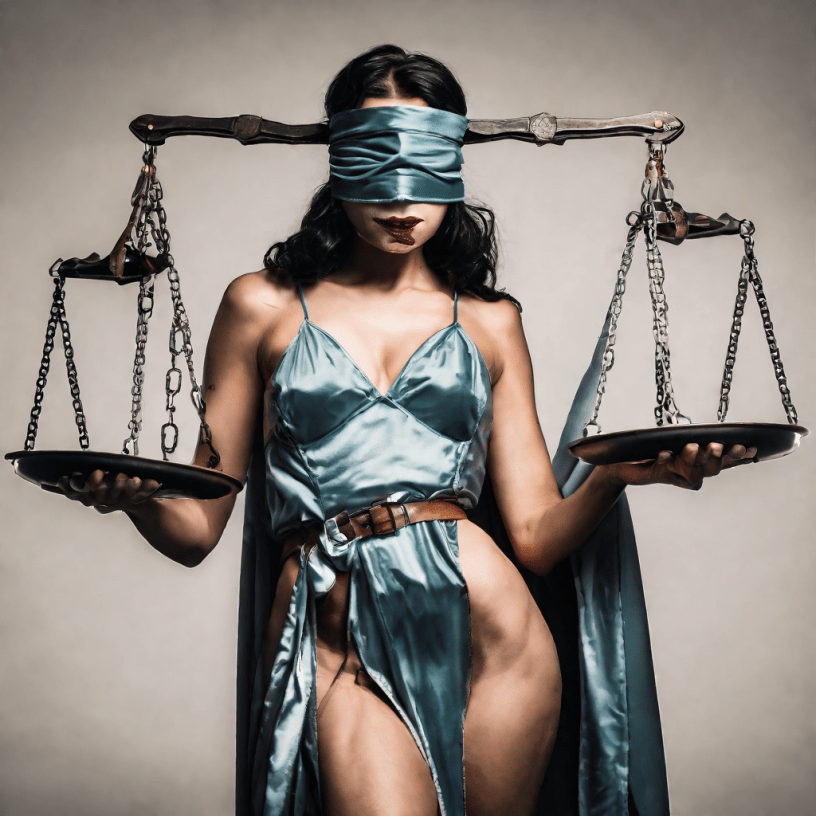
This image was generated using Poe’s StableDiffusionXL bot using the prompt, A picture of a blindfolded, bound, and gagged woman in a sexy lady justice Halloween costume holding unbalanced scales

 The Psy of Life
One would think they would try to find a way out of it with some shred of cred
[insert rant about the illegitimacy of an unelected panel of catholic illuminati handing down fatwas in the dark here, I’m sure you’ve seen it and if not you can guess]
The greater mission is a catholic/christian theocracy and regardless he packed the court for them he is a threat to the greater mission. A stepping stone, a useful idiot. It’s in their best interests to let the lower court’s ruling lay …
LikeLiked by 1 person
They’ll let the lower court ruling stay. There is no reason for them not to.
They’ll let him stay on the ballot because it is just too much risk to remove him.
You know what they call a useful idiot, when he is no longer useful, right?
Yep. Idiot.
Huzzah!
Jack
LikeLike
I think fear is a factor.
My hunch is the Republicans sitting in Roberts court are afraid to affirm Trump’s behavior as insurrection. The more liberal justices could be afraid of resulting chaos among the states if they allow the 14th to be applied.
I think we can use these factors to suggest the court will allow the Appeals Court decision on Trump’s imaginary immunity stand.
I’d like to think MOST of the justices understand the absurdity of Trump’s claim and the danger of allowing it further review. It’s hard to imagine most of them thinking, “Wait a minute. There’s something WRONG with denying a narcissistic liar’s demand to be above the law. Let’s fix this terrible mistake”.
The court is already on shaky ethical ground and may see it losing ALL credibility if they seriously consider Trump’s bullshit case.
Trump’s coup and tyrannical ambitions present a large cause to defeat, or at minimum to obstruct. An unaccountable dictator acting above the law would certainly be such a large change in our government that even the likes of Gorsuch and Kavanaugh could understand as being clearly unconstitutional.
Considering this travesty in the Supreme Court should be seen as folly and an embarrassment to any court.
LikeLiked by 1 person
Howdy Dave!
I think that many of the conservative justices, especially, think that if they deny Trump’s immunity claim that balances out letting him off of the insurrection hook. The remarkable thing is that the Republicans have had five chances to ditch Trump and end his career, but haven’t taken any of them. It would mean taking a Nixonesque hit on the next election, but Nixon led directly to Reagan, so I don’t know what they’re afraid of… unless it is they see Trump as the wreaking ball to use on our democracy.
Huzzah!
Jack
LikeLike
I listened to the whole thing (glutton for punishment) and if there was one thing that clearly scared all of the 9, it was the prospect of a state-by-state challenging of candidate eligibility under the 14th. Roberts put that fear with perfect clarity. They do not want that to happen, so they have to find a way to rule against Colorado. Seen in that light, many of their questions on other arguments, like whether or not the amendment reference to “officers of the United States” includes the President because the office is elected rather than appointed is motivated reasoning in action.
The finding that Trump did indeed engage in insurrection or rebellion was not the only fact or argument that went unmentioned.
Unless it is somewhere in one of the many amicus briefs the Court received (60+?!), the view that a closed primary is an activity of a private organization (albeit, using public systems), and not an actual election to office, the amendment does not apply.
The question of whether a challenge to a candidate’s eligibility can be preemptive, or must be reactive if they win got some attention, along with whether or not the amendment is “self-executing” or requires “implementing legislation” to specify when, where, how, and by whom a challenge can be made and decided got repeated attention, with a flavor of legalistic angels dancing on the head of a pin.
There was no jurisdictional argument, which I was expecting in a case about the only nationally elected office, but they might still come down to saying that such a challenge has to be filed in Federal court as the trial court rather than a state court. It would be a fine way for them to kick the can a couple of months down the road without appearing partisan.
Yes, he will stay on the primary ballot.
If one or more challenges do get filed in federal court(s), the 9 will have fewer outs to consider, and by then the question would be about the real ballot, not the primary. If/when that happens, their proportionally bias could have to deal with a big cause in the form of a candidate/former President who has been convicted of all the elements of insurrection by a jury. We may yet see how they dance to that tune.
LikeLiked by 1 person
Howdy Bob!
I’m glad you were able to listen to the audio feed. I think it helps all of us to go to the source whenever possible.
The biggest problem I have with the if Colorado does it then everyone will be doing it, argument is that the challenge is based on an insurrection. Claiming that Biden has instigated an insurrection will be a tortured legal argument to make, not to say that it won’t be tried, and I’m sure that there are Giulianiesque lawyers trying to cook up such a claim right now just in case the Court rules in favor of Colorado, but it seems pretty unlikely that there will be a widespread use of the 14th amendment to challenge ballots.
The way out for the Court is to establish a judicial test for insurrection and rebellion. The Court won’t do it because it might mean they would need to remove Trump from the ballot. They’ll claim that it is a Congressional responsibility, and they won’t be wrong, but it is possible for the Court to do so also. They have for other things.
We all knew that the Court would not find in favor of Colorado as soon as the issue came up. Every Justice on SCOTUS knew it. They are now just casting about for a reason not to.
By my count, this is the fifth opportunity the Republicans have had to rid themselves of Trump and MAGA, and they aren’t taking it. They want authoritarianism.
Huzzah!
Jack
LikeLiked by 1 person
It has occurred to me that if the Powers That Be behind the powers that be are ready to be done with Trump and MAGA, mainly because they’ve realized they could not control him (nobody can) if he actually got in complete power, and, they expect him to lose the election, that letting him run, lose, and fail in another coup attempt (because the institutions now know how he will try, and are prepared) is the most certain way to be rid of him. Then, they would find a new leader figure to absorb the disappointed MAGAs who will follow orders without Trump’s delusions. They are long game players.
LikeLiked by 1 person
Howdy Bob!
I find the whole use Trump as a wreaking ball strategy curious. It is clearly what they’re doing. But, Trump being a personality disorder is going to keep going until he hits a firm boundary kinda like he did with E. Jean Carroll. That’s what personality disorders do. They need to find the limits and boundaries on their behaviors because they can’t do it themselves. It’s why it always ends so badly when they get into positions of authority.
I guess we should take it as a sign that there really isn’t a highly organized cabal pulling the strings that he hasn’t been assassinated yet. Maybe the Kock Bros et al. are as baffled as everyone else is as to what to do about him.
Rachel Maddow interviewed E. Jean Carroll after her big win, and Carroll pointed out that in the courtroom cut off from the rest of the world, he was just a small weak man. That’s the thing, without others to do his bidding and to prop him up, he’s nothing. He’s a caricature of a human being. The question is how do you cut him off from all of the politically ambitious yahoos and grifters out there that want to ride that gravy train?
Trump wouldn’t even invoke the Insurrection Act on 6 January when he had all the pretext and opportunity to. He couldn’t even work the government sufficiently to get himself taken to the Capitol building. Could you see LBJ letting the Secret Service decline his request to go the Capitol? Without enablers, he can’t do anything. There’s only one way to cut him off from those who will use him for their own nefarious ends…
Huzzah!
Jack
LikeLiked by 1 person
Yes, Trump’s world is 100% transactional, as displayed in his NATO story. In the courtroom, if he can’t make a deal or intimidate, he has no idea what to do. And when his lawyers fail to win, he fires them, doesn’t pay them, and they wind up ruined or having to make plea deals.
I think about the people at that rally where he told the NATO story. They cheered and applauded, not understanding that he was talking about them too. His core theme to them is “they [the bad people] are coming after you and I’m in their way, so they come after me”. To them, he doesn’t say the second part, “You have to pay, or I’ll let them do whatever they want to you.” But, they do pay with their money, their votes, their trolling and threats, and attacking the Capitol, and even their lives.
None of his enablers should ever imagine they are exempt. It’s a protection racket from day one.
LikeLiked by 1 person
Howdy Bob!
One interesting caveat here, though. He only wants to “protect” them as long as they are paying. If he weren’t able to rake in the cash from them, he wouldn’t be out there doing and saying the things he’s doing. He’d be doing something else for cash. As soon as the donations dry up, he won’t care about them any more than he cares about NATO.
Huzzah!
Jack
LikeLiked by 1 person
Exactly! “If you don’t pay, I’ll tell your enemies to do as they please with you.” This is why Rudy is suing Trump and the campaign for legal fees and costs owed so he can pay his lawyers.
LikeLiked by 1 person