

SUMMARY: This post explores how cognitive biases—nostalgia, optimism, and proportionality—distort perceptions of Trump’s presidency and influence independent voter support. Nostalgia bias leads voters to remember Trump’s first term more favorably, while optimism bias makes them underestimate the potential hardships of another term. Proportionality bias causes them to dismiss concerns about authoritarianism, believing that if things were truly dire, they would notice clear signs. To counter these distortions, the post emphasizes the importance of publicizing the realities of Trump’s past actions and intentions, urging readers to share this information to break through the propaganda surrounding his candidacy. Use the table of contents to find the sections you’re most interested in.
KEY WORDS: Trump, Election 2024, Independent Voters, Cognitive Biases, Heuristics and Biases, Nostalgia Bias, Optimism Bias, Proportionality Bias, Distortion, Perception
COMMENT: Let us know in the comments what you think is keeping the race competitive. Why is the polling continuing to be within the margin of error? Why have voters rejected Trump wholesale after his shambolic first term?
- Focus Group Findings: Post-Debate Insights from Undecided Voters
- The Science Behind the Madness: Understanding Heuristics and Biases
- Understanding the Independent Voter’s Support for Trump
- Image Attribution
Why have we, as a nation, seemingly forgotten the unmitigated disaster that was Trump’s presidency? The Old Felonious Authoritarian Rapist Traitor’s handling of the #COVID19 pandemic should have disqualified him from ever seeking office again. The 6 January Insurrection should have been enough for him to have been banished from any public venue and completely shunned a la Nixon after Watergate. Yet here we are, collectively accepting Trump as an inevitable candidate and, until Harris entered the race, a likely winner. What explains this?
Focus Group Findings: Post-Debate Insights from Undecided Voters
After the debate, focus groups of REAL undecided uncommitted independent voters sprang up like weeds across nearly every network. Honestly, I’m surprised there was anybody left who could be in the viewing audience.
Two key takeaways emerged: (1) Very few Trump voters were swayed by his performance, and (2) those who remained “undecided” all seemed to echo, “I need to know more about Harris before I can commit.” Are you SERIOUS? What other options do you have? The Old FART? It’s a binary choice: vote for Harris or help Trump win by abstaining, voting third party, or—heaven forbid—voting for Trump himself!
How can anybody in the country be on the fence? For that matter, how can anyone take Trump seriously as a candidate? Luckily, there is some science to rely on to explain it.
The Science Behind the Madness: Understanding Heuristics and Biases

We’re going to look at some heuristics and biases that have been developed by behavioral economists and other psychologists that help explain how voters can still entertain Trump’s candidacy after his shambolic tenure. He did everything from losing a carrier strike group to allegedly paying pee-hookers to piss on the Constitution, the American people, and the Resolute Desk to causing the unnecessary deaths of over a million real live now dead Americans during the pandemic to refusing to honor the outcome of an election (Spoiler: the surest way to destroy a democracy).
Heuristics and biases are cognitive shortcuts that simplify decision-making processes and help explain—and often predict—behavior and beliefs in certain conditions. These frameworks reveal the psychological, linguistic, and mathematical underpinnings of human errors in judgment, illustrating how our reasoning can falter in the face of logic and probability.
Nostalgia Bias: The Myth of the “Good Old Days”
Let’s delve into the puzzling acceptance of Trump, starting with nostalgia bias, which helps explain why some voters remember his years in office as better than the disaster they truly were. Nostalgia bias is the psychological tendency to remember the past as better than it actually was—those mythical “good old days” that never really existed.
For instance, recent polls indicated that many believe Trump would handle the economy better than Biden or Harris, a sentiment likely fueled by the inflation spikes we’ve seen. In contrast, the Trump years are remembered as a halcyon time of low prices and full employment.
However, this rosy retrospection conveniently overlooks the significant issues during Trump’s tenure. His tax cuts for billionaires ballooned the deficit, and the tariffs imposed cost American households about $800 annually, stifling economic growth.
This nostalgia bias not only affects voters but may also lead some reporters to view the Trump years through a lens of rosy retrospection. The classic presidential election question, “Are you better off now than you were four years ago?” should be answered with a resounding no. Four years ago, we were in the throes of the worst pandemic in a century, which tragically shortened American life expectancy by a full year. Yet, this glaring reality seems to get lost in the afterglow of Trump’s deficit-exploding spending spree, allowing the myth of a better past to persist.
Nostalgia bias isn’t enough to explain the current level of Trump’s support. Like Maya Angelou said, When someone tells you who they are, believe them. Hasn’t Trump told us who he is? Shouldn’t we be wary of giving the scorpion a ride across the river on our backs? Won’t he just try to steal the election, again, refuse a peaceful transfer of power, again, in 2028, and ratchet up the debt further, while enriching himself on emoluments, again, and leaving us to fend for ourselves no matter how dire the situation, again. Why aren’t more of us predicting that future under Trump?
The mirror image of nostalgia bias is optimism bias. While nostalgia paints a rosy picture of the past, optimism bias offers an equally unrealistic view of the future.
Optimism Bias

Optimism bias describes our tendency to overestimate the likelihood of experiencing positive events while underestimating the chances of negative ones in the future. In short, we’re fools—rose-colored glasses-wearing fools. Sure, bad things happen, but they’re bound to happen to “those people” over there, not to me!
We can see this effect in the surprise people express when bad things do happen to them or in their town. Mass shootings won’t happen in my town, not to me. Climate change won’t affect me. No one I know will ever need an abortion.
This bias is evident in the shock people express when misfortune strikes their lives or communities. “Mass shootings won’t happen in my town—certainly not to me!” “Climate change won’t affect me!” “No one I know will ever need an abortion!”
This kind of thinking fosters a dangerous complacency, particularly regarding the prospect of another Trump term. Much of his support seems rooted in a pollyannaish belief about what four more years would entail. Surely he won’t kill another million Americans, further shortening our life expectancy. He wouldn’t transfer even more wealth from the middle class to billionaires, pushing our debt and deficit into the stratosphere, would he? And even if he does withdraw from NATO, he’ll still protect our interests abroad—right? All the bad things are going to happen to those who deserve it, not to us, the good Americans. We’re going to be fine. Really, we are, or so they seem to think.
When we combine the halcyon view of our past with optimistic outlook on our future and the effects of proportionality bias, which discounts of the dire predictions that Trump’s critics are making, we get a real willingness to vote for Trump.
Proportionality Bias: Distorting Reality
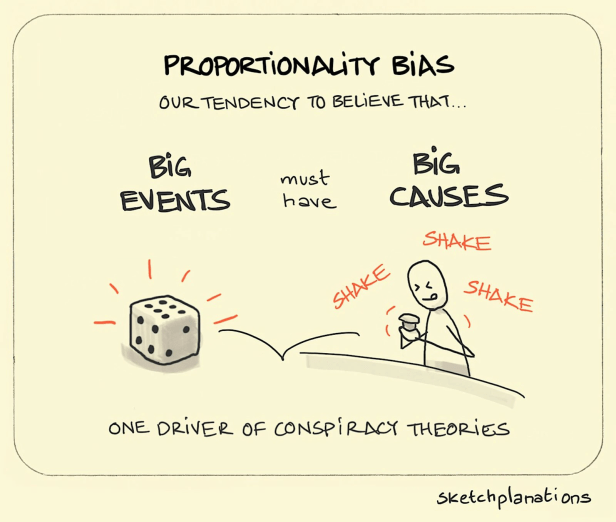
Proportionality bias refers to our tendency to judge the severity of events based on their perceived scale relative to historical examples. This bias plays a significant role in how people interpret Trump’s first term and the potential consequences of a second.
On one hand, this bias allows many to dismiss serious accusations of fascism, authoritarianism, and anti-democratic tendencies. Supporters may think, “If Trump were truly authoritarian, wouldn’t we see Brown Shirts marching through the streets or a Reichstag Fire? I can still vote, after all, so we must still have a democracy.” This line of thinking discounts the subtle erosion of democratic norms, as if overt signs are the only indicators of danger.
On the other hand, proportionality bias can also lead supporters to minimize the gravity of criticisms leveled at Trump. Many might argue, “If things were as dire as critics claim, why am I still doing well?” For many white Americans, the current economic and social landscape appears stable and thriving, which feeds a belief that Trump’s first term wasn’t as catastrophic as portrayed. This bias creates a distortion where the absence of overt chaos leads to an underappreciation of the more insidious threats to democracy.
Understanding the Independent Voter’s Support for Trump

When taken together, these three biases—nostalgia bias, optimism bias, and proportionality bias—illuminate the psychological tendencies and logical errors that lead low-information independent voters to support Trump. Nostalgia and proportionality biases distort our collective memory of his first term, making it seem better than it was and prompting the question: if all the criticisms were true, wouldn’t we be worse off now? Meanwhile, optimism and proportionality biases combine to downplay the potential hardships of another Trump term, with optimism blunting predictions of personal adversity and proportionality suggesting that if he were truly gearing up for authoritarian actions, we’d see clear signs of it.
To combat these distortions in thinking, we must take action. First, we need to publicly highlight how devastating Trump’s presidency was, particularly during the #COVID19 pandemic. He utterly failed in his responsibilities to lead, leaving scars that we are still paying for today. His heavy-handed response to the BLM protests demonstrated a troubling disregard for our Constitutional rights, while his support for abortion bans reveals his willingness to strip away those rights. The cruelty with which he treated immigrants foreshadows how he will treat us.
Moreover, we should actively share what Trump says he plans to do. The impact of publicizing Project 2025 on his campaign has been significant. Now, we can continue this momentum by posting his confused, chaotic, and conflicting statements on social media, amplifying the message that he is in clear cognitive decline and actively trying to hide his true intentions from us.
There is ample evidence available about the failures of Trump’s first term and the dangers of his proposed second term. It is up to all of us to ensure that this information breaks through the firehose of propaganda that Trump and the MAGA Republicans use to manipulate our perceptions of the election.
If you enjoyed this application of heuristics and biases to the baffling continuing support for Trump in the polls, let me know by doing one or all of the following:
- SHARE this post with someone you think would like it.
- LIKE or RATE this post using the buttons before or after it.
- COMMENT on this post letting us know what you think is driving Trump’s support and keeping the race competitive.
- FOLLOW the blog or join our email list!
Image Attribution
This image was found on J J’s Flickr page using a DuckDuckGo Creative Commons license search.

 The Psy of Life
I’m new here. This comment looks fine now but will become close to unreadable when posted. WTF was anyone thinking with the light gray type?????
It’s absurd.
LikeLiked by 1 person
Howdy MJ!
Well, you certainly know how to make a first impression. The truth is, I hadn’t ever read the comments on the post. I only read them on my dashboard. I recently changed my template. I’m not happy with the new one, but don’t really have time to change it again. I’ll look into the changing the type or the background on the comments. Thank you for the tip.
Any thoughts on cognitive distortions?
Huzzah!
Jack
LikeLike
Thank you for pointing that out otherwise I probably never would’ve noticed. I had to use CSS to fix it, so there’s that.
Jack
LikeLike
“BEHAVIOR ECONOMICS” OR BEHAVIORAL ECONOMICS?
LikeLiked by 1 person
What’s your point MJ?
Jack
LikeLike
Jack, you have earned yourself a reblog on this one, great post!
LikeLiked by 1 person
Thank you, Ben. Your kind words are much appreciated. And, I appreciate the reblog.
Jack
LikeLiked by 1 person
The best way to understand Trump Support is to understand that those supporters have a certifiable mental condition that borders on the psychotic. There is a lot of morbid paranoia too.
LikeLiked by 1 person
Howdy John!
The mass psychosis that Trump has induced is in his base. I’m trying to understand the so-called undecided independent voters. Trump is just over the ceiling of his MAGA base at 45 – 47% support. There are people who support him that have not been brainwashed. What accounts for that? If you can understand that, you have a chance of winning them over.
Huzzah!
Jack
LikeLike
People who have not been brainwashed who still support him are either gullible, naieve, low information (stupid) or have tossed a coin. No reasonably sane person who is well informed could ever support him unless they share his traits.
LikeLiked by 2 people
(note: this comment is about the actual ‘undecided’ folks not the MAGA hordes…)
The correct answer to ‘Are you better off than you were 4 years ago” should be “Four years ago we were using refrigerator trucks as morgues and wiping our butts with coffee filters because you couldn’t buy toilet paper for love or money, are you INSANE???“
One thing that just does not ever seem to come up with these ‘undecided” voters is where do they get their information from?
The mass media is full of misleading information.
For example we’re inundated by news reports and ‘anecdata’ presented as ‘fact’ the “Americans overwhelmingly feel the economy is doing badly” yet when these very same polls ask the respondents about their own personal economic situation; the majority, sometimes the vast majority respond by saying their own situation is good or excellent. (Paul Krugman has been pounding the drum about this for some time now)
When these narratives of a ‘bad economy’ get repeated over and over and over again it becomes the ‘common wisdom’, but it’s all just repeated and re-inforced ‘anecdote’ being framed as ‘fact’. So if you keep hearing this, yor own good situation starts to feel like “Oh we must just be lucky…all those poor people out there suffering”
So of course people think “oh the economy is bad” because that’s what they keep hearing, everywhere. Pushed as propaganda by the GOP, and mindlessly ‘reported’ as ‘how people feel’ by the rest of the mass media.
And this doesn’t even get into the fever swamps of social networks, which have exquisitely tuned their algorithms to reinforce engagement with bad news, whether real or not and to stoke outrage (which is done by both sides, alas, because ‘outrage’ gets people motivated..
LikeLiked by 2 people
Howdy Bruce!
Have you hacked Ye Olde Blogge?!? Originally, I was going to include the media in the heuristics and biases post, but it became too long, so I’ve split it in two. My next post is about heuristics and biases that may influence reporters to continue spreading their misinformation. But, the short answer is yes, they have started believing their own stories and have quit actually reporting on the facts and are using motivated reasoning and confirmation bias to report the story the way they see fit.
I don’t think that explains why they keep sane-itizing Trump speak. I’m not sure what explains that other than chasing profits through clicks, likes, and shares, which also explains the social media algorithms.
I’ll have that post up later this week.
Also, I can’t believe people have “forgotten” how bad the worst peaks of the #COVID19 pandemic were. It just astonishes me. I think back to it and I have a visceral reaction remembering the freezer trucks parked out back of hospitals, the struggle to set up field hospitals in stadiums and parking garages. The absolute emotional destruction of doctors and nurses trying to provide care with too few resources and way too many patients. Instead we remember making sour dough bread and singing on our balconies, which is fun and all, but in the larger scheme of things not as important as Trump’s absolute failure in the face of one of the biggest challenges the world has ever faced and the shocking speed with which Biden got the situation under control and recovered from it.
Huzzah!
Jack
LikeLike
Ironically, the one good thing Trump did during the pandemic was authorize Project Warp Speed, early in the pandemic which definitely sped up the delivery of the vaccine in early 2021.
Which he then repudiated because he was lead by the base to torenounce any measures to control the spread of the disease and endorsed absolutely ineffectual medicines as a sovereign cure.
I knew the moment he came back from his near-death episode of Covid, marched up the the balcony and ripped off his face mask, that we would be lucky to get through with only million dead.
And therein lies the fatal rotten core of his kayfabe reality teevee tenure in the presidency…he wasn’t leading the cult so much as being lead by it.
The audience determines the direction that the kayfabe takes; in pro wrestling the ‘story’ changes as they find out how the audience responds..just look at the heels turned hero and vice versa.
He was never even remotely qualified or competent to be the President, but he could play one and he figured that would be enough, if he could get enough people to believe it.
And the media fell for it hook, line and sinker because above all they need a narrative, so we suffered episode after deeply stupid episode of them solemnly intoning “Today Trump became Presidential”
No, he did not even once ‘become Presidential’ because he’s utterly incapable of doing so.
And here we are in despair that 40% maybe even more Americans, maybe enough to put this absolutely incompetent, criminal, wannabee dictator back in office.
LikeLiked by 1 person
Howdy Bruce!
That’s the problem with the whole damn Republican Party. They’ve got the tail wagging the dog. There is a political science theory called “Follow the Leader Politics.” It comes from the sportification of politics. Nowadays, we’re more fans of star players and winning teams than we are the local team. If the star player moves, we adjust our loyalties accordingly.
Same thing with Follow-The-Leader Politics. If the leader changes their mind on an issue, most of their supporters go right along with them. That’s why many MAGA support Putin and Russia, Trump does. But, now that they’ve got the 30 to 40% of the population that turns out and votes MAGA, what do you do as a politician? You can’t win without them and you can barely win with them. If you’ve no morals or scruples other than the die-hard narcissistic belief that the best thing for the country is your continued occupation of elected office, then you support whatever MAGA does. It’s why Trump supports forced birth and the religious liberty of Christians to oppress the rest of us in the name of their sincerely held beliefs. It’s just a happy coincidence that they both happen to be deeply racist and are willing to sacrifice all in order to hurt the Other first and worst, especially since it incentivizes MAGA to support whatever policies, especially tax and environmental policies, Trump has even though they are detrimental to them.
And, the Southern traitorous slavers are having the last laugh. Their deeply anti-democratic measures that skewed our elected government in their favor is finally bearing fruit.
Huzzah!
Jack
LikeLike
I just had another thought about the “undecideds”. There are those who want to vote for the winner. They will feel stupid if they end up voting for the looser. But especially with the change from Biden to Harris, they don’t know who will win. After the Biden-Trump debate, they were sure that Biden was toast. They are stuck waiting for the MSM to tell them who will win, but the MSM won’t do that for as long as they can sell the coin flip horse race. These people are voting on policy, character, ideology, or any other grounds than being on the winning side. Unless they think they know who will win, they probably will not vote.
LikeLiked by 1 person
Howdy Bob!
That is a very big human motivator, the fear of appearing stupid or inept, social embarrassment. It explains why people lie about who they voted for in various elections. When Reagan was a national hero, more people claimed to have voted for him than actually did. Now, that his legacy is questioned by liberals and MAGA, fewer people will claim to have voted for him than actually did. Perhaps one of the things that all of those undecided voters have in common is a greater fear of social embarrassment.
Huzzah!
Jack
LikeLiked by 1 person
That does seem true. People lie to pollsters, often in trying to look smart and thoughtful.
LikeLiked by 1 person
Or cover up their socially embarrassing beliefs and practices.
Jack
LikeLiked by 1 person
Or, even just to mess with them, the “wise ass teenager effect”.
LikeLiked by 1 person
There has been some reporting back in 2020 about MAGA messing with pollsters either being avoidant or giving them “skewed” answers.
LikeLiked by 1 person
Their distrust of the media would be a strong motivation.
LikeLiked by 1 person
Every time I hear that, “I need to know more about Harris.”, line from an “undecided” voter, I hear it as a doge. They are ducking the question, avoiding the responsibility of making the choice. After all, if you actually go and vote, and the one you voted for wins, and you don’t like what happens, you did it (Karma’s a bitch.).
Thinking past those bias shortcuts is hard. It means remembering, for example in this case, how scared you were of COVID, how horrified you were by school shootings, what it felt like watching that cop kill a man with his knee, how you worried about running out of toilet paper, your disgust hearing a guy brag about grabbing women by their lady parts, and on and on and on. PTSD isn’t always a response to one major trauma. It is more often cumulative, trauma by a thousand cuts. We try to avoid painful memories. We try to not imagine them happening again. Doing otherwise is work, intellectual work, emotional work, even spiritual work. The rose colored glasses, Pollyanna dreams, and the best of all possible worlds according to Professor Pangloss, and all so much easier.
And, the more it is stressed that this is an election that will make a real, possibly permanent difference, not for four years, but for at least a generation, the more some of those potential voters will avoid the responsibility of choosing.
LikeLiked by 1 person
Howdy Bob!
You are right about the effort it takes to overcome the easy answer that biases and heuristics provide when faced with complex difficult questions and choices.
When I hear an “undecided” voter say they need to know more about Harris, I hear a Trump voter in disguise having lied to get on the panel or someone who leans Trump but can’t bring themselves to say to a pollster much less on national television.
It is such a horrifying field experiment we’re conducting in minority influence and collective decision-making. If “leading” Republicans bit the bullet and came out against Trump, then most of his base would fall away. The Mitch McConnells, Lindsey Grahams, Ron DeSantises, Greg Abbotts of the party are responsible because they don’t have the huevos to oppose him. Especially McConnell who had the opportunity to rid of us Trump once and for all by voting guilty in his impeachment trials and didn’t take that chance, who had the opportunity to stop Trump before he got started by supporting Obama in releasing information of Russian support for Trump’s candidacy. Absolutely unforgivable.
Huzzah!
Jack
LikeLiked by 1 person
I think that a major part of Trump’s success in capturing the GOP has been his well cultivated image as “The Guy Who Can’t Lose”, and therefore will do that for the party. The popular perception of his in that way was firmly created in “The Apprentice”, which is what most people know about him. Once someone has got that image of him well set in, motivated reasoning and cognitive dissonance can easily reframe all his failures as successes or the fault of others.
Republicans have a long history of suffering from the delusion that having a businessman running the government like a business is a good idea.
As for those GOP leaders, the Governor of Ohio just yesterday managed to say that although what Trump and Vance are saying about pet eating in Springfield is not true (without saying they are lying), he will still vote for them. That is a definition of craven cowardice.
LikeLiked by 1 person
Howdy Bob!
The Republicans have found themselves in quite a pickle. MAGA only makes up 30 – 40% of the electorate. It’s not quite enough to guarantee victory except in certain gerrymandered circumstances, including the gerrymandered state lines, but is enough to guarantee a loss, especially in a primary. If your life is predicated on the belief that the best thing for the country is your continued occupation of elected office, then what are you going to do? Flush the country down the toilet by standing up for what you believe in or mouthing whatever foul nastiness you have to stay in the good graces of Trump and MAGA? For the McConnells of the party their answer to that calculus is clear.
Jack
LikeLiked by 1 person
Indeed, they (and, when they win, us with them) are hoist on their own petard.
LikeLiked by 1 person
As the supporters of the Good Ol’ Party become blind, they can’t see the truth, because they’re already, POISONED by, Trump’s lies, and, will follow their leader, like in the cult suicides. And, the commonality of all of these, hoard suicides is that, the members of the groups, they all need a leader, and, just, followed the first people that, stood out, and, none of the members of these groups had, independent, thinking skills, which made them, that much EASIER to, mislead, and, in the end, it’s still, the people’s, LACKING a BRAIN, and that is, what’s happening in, how the Republicans, still, supported Trump.
LikeLiked by 2 people
Howdy Taurus!
Some of what you say is true for MAGA, but not so true for the independent undecided voter, few though they may be. That’s the phenomenon I was trying to explain. How can anyone not in the cult feel like Trump is a viable candidate? The extension is that reporters might actually be vulnerable to these same cognitive biases.
One of the subtexts of the entire blog is that we are all vulnerable to these psychological tendencies that are used to explain the seemingly inexplicable political choices people make. We all will on occasion look back at former times and find them more pleasing than they were. We need to remember that when we’re making important decisions like re-electing someone who is responsible for a million deaths through mismanagement of a public health crisis. We all will on occasion discount the possible negative outcomes of a decision like re-electing someone who has threatened to break apart NATO. We all will on occasion dismiss an obvious conclusion because we can’t find a cause big enough to justify it, like that someone who refused to accept the peaceful transfer of power being a threat to our democracy because aren’t we all living in a democracy now?
That’s the message here. That’s the take away. We know MAGA is brainwashed and very supportive of all the deeply racist cruel ideas that Trump has and longs for the simplistic black-and-white solutions to their problems.
Huzzah!
Jack
LikeLike
Lol I’m working this out in my head, in public between two blogs because this one, and Mock Paper Scissors have serendiptiously arrived at a common touchpoint
(it’s on the ‘About the shutdown‘ thread) so I’ll avoid retyping it (with a couple minor edits)
The MAGA brainwashed do need ever-stronger doses to keep up their outrage and engagement; if they’re not satiated, they may well wander off and look for it elsewhere.
LikeLiked by 1 person
Howdy Bruce!
You’ve got a pretty good take on it there, especially the WWII analogy. I would differ in only one small respect. The effect of the outrage machine is not dopamine and activating the liking-wanting system of addiction. It is clouding the rational part of the brain with cortisol and other stress-related neurotransmitters which literally makes thinking impossible and means that you’ll only react emotionally. It’s called mass psychosis. If you let your foot off the gas for even a moment, your followers come to their senses, realize the madness, and either engage in cognitive dissonance and continue on as they once did or they leave.
Either way, we’re stuck until a majority of Republican politicians decide that straining on the MAGA toilet is only going to give them hemorrhoids and give it up and start another competitive conservative party. Right now, the prospect of hemorrhoids hasn’t become daunting enough for most of them.
Huzzah!
Jack
LikeLiked by 1 person