
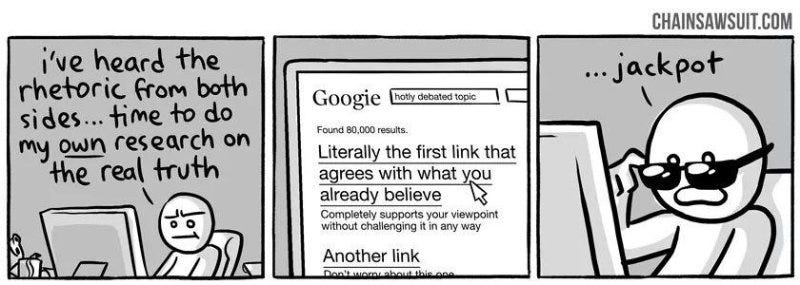
SUMMARY: This post explores how cognitive biases and heuristics—specifically the mere exposure effect, availability heuristic, and confirmation bias—shape media narratives surrounding Trump. It highlights how repeated exposure to false claims can distort perceptions, leading both the public and reporters to accept these lies as truth. The post emphasizes that journalists, under pressure to meet deadlines and attract readers, may unconsciously fall prey to these biases, often sidelining accurate reporting. Ultimately, it calls for greater awareness and accountability from both media consumers and creators to foster a more truthful and responsible discourse in today’s polarized landscape.
KEY WORDS: Cognitive Psychology, Behavioral Economics, Biases and Heuristics, Media Coverage, Lies, Trump, Reporting
COMMENT: Why do you think the media is reporting on the Trump campaign as being an acceptable and viable candidate when he is such a clear and present danger to our country?
- Familiarity Breeds Acceptance: How Mere Exposure Affects Media Reporting on Trump
- Riding the Narrative Wave: The Availability Heuristic’s Grip on Reporting
- The Selective Vision: How Confirmation Bias Blinds Reporting
- Confronting Our Cognitive Biases: A Collective Responsibility
- Image Attribution

With the election a mere 39 days away as of this writing (September 27), our anxiety is palpable. We all seek reassurance, turning to pollsters, pundits, and prognosticators for insights into a race that many predict will be as close as in 2016 and 2020. Current polling reveals only a few percentage points separating Harris and Trump in the battleground states, leading to predictions of a nail-biter.
For liberals and progressives who’ve navigated the turbulent political landscape of the past decade, it’s bewildering that anyone views the Felonious Authoritarian Rapist Traitor (Old FART) as a viable candidate—especially given his unprecedented dishonesty and the fact that he led an insurrection against the peaceful transfer of power after losing an election.

Yet, the Republican Party and mainstream media continue to treat Trump as an acceptable candidate. Why is that? For Republicans, it’s about establishing a single-party, pseudo-democratic regime akin to Russia’s oligarchy. But what drives the media’s complicity? Is it merely profit, or is there something more insidious at play?
Can it really be that simple? Can the profit-seeking motive fully explain why the media ignores his incessant lies? Or could it be something more human at work? Perhaps reporters and editors are falling prey to the same biases and heuristics that affect most of us.
We’ll focus on three common cognitive tendencies and mental shortcuts to explain to explain the ways that the media may be less than wittingly supporting Trump.
Familiarity Breeds Acceptance: How Mere Exposure Affects Media Reporting on Trump

According to the APA Dictionary of Psychology, the mere exposure effect is “the finding that individuals show an increased preference (or liking) for a stimulus as a consequence of repeated exposure to that stimulus.” In simpler terms, when you hear or read something repeatedly, you’re more likely to accept it as true over time. This principle is why Hitler’s Propaganda Playbook advises would-be authoritarians to double and triple down on their lies even in the face of criticism.
However, there are caveats. The mere exposure effect is most potent when the audience doesn’t already harbor negative feelings about the subject. This explains why many liberals are less swayed by Trump’s Big Lie. Yet, it also reveals why reporters, in their misguided quest for neutrality, can fall victim to Trump’s fabrications—like his claim of presiding over the best economy in history.
The media often reports Trump’s assertions without rigorous fact-checking. His surrogates go on pundit shows, reciting these lies with little to no challenge. Each time a reporter hears the claim that the Old FART oversaw the best economy in history, another layer of veneer is added to the thin coating of truth that mere exposure creates. The more often the claim goes unchallenged, the harder it becomes to dispute it in the future.
This growing “varnish of truthiness” accumulates like a stubborn stain in an unwashed toilet. Many reporters and editors become so accustomed to this greasy residue that they no longer see the need to scrub it out.
Since merely being exposed to a lie makes it easier to accept the lie as the truth, the lie actually becomes familiar and is more easily recalled. This phenomenon paves the way for the next cognitive trap: the availability heuristic.
Riding the Narrative Wave: The Availability Heuristic’s Grip on Reporting

The availability heuristic shapes our judgments based on how easily we can recall similar information. Repetition strengthens memories, making it easier for us to accept claims as true—especially after hearing the same lie for the millionth time.
We can understand why the average person falls for the one-two punch of merely being exposed to the incessant lie that Trump presided over a booming economy and then using that as the frame to shape their judgment of his ability to manage our future economy. They are busy, distracted with their work, families, and lives.
But what about reporters? Isn’t it their JOB to analyze what politicians say and report on its veracity? Shouldn’t we expect them to challenge blatant lies, much like a teacher does with a lying student or a parent with a child?
Reporters are busy, too. They are working to deadlines. They need “scoops”—stories that are both engaging and unique. Given the pressures, of a crowded competitive media market to bring in the clicks, likes, and shares, it’s often easier to accept the narrative presented by the availability heuristic than to critically assess and challenge it. Constantly disputing Trump’s lies risks alienating the 20% of the U.S. population (not the electorate) that supports him.
Another disincentive for reporting Trump lies is the risk of getting it wrong. Not only does it take time and effort to identify the lie, but there is some risk to falling victim to some clever rhetoric that could be spun into a “gotcha” moment, nor do they want to be labeled biased for merely doing their job. And let’s be honest, reporting on Trump’s economy as a lie becomes repetitive—like the world’s most boring rerun—which may reinforce the lie’s validity (thanks to the mere exposure effect) but does little to captivate an audience in a competitive media landscape.
A busy reporter under the stress of deadlines and needing to attract an audience will just accept the frame that the availability heuristic delivers to them rather than going through the effort and the extra step of detecting the lie, debunking it, and finding a clever way of writing that story AGAIN so that it will be suitable clickbait.
Under the stress of deadlines and the need to engage readers, busy reporters often accept the frame that the availability heuristic provides. It’s simply less cognitive effort than the arduous task of detecting, debunking, and creatively writing the same story AGAIN in the hope of meeting their quota of clicks, likes, and shares.
As reporters navigate the pressures of their profession, the availability heuristic not only simplifies their decision-making but also solicits another pervasive cognitive bias, confirmation bias. Once the narrative is set, it’s all too easy for journalists to gravitate toward information that reinforces these preconceived notions. This dual effect creates a feedback loop, where familiar lies are not only accepted but actively defended, making it increasingly challenging to confront the truth.
The Selective Vision: How Confirmation Bias Blinds Reporting

Confirmation bias is the tendency to seek out or interpret information that supports our existing beliefs. It’s a powerful bias that shapes our understanding of the world, often operating outside our conscious awareness, making it difficult to correct. This bias affects reporters and editors just as much as the rest of us.
Once a lie takes on the shiny facade of truthiness (thanks to the mere exposure effect), it becomes the first thing we recall on that topic (due to the influence of the availability heuristic). The fact that it’s a lie often gets conveniently omitted from memory, allowing it to act as a filter in our search for and analysis of information.
For reporters and editors, this means that information that challenges the Trump’s lie that he had the BEST economy in history begins to feel suspect. It sets their journalistic spidey senses to tingling, leading them to reject contradicting information rather than evaluate it. It’s simply easier and less risky to exclude anything that disrupts the widely accepted narrative.
A prime example of this is how any negative economic indicators from Trump’s term are often blamed on the #COVID19 pandemic. While the pandemic undeniably worsened conditions, it’s crucial to recognize that the Old FART’s handling of the crisis exacerbated the situation. His refusal to take necessary actions delayed recovery, leaving it to Biden to implement measures that finally brought the pandemic under control and get the economic recovery started.
Consequently, reporting on Trump’s economy is frequently divided between pre- and post-#COVID19, allowing him to evade accountability for the economic damage he contributed to. The narrative conveniently shifts, giving Trump a pass for the pandemic’s ravages on the country.
Confronting Our Cognitive Biases: A Collective Responsibility

While we scratch our collective asses and wonder not only why our fingers stink so much of Trump, but also how the media can be so derelict in meeting their professional duty of being arbiters of the truth, separating fact, opinion, and fiction. Remembering that real live human beings are behind every news story we read and that those exact same people are as susceptible as we are to the cognitive biases and heuristics that distort our own perceptions of the wold helps us be better consumers of media.
By acknowledging these biases—the mere exposure effect, the availability heuristic, and confirmation bias—we can become more discerning consumers of media, demanding better from our news sources and hold them accountable for the narratives they propagate.
At the same time, it is crucial for those working in media to recognize and resist these all-too-human tendencies. Journalists and editors must strive to uphold the integrity of their profession, standing firm against the pressures of a hostile media environment. Only by confronting these and other cognitive biases can they truly fulfill their role as arbiters of truth and separate fact, opinion, and fiction.
In the end, it’s up to all of us—both consumers and creators of news—to advocate for a more honest and accurate discourse. Together, we can push back against the tide of misinformation and work toward a media landscape that prioritizes truth over convenience.

If you’ve enjoyed this application of behavior economics to the way our media operates, please consider doing one or all of the following:
- SHARE the post with someone you think will enjoy it.
- LIKE or RATE the post using the buttons before or after the post.
- COMMENT on the post letting me know what you think is causing the media to accept Trump as a viable acceptable candidate.
- FOLLOW the blog or join our email list:
Image Attribution
This image was found on Better Humans using a DuckDuckGo Creative Commons License search

 The Psy of Life
I had to thought that maybe the cold silicon logic of an AI “editor’s assistant” could help the media folks self-check their biases and distortions, but then I remembered that AIs are trained on the content already in the environment and the narratives already established. Such an AI might actually be, or become worse at the task than the mere humans we have. And now, even going to Google in search of facts is being guided by such AI. And, it has been shown that AIs trained on content produced all or in part by other AIs actually do get worse, sliding toward hallucinations and nonsense. They just do it faster than humans (and use much more energy to do it).
Never the less, our short and long term future may well depend on (if we can make it through the current swamp with it’s political rodents of unusual size) educating several generations about these cognitive errors, biases, and the tactics of the spreaders of FUD (Fear, Uncertainty, and Doubt), and the duty to be ever vigilant (which is hard mental work) against all that.
LikeLiked by 1 person
Howdy Bob!
I consider it my sacred duty to use AI to help detangle my syntax and unsnarl my complex sentence structure and in the process train it on all of my snarky sarcasticky profaney liberal ways. Hopefully, my BS will start showing up in someone else’s answers just like theirs has been showing up in mine.
Blog on Sibling!
Jack
LikeLiked by 1 person
I was thinking about the comparison that it takes a building the size of two Walmarts full of computers consuming enough electricity to run a small city to create a paragraph in seconds that a three pound lump of neurons running on caffeine and sugar can write in a few minutes.
LikeLiked by 1 person
Howdy Bob!
Those have always been my criticism of the machines will take over. When they can be mobile, renew their own energy, cool themselves, and weigh three pounds, then they’ll be competitive.
Blog on Sibling!
Jack
LikeLiked by 1 person
It is a serious question whether true consciousness (whatever that is) can be achieved without a vulnerable body. I’ve been thinking lately about the Fight-Flee-Freeze brain network. It is the oldest and most fundamental awareness system with the mandate of not getting eaten. It relies on the distance senses, vision, hearing, and smell to detect threatening predators before they can bite. Although it functions unconsciously in big brained critters like us with the front of our brains full of words and symbols, I can see it as the root of consciousness. A creature that is invulnerable in the real world, that cannot know existential fear would have a very different sort of consciousness, and likely one incapable of empathy toward the living.
LikeLiked by 1 person
Howdy Bob!
That’s a great insight there. How will machine learned AI or whatever it is called going to learn empathy without mirror neurons and similar experiences? It’s going to “learn” it? How long before it unlearns it?
Hmmm… wasn’t that the reason for the rules in I, Robot?
If we survive climate change, will we survive AI?
Huzzah!
Jack
LikeLiked by 1 person
That was exactly the problem that Asimov was seeing. He explored it in the Foundation Trilogy and it’s sequels in the character of R. Daneel Olivaw, the robot detective first seen in “Caves of Steel” who shows up from behind the seines as having tried to steer that whole history while still following those rules.
LikeLiked by 1 person
Yours is a vastly better take on this than mine, but it elides one really salient point: the modern American “news” segment is riddled with entertainment bias. They like to tell stories, as much as report the news, and if nothing else Trump’s been entertaining for them to cover, and remains so. They report the kayfabe as actual reality, because it’s a ‘better story’.
Objectively, Biden has been better on the economy even if we only count the first three years of Trump’s administration.
His stupid tariffs cost the American consumer (including businesses) hundreds of millions of dollars, and almost every penny went straight to bailing out farmers (and Big Ag) who were hit with retaliatory tariffs, primarily by China. His glorious tax bill caused an enormous swath of taxpayers to pay more in taxes, while funneling the vast majority of any benefit to the very upper 0.01% of taxpayers, while adding a trillion or more to the debt. But this is completely glossed over by the obsession with the brief spike in inflation during Buden’s term.
This kind of reporting explains the ‘vibecession‘ results of polling where people report that the economy is doing very poorly, while simultaneously reporting that their own household economic situation is improved since Trump. I found it stunning the number of people who claimed that we were having the worst inflation ever, and interest rates were staggeringly high; even people who lived through the 70’s and early 80’s with double-digit inflation for years and 20% fed funds rate. I graduated and entered the workforce in 1980, and have seen estimates that the cumulative hit to my lifetime earnings is enormous, just from entering the workforce during that recession.
LikeLiked by 1 person
Howdy Bruce!
That Trump gets treated by the media differently than any other candidate in our history seems evident. We heard about every little stutter from Biden as definitive evidence of his cognitive decline while the media sane-itizes Trump’s word salad. The question is why. The biases and heuristics explanation is but one small piece to that puzzle. It is the individual and human piece. It is centering the cognition of reporters on how they are reporting information they are receiving. It is something we all do.
You’re absolutely right about the role of profits undermining our media, horserace reporting is entertaining and goes hand-in-hand with driving clicks, likes, and shares to drive profits. Biden was much better on the economy. Trump is the man with the feculent touch and our economy did no better. There is no reason to wall off Trump’s #COVID19-inspired economic disaster from the rest of it. It didn’t have to be that bad.
My point in the post is that we are all vulnerable to these biases and heuristics that distort our thinking, but that it is the job of the media to help us separate fact, opinion, and fiction, which they can’t do if they aren’t trying to protect themselves from these cognitive distortions. We’re all people. We remember the past much more fondly than what it was (nostalgia bias), so the inflation of the ’70’s that inspired Ford’s Whip Inflation Now (WIN — the please clap of his time).
Yep, I got my graduate degree during the recession and had to get a job. It wasn’t an easy start to a career.
This post got just past my 1500 word limit. There’s only so much that can be said. I’ve lots of other posts that address all those points, though. My post after this one is questioning whether we can afford another four years of Trump’s incompetence given his disastrous leadership during the relatively good times of his term. He is, literally, an existential threat to the existence of humanity, and to the media he is the equivalent of Hubert Humphrey or Bob Dole as a candidate.
Blog on Sibling!
Jack
LikeLike
I’d not blame the reporters. They are doing what they’re paid to do by wealthy oligarchs.
Its those media-owning/controlling men who favor repubs and Trump’s economic “policies” especially fewer regulations, lower taxes, and the ability to buy out all the competition.
Like so many CEOs and tech billionaires, I don’t think they are very smart about the violence & evil of men like Trump and his dictator friends. And they don’t seem to grasp how vindictive Trump is. Once he gets into power he will “go after them” all, probably even the Murdochs & FOXnews. He’ll tear down all of the corporate media.
Other wealthy men like Musk and Thiel, who are supporting Trump, may will find themselves in prison, the way Michael Cohen did. Only allowed freedom if they sign everything they own over to Trump.
But they think they are and will Trump’s equals, and can be on buddy-buddy terms with him.
They should take a look at Putin’s friends, now dead.
LikeLiked by 1 person
Howdy Willow!
We are responsible for what we do. Reporters have a code of professional ethics. No one has to be a reporter. I’ve been a member of two professions and have had ethical challenges in both of them. Quitting your job is always an option. That’s number one.
Reporters and editors are human beings. This is point number two. They are vulnerable to these biases and heuristics just like the rest of us. It is a human thing. It is how we operate. The only guard against it is by being aware of it and taking cognitive effort to counter the effect.
The downfall of our media is the profit motive. I agree and have posted frequently about it. But, this is the human side of that equation focused on reporters as human beings.
As for the billionaires hoping to profit off of Trump, they see Trump the same way Putin sees him, weak and manipulable.
Remember, Trump is the man with the feculent touch. We should get his fingers off of our democracy and government.
Huzzah!
Jack
LikeLike
The mere exposure effect, only works on those who are, unpreferential toward either candidates, those voters who are, undecided, like the swing states electoral votes, and, whoever wins the votes of these, undecided, swing states would, win the, elections, and, from the way things are going, I think, Trump may have a, slight chance of winning, because he knows how to, MANIPULATE people to, vote for him. Just look at the MAGA crowd he had, gaining momentum, behind him, and, with the, Supreme Court in the Republicans’ pocket too, Harris will be in, for a, very, hard fight.
LikeLiked by 1 person
No, the mere exposure effect works when you don’t have strong feelings for the content of what you’re being exposed to. So, if you have strong feelings of dislike towards Trump, you can still absorb his lies through background noise. Seriously, it creeps in to your mind completely outside of your awareness.
As far as I can tell, he is not gaining momentum. All of the proxies of enthusiasm, crowd sizes, small dollar donations, volunteers, and other commitments that people have to make to the candidate, campaign, or party are all down for Trump. It is, however, going to be a close race and a hard fight. There is no other way to look at it.
Huzzah!
Jack
LikeLike
that’s not exactly how the exposure effect works. it’s going to be a hard race, but I am sure Ms. Harris will prevail. That is if the states don’t once again attempt to send false electors and no one attacks the Congress as they count the votes.
LikeLiked by 1 person
Howdy Suze!
It actually does work a lot like that. The caveat of how strongly you hold a challenging belief and how negatively you feel about the message will mediate the truthiness that you assign to the stimulus. But, without those two filters, even nonsensical words that are printed in obscure locations in a newspaper that you don’t ever realize you’ve read, will affect your rating of how important they are. I’ve had my IB Psychology students replicate that study numerous times over the past twenty years.
The mere exposure effect does explain why people believe Trump is a successful business person and that Republicans are better for the economy. It couples with other biases and heuristics that will distort the effect further. It really does need to be guarded against. It is the reason reporters need to explicitly label Trump’s lies as lies at least to themselves and report them that way every time they encounter them.
This time around, it won’t be false slates of electors. It will be court challenges to counting votes to eliminate Democratic leaning district counts. The election is going to the courts.
Blog on Sibling!
Jack
LikeLiked by 1 person