


SUMMARY: The role of moderate voters will be critical to the outcome of the 2024 election. Furthermore, moderate voters are not a monolithic block of voters. They have different profiles and motivations. Understanding their tendencies, values, and potential influence on the election is fundamental to ensuring a Biden win. The recent Quinnipiac poll highlights Biden’s weaknesses and points to how moderate voters can be tempted to vote for Robert Kennedy, Jr. However, it is possible to appeal to the various types of moderate voters, to diminish Kennedy’s appeal and retain the Biden coalition.
KEY WORDS: 2024 election, Moderate voters, Quinnipiac poll, Voter demographics, Robert Kennedy, Jr, Independent voters, Swing voters, Undecided voters, True moderates, Weird voters, and Meh voters
COMMENT QUESTION: Do you know where I could find data on where the various demographics of voters get their information? How influential do you think Kennedy or a No Labels candidate could be in 2024?

By now my highly engaged political readers have read reporting on the latest Quinnipiac poll on Election 2024, and we’ve seen the topline results of the poll: Biden is beating Trump by six whole points! The election is obviously over, so we can all go back to doom scrolling and binge watching, right?
Well, not quite. We need to take a deeper dive into the evidence that we have to start to figure out how the issues, the narratives, and the sentiment of the electorate will affect the outcome of the election. As someone somewhere on the liberal media scene said, no election with Trump in it is business as usual. We’ve got to treat everything as breaking all the rules that we know… well, except the predictive behavioral economic rules, right?
Distinguishing the Swing and Moderate Voters

Several prominent public policy and political science scholars have been looking at elections and election data for a long time and have some observations that if we add them to the cross tabs of the Quinnipiac poll and behavioral economics findings, we might could just have us some insight into how the vast quivering squishy quavering jello-mold of the middle-of-the-road voters are going to affect our election.
The Truly and Weirdly Moderate Voters Will Determine the Election

- THE TRUE & “WEIRD” MODERATE voters swing elections according to University of Chicago public policy professor Anthony Fowler. We’ll get to what is meant by both true and “weird” moderate voters in a minute.
- MODERATE VOTERS have the least support for democracy and the most support for authoritarian strong-person rule according to Rachel Kleinfeld reporting in a recent Carnegie Endowment for International Peace article on political polarization and violence based in part on a 2018 Democracy Fund survey on political views of Americans.
The Types of Moderate, Swing, and Independent Voters
We’re now left buggering the question, what is a moderate voter? We throw around a lot of terms: swing voter, independent voter, moderate voter, occasional voter, and undecided voter. They are all animals of different stripes and can affect our elections in different ways. We’ve bitched about the disaffected, disinterested, and disinclined independent, occasional, and undecided voter A LOT at Ye Olde Blogge, but rarely have we defined our terms very well. That trend ends today because we read an article on Vox and an article on FiveThirtyEight!
- INDEPENDENT VOTERS tend to have a partisan lean but not necessarily a strong party affiliation or identity even though they tend to vote for one party over the other… usually… sometimes…maybe always, except for that one time. They are the flexitarian that subsists on heavy meat diets except on their dating app profiles. Knowhatimean? Whatever they are, they are not centrist voters. They vote for one party too consistently.
- TRUE MODERATE VOTERS tend to value policies that end up in the middle of political spectrum. However, there is another way of defining moderates.
- THE MEH VOTERS are the ones without a real guiding ideology. They tend to pick and choose political and policy issues from across the spectrum and for a variety of reasons, which can average out to being in the middle. Think fiscally conservative, socially liberal Manchenima and the resulting mess that comes sliding out of that combination. One important thing to note here: they don’t usually vote. A lack of ideology generally means a lack of political motivation.
- THE WEIRD VOTERS are ones who don’t really fit any ideological profile. However, they tend to be engaged politically and will vote at least occasionally. They are the true wildcard of the elections.
Analyzing the Results of the Quinnipiac Poll

Great. What do we make of this mess, amirite? That’s where the Quinnipiac poll comes in… and a little bit of behavioral economics. Most polls have Trump beating of Biden and have for some time, so why should we care what one outlier of a poll says? Two reasons: (1) It is a recent poll. And (2) it comes after the Republican Iowa caucus and New Hampshire primary and the Democratic New Hampshire primary. We can corroborate the polls with findings in how folks voted. Hunh? Hunh? Pretty smart, right?
Polling Analysis Caveats for the Ages
Here’s some smart brevity regarding caveats on this poll:
- NINE MONTHS. It’s still nine months BEFORE the election and the primaries have just started. Still a bit early to say anything other than if the election were held today, but that isn’t very good click bait, is it? Better to pretend that it is IMPOTENT, right?
- ONE POLL. It is always better to look at polling averages than single polls because regression to the mean.
- REGISTERED VOTERS. Quinnipiac chose to poll registered voters over likely voters, which is always worse because, uh, voting, you know?
- NATIONAL POLLS. As we learned in 2016, presidential elections are won at the state level. The national vote totals don’t mean diddly.
The Unsurprising Top Line Poll Results
Even with all of this noise and chafe recommending against paying attention to this poll, it has some interesting findings.
- 50% – 44%. For one of the first times in a year, Biden leads Trump in a high quality national poll from a high quality polling organization. That in and of itself is heartening to all of us who think our democracy is being maintained one election at a time.
- 47% – 46%. The Quinnipiac poll from December had Biden ahead by a meaningless percentage point, so if the trend holds up, it could be significant.
- GAPING GENDER HOLE. Unsurprisingly, women hate I2I4 and are moving towards Biden as the election creeps closer. Biden’s lead has widened to 22% accounting for his overall lead.
- UNDERWATER. For issues like the economy, foreign policy, Israel-Hamas, the border, Biden is fairly far underwater. People, for whatever reason, ain’t happy with what’s going on in those areas.
The Surprising Cross Tab Results and Biden’s Weaknesses
There are some surprising changes when other candidates are polled, though, like Kennedy and Hailey. We shouldn’t get too bogged down in the exact numbers, but here’s what I found:
Kennedy’s support comes mostly from Biden among all demographics putting the election to within a couple of points. A viable Kennedy candidacy could really throw the election. That’s why conservative billionaires are funding his run.
Hailey actually barely beats Biden 47 to 45% leads him across all demographics. While she can’t win the primary, it helps spell out Biden’s weaknesses going into the general campaign.
Appealing to the Various Types of Moderate Voters

Looking at the swing voters that will sway an election, we get some ideas for how to appeal to them.
The True Moderate Voter
The true moderate voter can’t be scared into voting by emphasizing Trump’s threat to democracy. They just don’t care about politics and democracy. Fowler’s research suggests that they do not have much ideological interest and will vote for the “interesting” or more likable candidate.
Unfortunately, both Kennedy and Hailey may qualify for this group as an interesting or novel candidate like Trump and the other third party candidates did in 2016. Biden should not take Kennedy’s lack of viability as a given. He should come out early and emphasize just how normal and safe he is as a candidate and president and how unhinged and dangerous Kennedy is.
The Meh Moderate Voter
The meh voter is disengaged and indifferent to politics, but that doesn’t mean they don’t care. They are more than likely to be risk averse, meaning they are afraid to change things unless a sure loss is staring them in the face. They will come out to vote to save democracy. They will come out to vote if they feel threatened enough by I2I4.
The crazier Trump, Kennedy, and Hailey act, the more likely it’ll catch their attention, and the more likely they will be to vote against them.
The Weird Moderate Voter
The weird voter is politically engaged; they just aren’t ideological. These are the people who want to feel special and do their own research, which means they’re vulnerable to mis and disinformation campaigns. They are not risk averse, so appealing to them by hyping the threat to democracy is not likely to work. Worse, these are the folks that will decide the election because, they are the most likely to vote.
Appealing to them has to be based on messaging. Not a threat to democracy, but Democrats get things done, make life better, maintain the status quo (status quo bias), and Republicans obstruct and play politics. That is a message that will work with these folks.
If you liked this analysis of the electorate and would like to see more of it, please consider doing one of the following:
- SHARE this blog post. Sharing is the easiest way to drive readers to Ye Olde Blogge, so please help.
- LIKE or RATE this blog post. It is the shortest surest way to my heart. It really does the body good to see a post liked or rated and you don’t need to be logged into a WordPost account to rate ’em.
- COMMENT on this post. Lest me know where you think the divisions in the electorate are and how to reach them, especially if you have any solid information on where different demographic groups get their news.
- FOLLOW the blog or join our email list. It is the surest way to keep up with our erratic yet frequent posting of articles.
Image Attribution
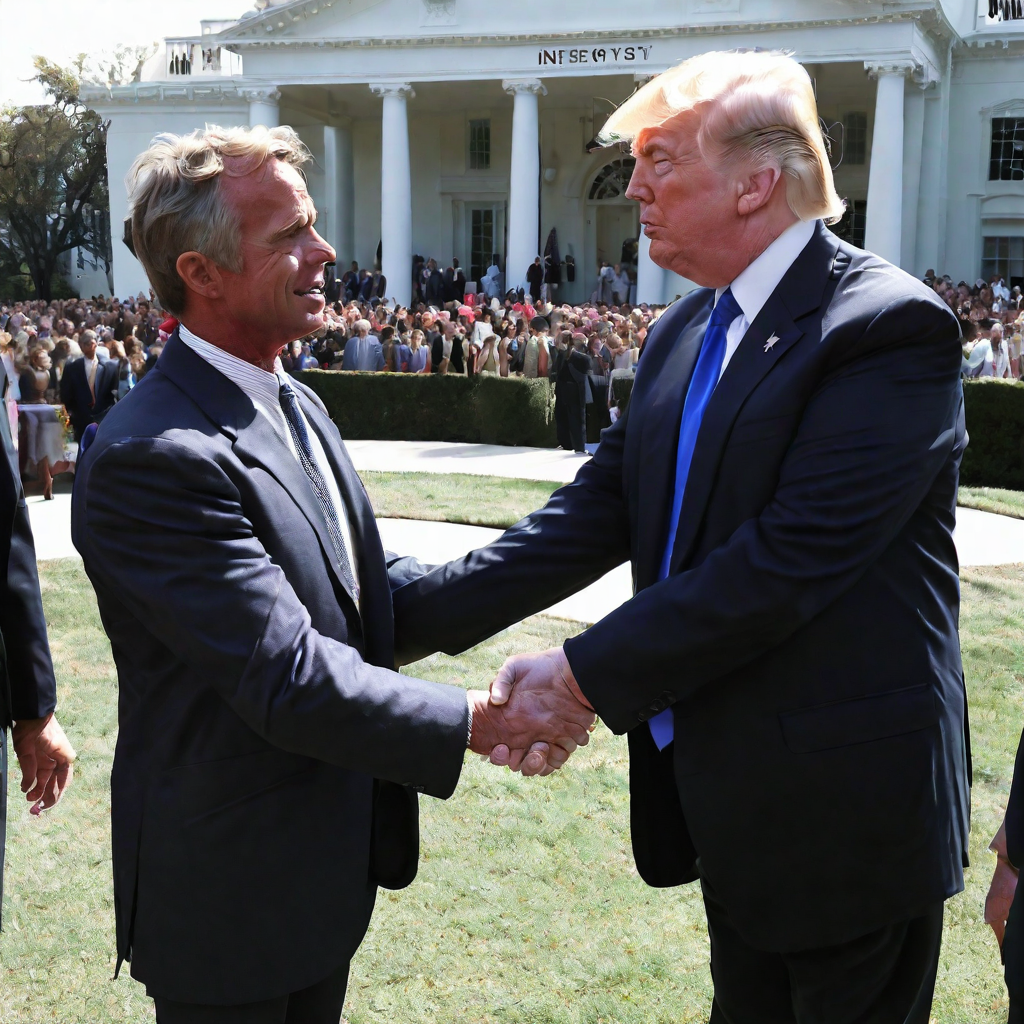
This image was generated using Poe’s StableDiffusionXL bot using the prompt, Robert Kennedy Jr shaking hands with Donald Trump

 The Psy of Life
Sad thing, where to start? I’m rolling up on seventy and my mother still proudly displays a photo of me all dressed up in a little Class A Army uniform with my father shaking hands with John the President at the eternal flame of peace in Paris (France), not long before he left us and the truth is we’ve immortalized the brothers in their passing though they really weren’t around long enough to actually do something to immortalize. They’re mostly famous because they got assassinated, otherwise they were pretty much a product of the times. To be polite
Oh! The sad part: for all that ~ literally a lifetime ~ at first blush I associate the Kennedy name with RFK Jr, Anti-Vaxxer and Conspiracist, and that racist nutball Senator from Louisiana. The brothers are historical figures of limited consequence
We would do well to recall that the Kennedy Klan made its pile running rum down the coast of New England in high-tech cigarette boats during Prohibition. They were drug-runners …
LikeLiked by 1 person
Howdy Ten Bears!
The Kennedys certainly have fallen from their high perch atop the upper crust of America. The generations following John and Robert just haven’t lived up to expectations. Robert is certainly letting them down even further.
No matter what happens, I’m pretty sure it won’t be a Kennedy that saves us. Unfortunately, it may very well be a Kennedy that torpedoes our democracy.
Huzzah!
Jack
LikeLike
That’s a lot to absorb. All the focus in polls and media commentary, and campaign strategists tend to be on those head to head questions about the known candidates. That correlates with the general tendency of people to think of the President as The Boss who determines everything, as if we actually live in a Strong Man authoritarian system. The current implied expectation that if Biden wanted to, he could just make a ceasefire in Gaza happen, or stop people showing up at the border, or control inflation and housing prices. Part of Trump’s attraction is that he promises to be able to do that sort of thing. Nobody seems to be considering the effect that the obstruction and flat out dysfunction on Capitol Hill might have in an election when the Republicans insist on saying the quiet part out loud and proud.
The typology of moderate voters should be helpful in crafting messaging targeted at each type that either misses or doesn’t alienate the other types.
RFK Jr. is the rabbit hole candidate. To really know, and be swayed by the feeling that attached to the Kennedy brothers, you have to be as old as me or close to that. For anybody who came of age later than about 1975, they are as much characters out of history as George Washington and Abe Lincoln. He is likely to get the anti-vax vote.
LikeLiked by 1 person
Howdy Bob!
An earlier version of the post carefully examined the cross tabs and demonstrated how much Kennedy hurt Biden in each demographic category. It was a bit tedious. Maybe I’ll do a quicky with just that in it. He hurts him in every demographic, but especially with the under 49 yos and women. He hurts him far more than he hurts Trump.
That’s the alarm bell. Assumptions have been that he would pull from Trump supporter, but not so.
Interestingly Hailey also hurts Biden with his most important demographics, but unless or until she looks like she could actually get the nomination, Biden is best off ignoring her. Not so with Kennedy. Kennedy is likely to be on the ballots in all fifty states given his backers and his numbers. Biden needs to work on knocking him out early.
Huzzah!
Jack
LikeLiked by 1 person
Then, the question arises as to what can be the most effective messaging to the various demographics against Kennedy.
LikeLiked by 1 person
Howdy Bob!
To me the phrase is “Remember 2016!” “Do you prefer pre- or post-Dobbs USA?” Pointing out that voting for anyone other than the winner of a two-party election, helps the winner win. So, you vote Biden or you help Trump win. I think the Biden camp has that, but I don’t know if they can communicate it successfully.
At least democracy is the top issue in the election.
Huzzah!
Jack
LikeLike
Right now, I’m hearing this interview on the radio. [https://www.npr.org/2024/02/06/1229405638/american-democracy-is-under-pressure-historian-says-its-stronger-than-you-think] and earlier there was discussion of voters registered as Independent, especially the young, being disgusted and disappointed with both major parties. It occurred to me that that is a reaction to the polarization and sportification of that system. I think also that they express a hunger for a real debateful process instead of the immediate coronation of presumed nominees before primaries have even started. Im not sure what all that means in terms of messaging and framing.
LikeLiked by 1 person
Howdy Bob!
Unfortunate timing. I was away on a week-long school trip far far from the natural habitat of WIFI.
I think the younger generations recognize the existential threat that climate change is in ways that most people of later generations do not. The pressure of actually doing something effective to stymie climate change may be the thing that ends the sportification of politics. It was the Renaissance that ended the European Witch Panic, suggesting that major change is necessary to alter such a debilitating social trend.
Huzzah!
Jack
LikeLiked by 1 person
There it is, the core of truth in proportionality bias. Sometimes it is true. The cognitive error is in assuming it is always true.
Still, many of us assumed in our youth that our new ideas and consciousness would change the world. How could it not? Well, the backlash was also real. And it was made clear that you can’t hold down a corporate job wearing bell bottoms and flowers in you hair at the office.
We can hope that the truly existential scale of the climate situation will keep the kids focused long enough and soon enough, and fierce enough.
I suspect that much of the unhappiness about the age of our presidential candidates is related to that awareness.
LikeLiked by 1 person
Howdy Bob!
In an earlier comment, I was saying that it will take a 1932-sized win to put an end to Trump, MAGA, and the Republican Party. The only reason there was such a huge victory for the Democrats was because of the huge cause, The Great Depression. Even though it had started three years earlier, it still swept FDR and the Dems into office and kept them in the House for the next thirty years.
We don’t have such a large obvious cause for voting against the Republican Party now. Climate Change may be it. The threat of fascism and losing our democracy is just too nebulous to work.
It took the Renaissance to finally put the European Witch Panic to rest, it may take climate disaster to put this conspiracy theory house of lies down.
Huzzah!
Jack
LikeLiked by 1 person
Hopefully, soon the weather will be crazy enough for enough people to connect the dots.
LikeLiked by 1 person
It already is. The news just has to spread. In fact between Trump’s nuttiness, abortion, and climate change, the Dems may not have to worry about much this election.
Jack
LikeLiked by 1 person
The Democrat just won the special election to replace George Santos. One more clipped off the GOP House majority.
LikeLiked by 1 person
And won by a healthy margin of around 7% in an election which many assumed would be closer… at least in our horse race focused press.
Jack
LikeLiked by 1 person
I have very little trust in polling. It’s so easy to introduce bias into a poll, even if it’s well done, that the results can be skewed into any direction the pollster wishes. In an era when my email system routes messages from unknown sources directly into the trash bin, and my phone rejects all phone calls and text messages from sources that aren’t specifically white listed by me, how do they manage to get a truly random sampling of people in the first place?
As for Kennedy, the only people he appeals to are the hard core anit-vaxxers and conspiracy whackos, the people who think abandoned Kmarts are going to be turned into concentration camps and that Obama’s wife is really a man.
The Kennedy name? Doesn’t mean a thing these days. The average voter out here in the great wasteland that is the US doesn’t even remember who JFK was. Or if they do they believe he was a drugged up sex fiend, thanks to decades of “tell all” books and stories in the tabloids. If Kennedy does manage to get on the ballot and pull in a significant number of voters the vast majority of them are going to be pulled from the MAGA crowd.
LikeLiked by 1 person
Howdy Grouchy!
A good quality pollster is aware of how asking questions and giving choices of responses affects the outcomes and uses techniques to minimize the effect. True, there are effects that the pollsters aren’t aware of or can’t control for. That’s why you should never put too much stock in one poll and look more towards the aggregation of polls.
The cross tabs on this poll are what troubled me, but reporting the numbers was just too tedious. Kennedy clearly takes from Biden across all of the demographics. One group in particular, 65+ remember the Kennedy brothers, John, Robert, and Ted, and probably very warmly. Younger generations, not so much. Most of the damage done to Biden is in the under 49 yo group and among women, though.
The political scientists tell us that when the electorate is dissatisfied with the choices of the top party for president, they take greater consideration of third party candidates. That’s what happened in 2016. Kennedy is clearly benefiting from that now. What it tells Biden’s folks is that they shouldn’t wait to “drive up the negatives” on Kennedy as they play up Biden’s achievements.
Huzzah!
Jack
LikeLiked by 1 person