

While the Ol’ Pussy Grabber is giving the farm away to Vladimir Putin over in Germany and the GOP is ravaging our healthcare to give the wealthy another needless and destructive tax cut, I thought I’d address something a little easier to take and resolve than the wholesale give away of our democracy. In other words, I’m continuing my assault on rape culture!
According to social psychology, not only does the situation we find ourselves in contribute more to how we behave than does our personality, people consistently underestimate how much the situation affects them.
What’dya ‘xpect from a brunch of pointy-headed academic socialists? My favorite drunk uncle quickly slurs. Pro’lly the personality psychologists say they’s the bes’, too! Ya can’na trust them scientiss. I keep tell’n ya that!
As much as personality psychologists would like it to be otherwise, there is pretty widespread agreement in the psychology community that situation has greater influence on behavior that personality.
Video Evidence of Situationism, Candid Camera
Here’s some “proof,” not that science ever proves anything. While it isn’t scientific proof, it sure is convincing, and it illustrates the point clearly. You don’t think people would conform this easily, but they do.
I love this old clip from Candid Camera. You would too if you watched it, but you won’t. I know. There’s a little video links counter on the dashboard, and it rarely shows a hit.
Not everyone conforms as readily as these folks do, but almost. Here’s something a little more scientific and a little more convincing.
Video Evidence of Situationism, the Smoke-Filled Room
This one is called the smoke-filled room. The researchers, and it is serious academic research, mimicked a fire by causing a room to fill with harmless smoke and allowed the smoke alarm to go off. They sat their participants (remember we don’t call them subjects any more because participant is more human than subject) either alone in the room or with a group of confederates. The confederates were instructed to (a) ignore the smoke and alarm and continue filling in their forms and (b) remind any fleeing participants that they were instructed to remain in the room until the nice lady returned.
You really should watch this video, too. It is truly astounding. You won’t, but you should.
Jus’ like some snowflake lib’r’ls, my favorite drunk uncle slurs after watching the video with his blurry watery eyes, ta not even know enough ta get outta a burning room. Jus’ proves that you-ni-versifiety jus’ makes ya dumber!
There are tons of these videos on youtube and other social media sites demonstrating the effect of the situation on behavior, and we here at the Psy have written about it, too. Not everyone will comply with the group or authority, but it is a large percentage of people. Psychologists believe that our behavior is influenced by dispositional (internal) factors like personality and situational (external) factors. But, situational factors prevail because we have evolved to fear expulsion from the group. We survived as a species because of our ability to work together as a group.
Knowing that the situation contributes to an out-sized proportion to our behavior, it occurred to me that the situations that sexual assault occurs in probably contributes the same degree of out-sized influence on that behavior, too.
In our exploration of the possibility, we start with an interesting campus-rape prevention program.
Campus Rape Prevention Program Focuses on Warning Signs

This study offers a suggestion of how the situation might encourage sexual assault.
In an article published on 11 June 2015 in the New England Journal of Medicine the following findings were reported. A controlled rape prevention program was tested on three Canadian university campuses for one year. The program consisted of teaching freshman women to recognize dangerous situations and take steps to decrease the danger.
Now, you might not realize this, but most sexual assaults are committed by someone the victim already knows. So, the people who developed the program figgered that recognition of when the date, party, or walk home was going pear-shaped would be valuable, especially if it triggered behaviors that might help it straighten out again. They figgered that this might could be an effective way of lowering the number of assaults.
They compared the findings of the three-month program to that of simply providing brochures and pamphlets. The program consisted of 12 hours of instruction divided over four meetings. That’s a lot. Not every participant completed all four units, but 90% completed at least three of the four.
This is the part where you wanna hold on to your ass. For the 451 women attending the program, 24 experienced “completed rape.” While in the control group of 442, 43 did. Out of those 893 women, 67 were sexually assaulted. Without the program, that number would be about 86. And that doesn’t include the incidents of attempted rape. In the program, 15 experienced an attempted rape and 41 in the control group. All together that is 97 women who were the victims of sexual assault on three Canadian college campuses in one year. Without the program, we can estimate that 168 women would’ve been sexually assaulted.
The program is effective, but it requires a huge investment of time, training, and effort. And, it only focuses on the victims. If we treat sexual assault as the public health problem that it is, we would need to intervene with potential perpetrators, too.
The link to the article on the college rape prevention program: Novel Program Cuts Sexual Assault Rates on College Campuses from Medscape (requires free registration to access)
Situational Factors that Contribute to Sexual Assault
My point here is that many of the men committing these sexual assaults are reacting to their situation. First, we should consider the situational factors that contribute to everyone’s behavior all of the time that is the factors that are present in every situation:
- the social context of the behavior
- the cultural and subculture norms that apply to the social context
- the people present
- the people each participant carries with them in their heads
- personal role models such as parents, caregivers, teachers, and peers
- cultural icons such the founder of the nation or a religious figure
Every behavior takes place in an environment. You go to a restaurant; you’re in a restaurant. You can recognize restaurants the world over. They all have very similar attributes and the sequence of events is very similar: you order your meal, you receive your meal, you pay for your meal. Sometimes it is table service; sometimes it is counter service. Sometimes you pay before the food arrives and consumed, sometimes after. The point is, you know just given the situation, and you behave accordingly.
Things go pear-shaped when the situation is ambiguous, when there are not clearly defined behaviors and expectations. Anyone who travels internationally knows this to be true. Cultural norms play a huge role in defining, guiding, and limiting your behavior.
The people present will influence behavior. I do not need to belabor that point, but what about the people you carry in your head. Anyone who has ever participated in petty delinquent behavior knows that somewhere in their head is the disapproving voice of a parent or parental figure. And, anyone who has traveled to Viet Nam, for example, knows that there are pictures of Ho Chi Minh everywhere reminding all Vietnamese to be good citizens. These things have a huge impact on our behavior.
Let’s now examine some of what is known about the situational context that sexual assault occurs in:
- alcohol and drugs
- excessive exposure to pornography
- an expectation that having sex is possible even likely
- others talking about or witnessing others having sex with less than willing partners who may or may not have been totally or partially incapacitated by alcohol or other drugs
While influence of alcohol and drugs are dispositional factors (internal to the individual), the others are situational or external to the individual. Alcohol and drug use results in lowered inhibitions and increased impulsivity. Pornography warps the individual’s sense of expectations increasing expectations for sexual behavior in the real world. We can add the other cultural influences to the expectations of sex to the warping of expectations that pornography provides. And, seeing others or knowing about others behavior will add to the role models that an individual carries within himself.
If we consider the milieu. Do any of these boys think that they are rapists? Probably not. Do they think that they’ve hurt these women? Probably not. Are they really even thinking about any of this? Probably not.
The act of sexual aggression has become part of their social milieu. That sexual assault can be reduced by teaching women to be more assertive and less concerned with hurting the feelings of these men is significant. That teaching women that predicting which men will be their rapist is nearly impossible and that they must be on guard with all men is also significant.
Hell fire! my favorite drunk uncle shouts with surprising clarity. Whut in tarnation is wrong wit you? Don’t you know that any girl who is that liquored up got that liquored up so she could? He is looking at me with a mix of anger and distrust and incredulity. Don’t kids know nuthin’ nowadays? Nice girls don’t! He intones with menace in his voice. Candy is dandy, but liquor is quicker! They is a reason these sayin’s exist.
Confluence Mediational Model of Sexual Aggression
Neil Malamuth has developed a model that seems to predict sexual aggression. He has identified two major constellations of attitudes or traits that seem to make men more prone to sexual assault. One constellation is hostile masculinity and the other is impersonal sex.
Hostile Masculinity
- Attitudes that accept violence towards women (I would argue that attitudes that accept aggressive behavior towards women)
- Narcissism, hostility towards women, or sexual dominance (I would argue that includes difficulty accepting women as equals)
Impersonal Sex
- Abusive home environment
- Early delinquent behavior
- Impersonal sexuality (early sex and promiscuity)
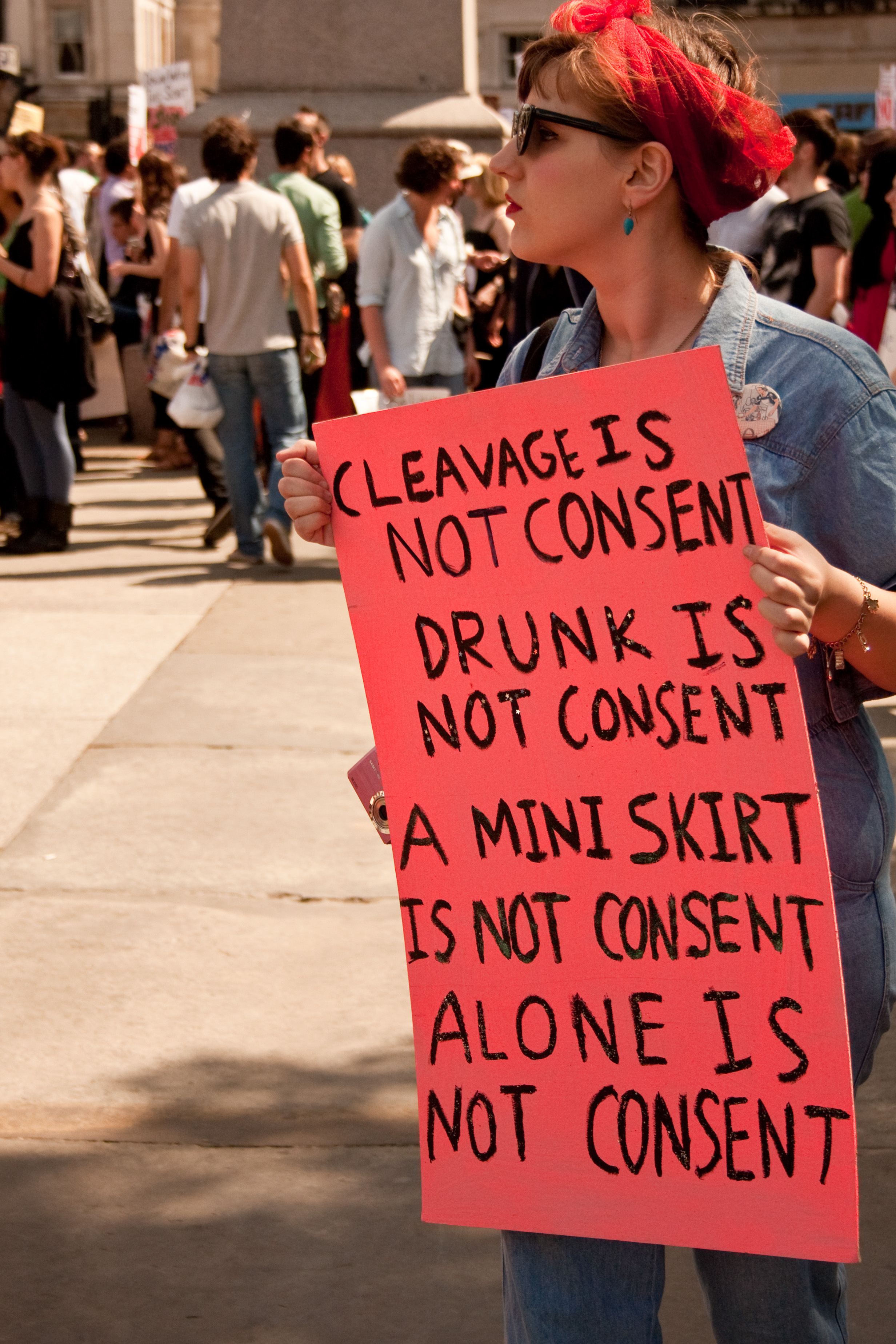
But, there is one more factor that Malamuth includes, low empathy. We know from Simon Baron-Cohen‘s work with zero-degrees of empathy that empathy can vary from moment to moment heavily influenced by environmental factors. Add to that the ideas presented in Prejudiced Norm Theory in which people who are highly prejudiced against a group will be encouraged to act on their prejudices if they feel supported by their environment and disparagement humor seems to be especially effective at bringing out this behavior. It is easy to imagine many of those locker room boys-only environments where the talk gets rough towards women bringing out the worst in fellows. And, helping to lead young men to committing sexually aggressive acts even sexual assault.
Add to this ugly mix the effect of ambiguity and uncertainty and just like ten people could be convinced to sit in a room slowly filling up with smoke while a smoke alarm is going off, young men can be moved to aggress sexually towards women. And it is through those ambiguous cracks that many of us will fall and either not intervene, not question, or actually participate in acts that we wouldn’t normally participate in and even wish we hadn’t years later.

So, what I’m arguing is that men find themselves in situations where there is peer pressure and expectations to behave in certain ways towards women and that these can easily lead nice guys into doing bad things like aggress sexually up to and including sexual assault.
I am arguing that all men are capable of committing sexual assault, but it is the situation that largely determines whether we do or not. Fortunately for us, the vast majority of men will only commit sexual assault in a very narrow number of circumstances, and a very small minority of men will commit sexual assault in a wider number of circumstances. To effectively prevent sexual assault, men have to recognize in themselves the circumstances that they will commit sexual assault in and take steps to avoid those situations and to recognize how the situation influences the behavior of others and commit to interrupting those situations to prevent others from stepping over the line.
Wednesday 3 September 2018: substantial revisions to the order that information was presented in and content of the post were made.

 The Psy of Life
OMG Jack, I too was denied credit and when I got into law school after taking the quota test for women I needed to go to school at night because I taught school during the day. I was told I couldn’t go because ONLY men raising a family could go at night. I tried to explain that I was raising a family and needed to work during the day but they just said rules are rules. I told off the head of the law dept. About three years later they changed that rule and by then I was submersed in teaching gifted children and loving it. But, there were so many times I was denied things because I was divorced. No credit cards either without a husband’s signature. I’m sorry your mom had to deal with that too. It really sucked. I remember when it was 1975 and the UN called it the Year of the woman and Helen Reddy’s song “I am Woman” was the theme song I really thought things would change.
LikeLiked by 1 person
Howdy Lesley!
I’m not surprised that my mom’s and your experiences were so similar. Most men don’t realize how sexism affects women, just as most whites don’t realize how racism affects non-whites.
Huzzah!
Jack
LikeLike
I really think it depends on we raise our boys. I was very careful how I raised mine. And as a single working mom they saw me in both a mother/father role. Very strong and yet I think innately they were, and still are, very protective of me. They respect strong, intelligent women, yet also understand that physically males are generally stronger and therefore they need to keep that in mind when dealing with women. I am constantly told how respectful and amazing my sons are, even now that they are men, and I wonder what I did differently to make them able to perceive women in this light. Perhaps, being a single mother was the key. I’m not sure. Maybe boys who grow with with a stern father who shoves machismo down their throats contributes to a perverse sense of superiority in their minds. I don’t know.
LikeLiked by 1 person
Scary topic and sadly pretty true. We are a society lacking in compassion, empathy,and self reflection.
LikeLiked by 1 person
Howdy Lesley!
You know it is funny that you say we lack compassion, empathy, and self-reflection since I’ve lived abroad since 1996 in Far East Asia and Africa. My take early on on the cultures of Far East Asia is that they are empathy, compassion, and self-reflection poor cultures. So if we lack sufficient levels of these qualities, then a lot of the wider world really lacks them. My other experience is that sexual assault, sexual harassment, and sexual aggression is pretty frequent and under reported in the three Far East Asian countries that I’ve lived in. Surprisingly, Kenya seemed rich in compassion and empathy, to a degree, but severely lacked in self-reflection and awareness. Again, sexual assault, sexual harassment, and sexual aggression occur to a much higher degree than in the West. The world, especially for women, is a very violent and frightening place.
Again and again, when I come back to this issue, I am struck by how many women have direct personal damaging experience with some form of sexual aggression.
Huzzah!
Jack
LikeLiked by 1 person
I suppose that’s true world wide. I can only speak from my experience in the United States. I was victim of an attack in the 70’s and it was not taken very seriously here because I was a young divorced woman. Apparently being divorced in America at that time made me a pariah. Many schools wouldn’t hire me because I was a divorced mother in the mid 70’s. So I likened it to wearing a scarlet letter D on my chest rather than an A. America says it is an open minded nation but I find it puritanical in nature with those on the right not having progressed in their views of Women since Hester Prynne.
LikeLiked by 1 person
Howdy Lesley!
My mother was divorced when I was eight in 1968. She was told by her boss — she worked federal civil service — that he would not recommend her for a promotion because she would be taking a job from a man who had a family to provide for. He knew she was divorced with two kids. She was denied credit by her bank because my father wouldn’t co-sign on it. She was a social pariah because of it.
I know exactly what you mean. Knowing the pure hell my mother’s male co-workers put her through at various times and knowing that my sister was assaulted in our home is a source of my passion on the issue.
Sexual aggression is damaging much more so than most people realize.
Huzzah!
Jack
LikeLiked by 1 person
it has ever been thus
LikeLiked by 1 person
Howdy Now!
Given the evolution argument in the previous argument, I’d agree. But, the thing about being human is that we have a rational mind that can override our emotional decision making; although, it takes some effort.
Huzzah!
Jack
LikeLike